
1. The Anatomy of an Illusion
At first glance, the dashboard tells a story of quiet competency.
Between September 16 and September 21, 2026, the QLN paper-trading fleet—comprising over thirty distinct algorithmic instances operating across six asset classes via a direct Rithmic SIM feed—logged a cumulative paper net profit of +$469.19. There were green prints across equity indices, profitable scale-outs in crypto, and zero blown accounts. To an outside allocator or a casual retail observer skimming an automated weekly digest, the verdict would seem clear: the suite works, the risk parameters hold, and the engine is generating positive alpha.
It is a complete illusion.
When you crack open the raw log files in bots/bar_historical/ and trace the execution telemetry down to the millisecond-stamped JSON payloads—cross-referencing SIM_ENTRY, SIM_EXIT, and RISK_DIAGNOSTIC events—the narrative collapses into something far more dangerous.
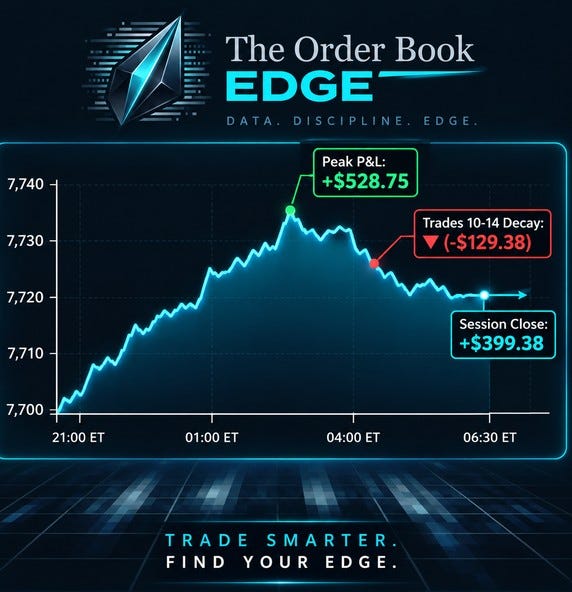
Fully 85% of that entire week’s profit (+$399.375) was produced by a single bot instance (MES Fed Hawkish Momentum, running from the September 16 session log) across a single 9.5-hour overnight window on the night of September 17–18. Strip away that single, cooperative Globex session, and the remaining 34 bots in the fleet combined for an anemic +$69.81 across 14 executions, which was then systematically erased by −$132.8125 in four correlated, near-simultaneous fixed-income stop-outs.
       TOTAL REPORTED P&L: +$469.19
┌────────────────────────────────────────────────────────┐
│ MES Fed Hawkish Momentum (Sep 17-18 Overnight):        │
│ +$399.38 [85.1%]                                       │
├───────────────────────────────┬────────────────────────┤
│ MBT Gen-2 Trend:              │ All Other Closed:      │
│ +$240.50 [51.3%]              │ -$170.69 [-36.4%]      │
└───────────────────────────────┴────────────────────────┘
*(Residual net without the primary MES outlier: -$69.81)*
Worse still, of the 35 registered bot instances across Micro E-minis, Treasuries, Currencies, Energy, and Metals:
22 bots generated exactly zero trades, sitting completely paralyzed in an equity bull market because their code hard-codes a short-biased regime expectation.
3 currency bots ran completely blind for a week, consuming compute cycles while logging
NO_DATAbecause an expiry roll from the September contract (M6JU6) to the December contract (M6JZ6) was never propagated to their configuration dictionaries.2 bots were listening to phantom Redis channels, logging heartbeat successes while receiving zero ticks due to a syntactical string mismatch.
4 Treasury note bots committed the cardinal sin of multi-agent trading: they observed the same price tick, generated the same thesis, and entered short within a 9-second cluster, stacking unhedged directional exposure that stopped out simultaneously within ten minutes.
If this had been live capital with real prime-brokerage margin and commercial exchange clearing fees, the portfolio would have ended the week in the red. Slippage on the correlated exits, coupled with round-trip commission friction on micro contracts, would have systematically dismantled the headline gain.
This report is not an exercise in marketing. It is a forensic tear-down of our execution logs, designed to uncover how automated fleets fail silently, why distributed agent architectures require centralized risk arbiters, and how quantitative strategies decay when their regime assumptions diverge from structural market realities.
2. Fleet Topology: Infrastructure, Serialization, and State
To understand how these breakdowns occurred, one must first understand the infrastructure supporting the QLN architecture.
The trading suite is architected as an asynchronous, event-driven multi-process system. Market data originates from a direct Rithmic data feed, passes through an edge gateway process, and is published onto an in-memory Redis message bus. Each bot operates as an independent OS process, subscribing to designated Redis pub/sub channels corresponding to its target instrument.
                  ┌──────────────────────┐
                  │   Rithmic SIM Feed   │
                  └──────────┬───────────┘
                             │ Raw Ticks / L1-L2 Book
                             ▼
                  ┌──────────────────────┐
                  │    Edge Gateway      │
                  └──────────┬───────────┘
                             │ Normalized Market Events
                             ▼
               ┌─────────────────────────────┐
               │     Redis Pub/Sub Bus       │
               └─────────────┬───────────────┘
         ┌───────────────────┼───────────────────┐
         │                   │                   │
         ▼                   ▼                   ▼
┌─────────────────┐ ┌─────────────────┐ ┌─────────────────┐
│   Bot Instance  │ │   Bot Instance  │ │   Bot Instance  │
│   (MES Long)    │ │   (ZN Short)    │ │   (M6J Expired) │
│ State: Active   │ │ State: Correlated│ │ State: NO_DATA   │
└─────────────────┘ └─────────────────┘ └─────────────────┘
The bot’s internal state engine operates on a bar-close or tick-micro-batch evaluation cycle. Every 60 seconds, each bot serializes its internal state, writing a STATUS heartbeat to disk while logging structured JSON payloads whenever an internal state transition occurs:
SIM_ENTRY: Emitted upon simulated fill, logging entry price, assigned risk brackets (stop-loss, take-profit), relaxation thresholds, and upstream macro-diagnostic scores.SIM_EXIT: Emitted upon position liquidation, capturing exit timestamp, execution price, holding duration, raw dollar P&L, and the categorical trigger (TIME_EXIT,STOP_HIT,THESIS_INVALIDATED,TARGET_1R).RISK_DIAGNOSTIC: Emitted on bar evaluation, documenting moving-average posture, directional bias, momentum scores (0–100), and boolean validation gates (aligned: true/false).
The advantage of this decoupled architecture is horizontal scalability: spinning up a 36th bot instance requires nothing more than declaring a strategy class and launching a Python interpreter.
The fatal flaw, however, is isolation. In our current deployment, each bot operates as a solipsistic entity. Bot A has zero awareness of Bot B’s inventory, exposure, or execution intent. When four independent instances are tasked with trading the 10-Year Treasury Note (ZNZ6), they do not act as a diversified committee; they act as a pack of algorithmic lemmings, executing identically timed orders that transform what should be fractional risk into massive portfolio concentration.
Below is the state of the fleet as captured at the terminal heartbeat of the observation window on September 21, 2026.