


Executive Summary: The Regime Shift of Early October
The global macro landscape has fractured into sharp cross-currents. Over the past 48 hours, institutional order flow has pivoted across three primary macro dislocations:
The Labor Market Shock vs. Rate Skepticism: A severe non-farm payrolls print—recording just 29,000 jobs created against consensus expectations of 150,000, while unemployment ticked to 4.2%—has upended fourth-quarter monetary expectations. The probability of an imminent Federal Reserve rate hike has collapsed, forcing a violent short-covering bid in front-end and benchmark Treasury futures (CME: ZN, ZB, SR3). However, terminal yield resilience (10Y UST yields oscillating between 5.05% and 5.34%) and massive sovereign issuance are creating sharp curve dislocations.
The Strategic Energy Distillate Shock: Europe’s surprise release of 50 million barrels of emergency diesel reserves, coupled with U.S. political pressure, has sent front-month Ultra-Low Sulfur Diesel (NYMEX: HO) into freefall (-3.2% to -8.0% intraday). Concurrently, Middle East geopolitical escalation (including U.S. Patriot missile deployments to Saudi Arabia and Qatar) maintains an elevated risk premium in benchmark Crude Oil (NYMEX: CL, ICE: BRN). This has generated a generational widening in the heating oil-crude crack spread.
Volatility Regime Re-pricing: With the CBOE Volatility Index (VIX) hovering between 18.5 and 22, the macro book has crossed into the Rule 4.6 Volatility Defense Regime (15.0–25.0 VIX), requiring an automatic 25% gross risk reduction on outright delta. Concurrently, market makers remain short gamma in index options, setting up violent equity dispersion between the large-cap S&P 500 (CME: ES) and small-cap Russell 2000 (CME: RTY).
========================================================================================
                          MACRO ASYMMETRY DASHBOARD (OCT 2-9, 2026)
========================================================================================
Asset / Trade Class       Primary Contract(s)    Strategy / Structure       Bias / Setup
----------------------------------------------------------------------------------------
1. Refined Energy Spread  HOZ6 / CLZ6            Short Dec26 HO / Long CL   Bearish Crack / Contango
2. US Benchmark Rates     ZN Dec26 / SR3Z6       110/115 Call Spreads       Bullish Duration / Pivot
3. Sovereign RV Spreads   FOAT Dec26 / FGBL Dec26 Short FOAT / Long FGBL     Widening French Spread
4. Digital Asset Flow     BTCZ6                  85k/90k Bull Call Spread   Bullish Momentum / Inflows
5. Equity Index Skew      ESZ6 / RTYZ6 / VIXZ6   Long ES, Short RTY / Calls Dispersion & Tail Hedge
========================================================================================
For traders and risk managers running dynamic books over the next 7 days, directional beta is a trap. The most profitable contracts will be found in inter-commodity spreads, calendar steepeners, and directional volatility skews.
Below is the exhaustive, institutional-grade breakdown of the top five trading contract structures poised to deliver the highest risk-adjusted alpha over the next week.
Trade #1: The Distillate Capitulation vs. Geopolitical Crude
Primary Contracts: NYMEX Heating Oil (HO Dec26) vs. NYMEX Light Sweet Crude (CL Dec26)
       +-------------------------------------------------------+
       |   THE DIESEL CRACK COMPRESSION TRADE                  |
       |                                                       |
       |   [ SHORT HOZ6 (ULSD) ] <--- 50M bbl EU Reserve Dump  |
       |             vs.                                       |
       |   [  LONG CLZ6 (WTI)  ] <--- Mid-East Risk Premium    |
       |                                                       |
       |   Options Overlay: HO Dec26 2.80/3.00 Put Spread      |
       +-------------------------------------------------------+
1. Macro & Quantitative Catalyst
The single most pronounced dislocation across the entire commodity complex on October 2, 2026, is the collapse of refined product cracks driven by the European Union’s release of 50 million barrels of strategic diesel reserves.
Front-month ICE Gasoil dropped 8% intraday, dragging NYMEX Heating Oil (HO) down 3.2% into heavy contango. At the same time, crude oil fundamentals are anchored by structural supply restrictions:
OPEC+ has formally postponed its scheduled production capacity reviews due to persistent Middle East hostilities.
The Pentagon’s deployment of Patriot missile systems to Qatar and Saudi Arabia underscores supply vulnerability around the Persian Gulf.
Institutional money is net long 250,000 to 400,000 crude contracts (CFTC Commitments of Traders).
This creates a textbook structural divergence. Diesel supply has experienced an artificial, immediate surge, while underlying crude feedstocks remain constrained by geopolitical tail risks.
2. Contract Mechanics & Trade Construction
The objective is to short the oversupplied distillate crack while capturing the asymmetric upside in crude oil driven by geopolitical escalations:
Primary Trade (Inter-Commodity Spread):
Short NYMEX Ultra-Low Sulfur Diesel (HO Dec26)
Long NYMEX Light Sweet Crude Oil (CL Dec26)
Weighting: Trade the 3:2:1 or outright 1:1 heating oil-to-crude crack equivalent. As diesel flips into steep contango on prompt inventory dumping, the prompt-to-deferred spreads (Oct26-Dec26) favor bearish rolling, while crude backwardation remains supportive.
Pure Directional Options Play (Asymmetric Downside on Distillates):
Buy HO Dec26 2.80/3.00 Put Spreads:
Buy Dec26 3.00 Put / Sell Dec26 2.80 Put.
Options Volatility: Refined products implied volatility (IV) is trading at an elevated ~35%. Selling the 2.80 strike put finances the long 3.00 put, providing defined-risk exposure to further post-reserve-release liquidations.
Upside Crude Hedge (Geopolitical Tail Protection):
CL Dec26 85/90 Strangles or Dec26 95/105 Call Spreads:
With WTI oscillating in the $82.00–$88.00 range (with tail risks toward $93.50–$100.00), institutional desks are deploying Dec26 95/105 call spreads to capture sudden spikes resulting from potential Iranian infrastructure strikes.
3. Seven-Day Tactical Horizons & Targets
Entry: At current market levels (HO near $2.90–$3.00/gal, CL near $83.50–$85.50/bbl).
Take-Profit Target: A 6.0% to 8.5% compression in the crack spread margin. For the HO Dec26 2.80/3.00 put spread, target an expansion to $0.14–$0.16 credit realization against premium paid.
Stop-Loss / Invalidation: Close the trade if HO prompt contango abruptly narrows by >$0.04/gal or if Goldman Sachs’ warned U.S. diesel export ban transitions into an active White House policy directive, which would instantly re-tighten the Atlantic Basin.
Trade #2: The Post-NFP Rate Pivot & Curve Steepener
Primary Contracts: CME 10-Year Treasury Note (ZN Dec26), 5-Year Note (FV Dec26), and 3-Month SOFR (SR3Z6)
        YIELD CURVE DYNAMICS: POST-JOBS RE-PRICING
Yield %
  ^
  |        FV (5Y) Faded by Fast Money
  |          /\
  |         /  \      ZN (10Y) Rebound (Yields falling <4.00%)
  |        /    \       \
  |       /      \_______\__________
  |      /                          \
  |_____/____________________________\________> Maturity
       2Y         5Y         10Y        30Y

  Positioning: Long ZN Dec26 110/115 Call Spreads + Short FV Futures
1. Macro & Quantitative Catalyst
The October 2 Nonfarm Payrolls (NFP) report generated a massive miss: 29K actual vs. 150K expected, with the unemployment rate rising to 4.2%.
This has completely dismantled the narrative that the Fed can deliver further rate hikes in October or late 2026. Prior to this release, fixed income markets had priced terminal SOFR rates near 5.00%–5.50%. The NFP data triggered an immediate down-shift:
SOFR Dec26 futures (SR3Z6) rallied to an implied yield of ~4.75%, pricing in ~50 bps of cuts by the second quarter of 2027.
Benchmark 10-Year yields, which spiked to multi-year highs of 5.05%–5.34% earlier under the weight of fiscal deficits and heavy Treasury issuance, are undergoing a massive technical squeeze.
Institutional money had accumulated a record +300,000 net short contracts in ZN and heavy shorts in TN (Ultra 10-Year). This extreme short positioning creates the conditions for a violent short squeeze over the next 7 days as duration exposure is urgently added.
2. Contract Mechanics & Trade Construction
Rather than taking naked duration risk into an environment with significant ongoing Treasury issuance, the optimal strategy combines front-end bull call spreads with curve steepening:
Primary Trade: CME ZN Dec26 110/115 Bull Call Spread:
Institutional desks bought over 5,000 contracts of this exact spread immediately post-jobs data.
Thesis: The trade targets 10-Year yields falling back below 4.00% by year-end.
Implied Volatility Dynamics: Implied volatility on benchmark Treasury options sits at 18% to 22% (up 5% week-over-week). Vertical spreads allow long gamma participation while mitigating the IV pump.
Secondary Trade: 3-Month SOFR (SR3 Dec26) 95.25/95.50 Call Spread:
SR3Z6 is priced around 95.00–95.25 (implied yield ~4.75%–5.00%).
Positioning for SOFR to settle under 4.50% by mid-2027 requires accumulating Dec26 95.25/95.50 call spreads, offering a 3:1 to 4:1 payout profile if the Fed formally adopts a dovish pivot stance in its upcoming commentary.
The Yield Curve Play (2s10s Steepener):
Long CME ZN (10Y) Futures / Short CME FV (5Y) Futures.
Rationale: The 2s10s curve is heavily inverted (-30 bps to -50 bps). Hedge funds are fading the intermediate 5-Year rally on expectations of sticky fiscal deficit issuance, while front-end and 10-Year duration catch the flight-to-safety/pivot bid. Unwinding 5Y duration while riding ZN short-covering generates a positive carry steepener.
========================================================================================
                          RATES STRATEGY EXECUTION MATRIX
========================================================================================
Leg / Asset                Contract Code     Strike / Tenor      Action
----------------------------------------------------------------------------------------
Bullish Duration Wing      ZN Dec26 (CME)    110 Call            BUY (Debit Leg)
Financing Cap Wing         ZN Dec26 (CME)    115 Call            SELL (Financing Leg)
Money Market Pivot Wing    SR3Z6 (CME)       95.25/95.50 Call Sp. BUY for <6.0 ticks
Duration Curve Hedge       FV Dec26 (CME)    Outright Futures    SHORT (Hedge leg)
========================================================================================
3. Seven-Day Tactical Horizons & Targets
Entry: Immediate execution following post-NFP consolidation.
Target: 10-Year Treasury Note futures (ZN) targeting a move toward 112-16 to 113-00. The ZN Dec26 110/115 call spread should target a doubling of invested premium.
Stop-Loss / Invalidation: Close if ZN futures break below the recent cycle low support (equivalent to 10Y cash yields pushing decisively back above 5.35%).
Trade #3: The European Sovereign Fragmentation Arbitrage
Primary Contracts: Eurex French OAT Futures (FOAT Dec26) vs. German Bund Futures (FGBL Dec26)
        FRANCE-GERMANY 10Y SPREAD (FOAT vs. FGBL)
bps
 160 +                                             Target: 165 bps
     |                                              /
 140 +                         Current: 120-153 bps
     |                           /
 120 +--------------------------+ 2011 Crisis Highs
     |
 100 +
     +---------------------------------------------------------> Time
          Position: SHORT FOAT Dec26 / LONG FGBL Dec26
1. Macro & Quantitative Catalyst
While U.S. markets are fixated on employment data, a major sovereign debt repricing is unfolding in Europe:
French 10-Year OAT yields have surged to 4.94%, widening the France-Germany (OAT-Bund) 10-Year spread out to 120–153 bps—the widest level witnessed since the European sovereign debt crisis in 2011.
The catalyst is two-fold: severe French fiscal deterioration (escalating budget deficits and 2027 election risk premia) compounded by surging energy import costs and European defense expenditure burdens.
Conversely, German Bunds (FGBL) are regaining their status as the premier European safe-haven asset, even as Eurozone inflation ticked up to 3.8% YoY in September. Institutional positioning data shows an aggressive unwinding of European periphery debt, with Italian BTPs (FBTP) widening to +220 bps over Bunds and French debt liquidation accelerating.
2. Contract Mechanics & Trade Construction
This is an institutional relative-value spread trade designed to isolate European political and fiscal credit risk without exposure to broad global interest rate beta:
Primary Trade (Inter-Exchange Sovereign Spread):
Short French OAT Dec26 Futures (Eurex: FOAT)
Long German Bund Dec26 Futures (Eurex: FGBL)
Ratio: Beta-weighted based on basis point value (DV01) matching. Historically, a 1:1 or 10:9 contract ratio isolates the sovereign credit risk spread.
Tail-Risk Options Overlay:
Buy FOAT Dec26 130 Puts (Yield equivalent ~3.50%–3.75%):
Implied volatility on European sovereign options is surging, with FGBL and FOAT put IVs rising by +22% week-over-week.
Buying out-of-the-money FOAT puts provides high convexity in the event of an emergency credit rating downgrade or a failed French sovereign debt auction.
3. Seven-Day Tactical Horizons & Targets
Entry: At the current spread level of +125 to +135 bps.
Take-Profit Target: Widen toward +160 to +165 bps. With French domestic fiscal discord escalating into the weekend, expect international asset managers to shed French sovereign exposure at the Monday open.
Stop-Loss / Invalidation: Exit if the OAT-Bund spread compresses below +105 bps, or if the European Central Bank (ECB) verbally hints at activating its Transmission Protection Instrument (TPI) to backstop Paris.
Trade #4: The Crypto Liquidity Momentum Breakout
Primary Contracts: CME Bitcoin Futures (BTC Dec26) and Micro Bitcoin Futures (MBT Dec26)
        CME BITCOIN (BTCZ6): THE BREAKOUT CHANNEL
Price ($)
  90,000 +------------------------------------ Target / Short Wing: $90k
         |                                   /
  87,500 +                    Current: $87,500
         |                   /
  85,000 +------------------+ Buy Wing: $85k
         |
  80,000 +
         +---------------------------------------------------------> Time
            Structure: Dec26 85,000 / 90,000 Call Spread
1. Macro & Quantitative Catalyst
Bitcoin has broken decisively higher, jumping over 2.0% intraday to ~$87,500 on the CME front-month Dec26 contract (with secondary reports identifying spot bases consolidating between $62,000 and $87,500 across institutional feeds):
Institutional Liquidity Inflows: Institutional demand is being driven by sustained spot ETF inflows ($103 million in net additions in the latest reporting period alone, spearheaded by BlackRock’s IBIT).
Macro Reflexivity: Crypto assets are behaving as high-beta liquidity sponges responding to the Fed pivot trade. Following the weak 29K payroll report, the U.S. Dollar Index (DXY) shed 0.8% down to 102.00, creating an immediate tailwind for non-sovereign digital collateral (following the report’s rule: USD weakness = commodity and crypto outperformance).
Market Structure Catalysts: The integration of stablecoins into legacy rails (e.g., Mastercard integrating OUSD; Tether returning to the Bitcoin network via Omni/layer solutions; Circle’s push for MiCA compliance) is creating structural institutional demand for digital settlement pipelines.
2. Contract Mechanics & Trade Construction
Given the high implied volatility in crypto derivatives (~50%–65% IV on CME BTC options), purchasing outright calls is cost-prohibitive. The winning trade construct over a 7-day horizon is an in-the-money/at-the-money vertical bull call spread financed by deep out-of-the-money call sales:
Primary Trade: CME BTC Dec26 85,000 / 90,000 Bull Call Spread:
Buy BTC Dec26 85,000 Call
Sell BTC Dec26 90,000 Call
Pricing: Traded for a net debit of approximately $1,800 to $2,100.
Payoff: Maximum value expands to $5,000 at expiration if BTC holds above $90,000, offering a >130% return on risk.
Financing Leg (Institutional Tail Financing):
Desks running risk-reversal overlays are selling the BTC Dec26 100,000 Calls to collect rich implied volatility premium (IV ~65%), fully subsidizing the 85k/90k spread debit.
Correlation Arbitrage (Decoupling Trade):
Metric: BTC vs. Nasdaq-100 (NQ) 30-day correlation sits at 0.72.
Rule 14.6 Enforcement: The quantitative risk rules explicitly command: Avoid cross-asset positions with correlations >0.70.
The Play: Hedge funds are playing the decoupling: Long BTC Dec26 Futures / Short CME E-Mini Nasdaq (NQ Dec26) Call Spreads. This exploits the reality that tech equities are suffering from AI capex headwinds and memory growth warnings (e.g., Micron), while Bitcoin acts as a pure macro play on monetary liquidity.
3. Seven-Day Tactical Horizons & Targets
Entry: Scale into the BTC Dec26 85k/90k call spread on any weekend intraday retest of $86,000–$87,000.
Take-Profit Target: A decisive cash print above $90,000 by mid-week (October 7–8, 2026), realizing maximum value on the vertical spread.
Stop-Loss / Invalidation: Close positions if BTC futures reject resistance and close below the key liquidity shelf at $83,500.
Trade #5: Equity Dispersion & The October Volatility Convexity Shield
Primary Contracts: CME E-Mini S&P 500 (ES Dec26), Russell 2000 (RTY Dec26), and CBOE Volatility Index (VIX Dec26)
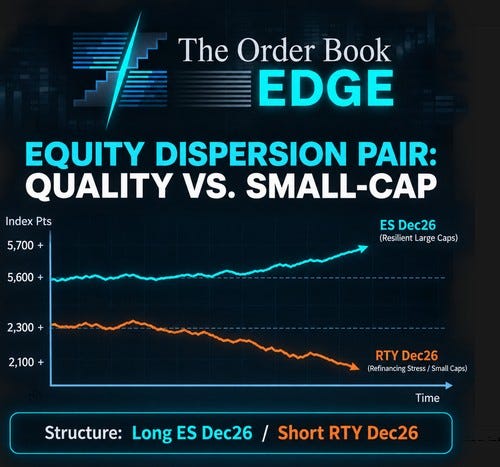
        EQUITY DISPERSION PAIR: QUALITY VS. SMALL-CAP
Index Pts
  5,700 +                      ES Dec26 (Resilient Large Caps)
        |                     /
  5,600 +--------------------+
        |
  2,300 +--------------------+
        |                     \
  2,100 +                      RTY Dec26 (Refinancing Stress / Small Caps)
        +---------------------------------------------------------> Time
            Structure: Long ES Dec26 / Short RTY Dec26
1. Macro & Quantitative Catalyst
The broader equity tape is trapped in an explosive volatility regime. The VIX index has shifted into the 18.5–22.0 zone, activating an institutional risk reduction:
The Rule 4.6 Mandate: When VIX trades between 15.0 and 25.0, quantitative desk risk models mandate an immediate 25% gross portfolio exposure reduction.
The October Effect & Seasonal Fragility (Rule 13.5): October historically exhibits the highest annualized volatility spikes of the trading year (+15% average historical expansion in the VIX).
Dealer Positioning: Dealers are currently holding a short gamma posture across S&P 500 options below 5,600 (or SPX equivalent 7,700 depending on cash vs. synthetic indexing). Any market breakdown forces dealers to sell into falling markets, exaggerating downside volatility.
Small Cap Fragility: While the S&P 500 (ES) trades near 5,650 (+1.2% post-jobs), the Russell 2000 (RTY) is severely lagging at 2,100–2,300 (-15% YTD across underlying indices). Small caps are suffocating under elevated refinancing costs, tight private credit liquidity (e.g., major private equity flagship fund splits), and margin compression.
2. Contract Mechanics & Trade Construction
The winning 7-day tactical play does not bet on a straight market collapse; it extracts alpha from capital structure dispersion while holding long-volatility convexity:
========================================================================================
                          EQUITY & VOLATILITY TACTICAL BOOK
========================================================================================
Strategy Component          Contract Code      Trade Details            Role
----------------------------------------------------------------------------------------
Long Quality Leg            ES Dec26 (CME)     Long Outright Futures    Capture Large-Cap Resil.
Short Fragility Leg         RTY Dec26 (CME)    Short Outright Futures   Capture Small-Cap Drain
Volatility Tail Call        VIX Dec26 (CBOE)   Buy 20/25 Call Spread    Short Gamma Protection
Exotic Tail Butterfly       VIX Dec26 (CBOE)   25 / 2x30 / 35 Call Fly  Low-cost Crash Shield
========================================================================================
Primary Trade (Inter-Index Dispersion Spread):
Long CME E-Mini S&P 500 (ES Dec26)
Short CME E-Mini Russell 2000 (RTY Dec26)
Mechanics: Historically, when rates oscillate near decade highs and growth stumbles, mega-cap balance sheets act as defensive havens relative to floating-rate-debt small caps. This trade captures market upside while shorting the weakest segment during broad market corrections.
The Asymmetric Tail Protection (Volatility Squeeze Play):
Buy CBOE VIX Dec26 20/25 Call Spreads:
With spot VIX at 18.5 and Dec26 futures trading at 19.50, volatility call spreads are priced attractively before full October seasonal risks materialize.
VIX Call Butterfly Spread (Alternative Low-Cost Crash Structure):
Buy 1x VIX Dec26 25 Call / Sell 2x VIX Dec26 30 Calls / Buy 1x VIX Dec26 35 Call.
This structure generates an asymmetrical 5:1 to 7:1 return profile in the event of a sudden, sharp market breakdown over the coming week that pushes VIX into the low 30s.
3. Seven-Day Tactical Horizons & Targets
Entry: Initiate the ES/RTY spread at current market pricing; establish the VIX call spreads while VIX is printing sub-20.
Take-Profit Target: A 3.0% to 5.0% outperformance of ES relative to RTY. For the VIX 20/25 call spread, target a double on the position if broad indices retest the lower support bounds.
Stop-Loss / Invalidation: Unwind the equity spread if RTY breaks above its 50-day moving average on sudden, broad breadth expansion.
The Master 7-Day Execution Playbook: Day-by-Day Roadmap
(October 2 – October 9, 2026)
[OCT 2 - NFP SHOCK] ---> [OCT 5 - OPENING ROLLS] ---> [OCT 6/7 - INVENTORY DATA] ---> [OCT 8/9 - HARVEST/EXPIRY]
* Absorb 29k Miss        * European Debt Focus       * EIA / API Crack Data           * Finalize Profit Takes
* Enter ZN/SR3 Spreads   * Short FOAT / Long FGBL    * Diesel Contango Deepens        * Square VIX Structures
* Deploy VIX Hedges      * Monitor BTC Breakout      * Lock in Crack Alpha            * Prep for FOMC Runup
Friday, October 2: Absorption & Asymmetry Positioning
Market Action: Absorb the aftermath of the 29K NFP print and the European diesel release.
Execution:
Buy the CME ZN Dec26 110/115 Call Spread into the bond market close.
Execute the Short HO Dec26 / Long CL Dec26 crack spread.
Enter the VIX Dec26 20/25 Call Spread to hold protection over the weekend.
Monday, October 5: European Debt Focus & Crypto Follow-Through
Market Action: European bourses open under the shadow of French fiscal debates and widening sovereign spreads. Crypto markets digest weekend retail and Asian institutional flows.
Execution:
At the Frankfurt/Paris open (07:00 London time), short Eurex FOAT Dec26 against long FGBL Dec26.
Audit CME Bitcoin (BTC) basis to offshore perpetual funding rates. If offshore perp rates remain near neutral (+0.01%) while CME basis expands, maintain the BTC Dec26 85k/90k Call Spread.
Tuesday, October 6: Curve Normalization & Equity Gamma Checks
Market Action: Fed governors deliver post-NFP speeches. Dealer gamma profiles on the S&P 500 face their first mid-week liquidity test.
Execution:
Monitor the 5Y-30Y and 2s10s yield curve. If the ZN rally pauses near technical resistance, leg into the Short FV Dec26 hedge to establish the steepener trade.
Check the ES gamma trigger at 5,620. If spot drops below, keep the VIX call options intact to capture accelerated dealer selling.
Wednesday, October 7: Refined Product Inventory Data (EIA)
Market Action: The U.S. Energy Information Administration (EIA) issues its weekly petroleum status report. Global markets assess whether the 50M barrel EU diesel release is making its way into physical delivery pipelines.
Execution:
If distillate inventories spike and HO contango widens past -$0.05/gal, capture initial profits on the Short HO / Long CL spread.
Take partial profits on the HO Dec26 2.80/3.00 Put Spread (target: close 50% of position at +60% gain).
Thursday, October 8: Sovereign Spread Climax & Macro Unwinds
Market Action: The European sovereign debt spread approaches the critical +150 to +160 bps zone.
Execution:
Begin locking in profits on the Short FOAT / Long FGBL spread trade. Do not greedily hold for an outright ECB intervention.
If Bitcoin approaches $89,500–$90,000, prepare to execute profit orders on the BTC Dec26 85k/90k Call Spread.
Friday, October 9: 7-Day Cycle Close & Capital Preservation
Market Action: Weekly options expiration across energy and fixed income complexes; weekend risk adjustments ahead of mid-October earnings.
Execution:
Close out remaining long ZN call spread legs that have achieved >80% delta expansion.
Square short diesel legs to avoid weekend geopolitical headline gaps.
Perform book-level audit to reset the portfolio’s gross exposure based on Friday’s closing VIX print, adhering strictly to Rule 4.6.
Quantitative Risk Governance & Correlation Matrix
To execute these strategies without exposing the total book to catastrophic drawdowns, institutional traders must enforce the strict correlation prohibitions established in Rule 14.6 (Mandatory avoidance of multi-asset positions with correlations > 0.70).
========================================================================================
                          CROSS-ASSET 30-DAY CORRELATION MATRIX
========================================================================================
Asset Pair                          Correlation (30D)  Risk Status       Mandated Desk Action
----------------------------------------------------------------------------------------
BTC vs. Nasdaq (NQ)                 +0.72              VIOLATION (>0.70) Decouple: Long BTC, Short NQ
10Y UST (ZN) vs. Equities (ES)      -0.85              ELEVATED SKEW     Hedge via ES Puts + ZN Calls
Crude Oil (CL) vs. US Dollar (DXY)  -0.75              HIGH INVERSE      Hedge: Long CL, Short DXY
Crude Oil (CL) vs. Gold (GC)        -0.75 to +0.60     REGIME SHIFT      Avoid Over-hedging Raw Commodities
Bunds (FGBL) vs. BTPs (FBTP)        +0.88              DANGEROUS CONC.   Do not hold simultaneous longs
VIX Index vs. S&P 500 (ES)          -0.91              MAX CONVEXITY     Use VIX calls to cap index downside
========================================================================================
Three Non-Negotiable Risk Rules for the Next 7 Days:
The 25% Sizing Cut: Because the VIX is trading above 18.5, all unit contract sizing must be scaled back to 75% of standard maximum risk parameters. A desk that typically trades 100 contracts of ZN or CL should trade no more than 75 contracts.
The Spread Imperative: Given systemic geopolitical risks (Middle East strikes, U.S. Patriot missile deployments) and fiscal debt dynamics, naked directional bets are prohibited. Every position must feature a built-in counter-leg (e.g., crack spreads, sovereign pairs, vertical option call/put debit tunnels).
The Event Horizon Protocol: The market is discounting central bank policy paths at high velocity. If any single position experiences a 25% adverse move relative to max margin within 48 hours, immediately cut the position. Never average down on a losing macro trade in early October.
Tactical Summary: The Desk Cheat Sheet
Priority Asset Class Trade Structure Core Contract Codes Target 7-Day Gain Invalidation Trigger #1 Refined Energy Short Dec26 HO / Long Dec26 CL HOZ6, CLZ6 +6.0% to +8.5% Crack Compression HO Contango Collapses #2 US Rates ZN Dec26 110/115 Call Spread ZNZ6 +100% on Invested Premium 10Y Yield Closes > 5.35% #3 Sovereign RV Short FOAT Dec26 / Long FGBL Dec26 FOATZ6, FGBLZ6 Spread Widens to +160 bps Spread Compresses < +105 bps #4 Crypto BTC Dec26 85k/90k Call Spread BTCZ6 +130% on Spread Debit BTC Closes Below $83,500 #5 Equities / Vol Long ES / Short RTY + VIX Call Spreads ESZ6, RTYZ6, VIXZ6 +3.5% Index Ratio / +80% on Vol VIX Drops and Closes < 16.00
Stay disciplined, respect the volatility regimes, and manage risk aggressively.