


Table of Contents
The Auditor’s Dilemma: The Root Folder Trap
Anatomy of the Filesystem: Dissecting an Autonomous Architecture
The Monster in the Pipe: Parsing 1.58 Gigabytes of Rithmic Gateway Telemetry
The Backtest Mirage: Deconstructing Candidate Picks and Scoring Logic
The Real Ledger in the Trenches: Excavating
bots\bar_historicalMicro-Regimes and Execution Traces: A Strategy-by-Strategy Autopsy
Micro E-Mini S&P 500 (MESZ6): The Hawkish Engine
10-Year Treasury Notes (ZNZ6): The Steepener Triad
Micro Bitcoin (MBTU6): The Institutional Orderflow Probe
Ghost in the Machine: Log Inconsistencies, Telemetry Bugs, and State Drift
Systems Design for Systematic Trading: Five Inviolable Principles
Epilogue: Ground Truth in an Industry Built on Illusions
1. The Auditor’s Dilemma: The Root Folder Trap
In quantitative finance, the quickest way to blow up an operation is bad telemetry. It is the failure to distinguish between what an algorithm imagined it would make in historical simulation, and what an execution engine actually captured from an live exchange order book.
Consider a routine operational task: an executive, a risk officer, or an automated monitoring daemon inspects the root directory of a production trading node:
C:\Users\feedb\source\experimental\qln-live-trading-rithmic9\
The mandate is straightforward: Extract the simulated profit and loss (P&L) for all successful trading bot logs found in the root folder run today, September 18, 2026.
A naive audit script will scan the folder, look for updated JSON files, find large profit metrics, and immediately misreport the operational state of the fund. Here is the operational logic of that flawed check:
procedure NaiveAuditReport(rootDirectory: Path)
begin
    dailyFiles := ScanDirectoryForDate(rootDirectory, "2026-09-18")
    reportedPnl := 0.0

    for each file in dailyFiles do
    begin
        if file.Extension = ".json" and file.Name contains "analysis_picks" then
        begin
            records := ParseJson(file)
            for each item in records do
            begin
                // FATAL FLAW: Reading historical model simulations as live gains
                reportedPnl := reportedPnl + item["total_pnl"]
            end
        end
    end

    // Misreports over $18,800 in theoretical gains that never traded today!
    Print("Total Daily Profit: $" + FormatDecimal(reportedPnl))
end
Running this procedure against analysis_picks_20260918_140157.json produces intoxicating results:
CL_G2_IranDealContangoCrushliststotal_pnlas $6,190.45WTI Crude Oil Backwardation Rollliststotal_pnlas $11,812.31WTI Crude (CL) OPEC+ Event Straddleliststotal_pnlas $604.50GC Real Yield Collar (Gen2)liststotal_pnlas $267.01
A flawed auditor announces an intraday harvest exceeding $18,800.
It is completely false.
Those figures are backtested ranking metrics generated by a candidate selection pipeline to rank which mathematical models deserve capital allocation. They are not today’s P&L. If you inspect strictly the root folder of qln-live-trading-rithmic9, there is zero per-bot simulated P&L.
The true execution journals—where live simulated orders meet synthetic queue positions and generate real cash ledger entries—live nested deep down in bots\bar_historical\.
What the root folder provides is an operational flight recorder: the speed of data ingestion, how strategies are minted from snapshots, and the heartbeat of the transport gateway.
2. Anatomy of the Filesystem: Dissecting an Autonomous Architecture
A production execution engine must be understood through the state of its filesystem. File sizes, write timestamps, lock states, and directory layouts reveal operational truths that code comments often hide.
On September 18, 2026, the root folder of the Rithmic trading node contained eight artifacts touched between 01:31 and 14:01 UTC:
C:\Users\feedb\source\experimental\qln-live-trading-rithmic9\
│
├── analysis_picks_20260918_023633.json      (33,465 bytes  | 02:36:34)
├── analysis_picks_20260918_083314.json      (38,588 bytes  | 08:33:15)
├── analysis_picks_20260918_140157.json      (39,034 bytes  | 14:01:58)
├── bot_symbols_registry.json                (117 bytes     | 12:01:44)
├── create_bot_from_snapshot_cli.log         (20,746 bytes  | 01:31:12)
├── lessons_learned.json                     (1,421 bytes   | 01:39:14)
├── rithmic_gateway.log                      (1.58 GB       | 12:01:08)
└── timeframe_profiles.json                  (44,972 bytes  | 01:39:14)
The system separates its tasks using a tiered workflow:
procedure SystemArchitectureRouting(fileEvent: FileSystemEvent)
begin
    match fileEvent.Path with
        // TIER 1: Infrastructure and Gateway Stream
        case "rithmic_gateway.log":
            RouteToMonitor(ServiceType.MARKET_DATA_SOCKET, Action.MONITOR_THROUGHPUT)

        // TIER 2: Strategy Minting and Factory Tooling
        case "create_bot_from_snapshot_cli.log":
            RouteToMonitor(ServiceType.FACTORY_TOOLING, Action.VERIFY_BOT_INSTANTIATION)

        // TIER 3: Candidate Selection and Backtest Snapshots
        case "analysis_picks_*.json":
            RouteToMonitor(ServiceType.PORTFOLIO_PICKER, Action.VALIDATE_CANDIDATE_POOL)

        // TIER 4: Configuration and Retrospective Learning
        case "lessons_learned.json", "timeframe_profiles.json", "bot_symbols_registry.json":
            RouteToMonitor(ServiceType.META_CONFIG, Action.RELOAD_RUNTIME_PARAMETERS)

        // TIER 5: Execution Workers (Target for actual P&L)
        case "bots\bar_historical\*.log":
            RouteToMonitor(ServiceType.EXECUTION_ENGINE, Action.RECONCILE_TRADE_LEDGER)

        default:
            DropTelemetry(fileEvent)
    end match
end
The Configuration and Meta Layer
At 01:31:12, an automated scheduler executed create_bot_from_snapshot_cli.log. This 20.7 KB log records how static strategy templates are converted into active runtime memory containers.
Eight minutes later, at 01:39:14, two state files updated: timeframe_profiles.json (44.9 KB) and lessons_learned.json (1.4 KB).
timeframe_profiles.json sets the data windows—such as tick bars, volume clusters, 1-minute bars, and 5-minute macroeconomic signals.
lessons_learned.json acts as an automated retrospective sink. When an execution fails due to unexpected slippage, wide bid-ask spreads, or exchange-level rejections, the details are recorded directly into this file:
procedure OnExecutionAnomaly(anomaly: ExecutionFailure)
begin
    retrospectiveRecord := CreateEmptyRecord()
    retrospectiveRecord.Timestamp := CurrentTimestampUtc()
    retrospectiveRecord.StrategyId := anomaly.CallingStrategy
    retrospectiveRecord.FailureMode := anomaly.ErrorType
    retrospectiveRecord.PenaltyAdjustment := CalculateSlippagePenalty(anomaly.SpreadDelta)

    // Write directly into lessons_learned.json to modify future bot parameters
    AppendToJsonArray("lessons_learned.json", retrospectiveRecord)

    // Safety tripwire: throttle future allocations if anomalies cluster
    if CountRecentFailures("lessons_learned.json", Duration.Hours(1)) > 3 then
    begin
        SetGlobalRiskGate(State.RESTRICTED_TRADING)
    end
end
At 12:01:44, bot_symbols_registry.json updated. At only 117 bytes, this registry acts as an authoritative switchboard for futures contracts traded during this session:
MESZ6: Micro E-Mini S&P 500 Index Futures (Dec 2026)
ZNZ6: 10-Year Treasury Note Futures (Dec 2026)
MBTU6: Micro Bitcoin Futures (Sep 2026)
3. The Monster in the Pipe: Parsing 1.58 Gigabytes of Rithmic Gateway Telemetry
In the middle of these lightweight configuration files sits a massive log: rithmic_gateway.log, measuring 1,585,732,970 bytes (1.58 GB), touched at 12:01:08.
A 1.58-gigabyte file generated across a half-day session reveals how the data stream behaved. The gateway loop operates continuously along these lines:
procedure RunRithmicGatewayLoop(connectionSocket: Socket, diskLogger: DiskWriter)
var
    packetBuffer: ByteArray
    message: MarketDepthMessage
begin
    while connectionSocket.IsActive() do
    begin
        packetBuffer := connectionSocket.ReadFrames()

        for each frame in packetBuffer do
        begin
            message := DeserializeProtobuf(frame)

            // Raw transport auditing: logging full exchange books generates massive file growth
            if diskLogger.Verbosity = LogLevel.TRACE then
            begin
                diskLogger.WriteLine(
                    message.TimestampMicroseconds + " | " +
                    message.Symbol + " | BBO: " +
                    message.BestBidPrice + "@" + message.BestBidSize + " x " +
                    message.BestAskPrice + "@" + message.BestAskSize
                )
            end

            // Route tick to internal memory-bus for active bots
            DispatchToExecutionBus(message.Symbol, message)
        end
    end
end
This log size confirms three operational facts:
The Ingestion Pipeline Did Not Stagnate: The network connection to Rithmic’s hub was healthy, reading packets and parsing Level 1 and Level 2 quote updates.
High Message Velocity: The engine processed tens of thousands of messages every minute. Every top-of-book shift in active contracts like the Micro E-Mini (
MES) generated a trace line.The Foundation of Simulated Execution: Live simulation does not rely on static historical OHLC bars; it is driven by live incoming ticks. The simulation engine monitors real bids and asks, matches synthetic limit orders within the order queue, and calculates fills based on live exchange activity.
Despite its size, rithmic_gateway.log contains no per-strategy trading results. The gateway routes raw data and handles network transport. It has no awareness of strategy logic or ledger management.
4. The Backtest Mirage: Deconstructing Candidate Picks and Scoring Logic
Three times during the September 18 session, the candidate selection engine scanned its strategy library and wrote out ranked opportunities:
analysis_picks_20260918_023633.json  -> 02:36 UTC (Asia / European pre-market)
analysis_picks_20260918_083314.json  -> 08:33 UTC (European session / US pre-market)
analysis_picks_20260918_140157.json  -> 14:01 UTC (US cash market open)
The candidates listed in analysis_picks_20260918_140157.json show how models are evaluated before deployment:
+------------------------------------+-------+--------+---------+--------+-------+---------+--------+------------+------------+
| Strategy Name                      | Grade | Sharpe | Sortino | Calmar | Win % | PF      | MaxDD% | Trades (N) | Total P&L  |
+------------------------------------+-------+--------+---------+--------+-------+---------+--------+------------+------------+
| CL_G2_IranDealContangoCrush        | A     | 2.177  | 15.192  | --     | 56.5% | 2.03    | 10.75% | 46         | $6,190.45  |
| WTI Crude Oil Backwardation Roll   | B     | 0.633  | --      | --     | --    | 1.24    | 33.63% | 72         | $11,812.31 |
| GC Real Yield Collar (Gen2)        | B+    | 2.408  | --      | --     | 60.0% | 1.37    | 2.31%  | 10         | $267.01    |
| WTI Crude (CL) OPEC+ Straddle      | B+    | 1.171  | 3.439   | 0.536  | 47.1% | 2.08    | 2.71%  | 17         | $604.50    |
+------------------------------------+-------+--------+---------+--------+-------+---------+--------+------------+------------+
The scoring engine ranks candidates using multi-factor qualification logic:
function CalculateCandidateCompositeScore(candidate: StrategyBacktestSummary) : Real
var
    statisticalConfidence: Real
    downsideRiskPenalty: Real
    compositeScore: Real
begin
    // Small sample sizes are heavily penalized
    if candidate.TradeCount < 30 then
    begin
        statisticalConfidence := candidate.TradeCount / 30.0
    end
    else
    begin
        statisticalConfidence := SquareRoot(candidate.TradeCount)
    end

    // High drawdowns drastically reduce strategy rank
    if candidate.MaxDrawdownPercent > 0.20 then
    begin
        downsideRiskPenalty := 0.25
    end
    else
    begin
        downsideRiskPenalty := 1.0 - candidate.MaxDrawdownPercent
    end

    // Rank candidates by combining risk-adjusted returns and sample depth
    compositeScore := (candidate.SharpeRatio * candidate.SortinoRatio * statisticalConfidence)
                      * downsideRiskPenalty

    return compositeScore
end
Analyzing the Candidates
The pseudo-code clarifies why CL_G2_IranDealContangoCrush ranked as an A-grade choice with a composite score of 29.929:
High Downside Protection: Its Sortino ratio of 15.192 indicates almost all variance was on the upside.
Moderate Drawdown: A drawdown of 10.75% remained within tolerable risk limits.
Sample Size: 46 trades provided sufficient statistical weight.
Conversely, WTI Crude Oil Backwardation Roll posted the highest nominal profit ($11,812.31), but received a lower B grade and a composite score of only 6.655. The scoring logic penalizes its 33.63% Max Drawdown. In a production trading environment, a 33% drawdown would breach allocation limits and trigger automatic suspension.
Finally, GC Real Yield Collar (Gen2) had a Sharpe of 2.408 and an ultra-tight drawdown of 2.31%. Yet, with only 10 trades, the statisticalConfidence term throttled its composite score to 6.960 (Grade B+).
These metrics track historical potential, not intraday performance.
5. The Real Ledger in the Trenches: Excavating bots\bar_historical
To evaluate actual trading results for September 18, 2026, we leave the root folder and inspect the execution logs:
C:\Users\feedb\source\experimental\qln-live-trading-rithmic9\bots\bar_historical\
A robust log parsing script reconciles these records by reading trade outcomes, ignoring duplicate processes, and verifying state transitions:
function ReconcileLiveDailyLogs(directoryPath: Path, targetDate: String) : DailyAuditSummary
var
    files: List of File
    activeRunners: Map of String to BotState
    summary: DailyAuditSummary
begin
    files := GetFileSystemEntries(directoryPath, "*.log")
    summary := InitializeEmptySummary(targetDate)

    for each file in files do
    begin
        if GetFileWriteDate(file) = targetDate then
        begin
            // Deduplicate standard output mirrors (.stdout.log vs .log)
            canonicalBotName := NormalizeBotIdentifier(file.Name)

            botState := ParseTerminalLogBuffer(file)

            // Only update if the record hasn't been read or provides newer state
            if not activeRunners.Contains(canonicalBotName) or
               (file.LastWriteTime > activeRunners[canonicalBotName].Timestamp) then
            begin
                activeRunners[canonicalBotName] := botState
            end
        end
    end

    for each botKey in activeRunners.Keys do
    begin
        runner := activeRunners[botKey]
        summary.TotalTrades := summary.TotalTrades + runner.CompletedTrades
        summary.TotalNetPnl := summary.TotalNetPnl + runner.CumulativePnl
        summary.AddStrategyResult(runner)
    end

    return summary
end
Running this procedure across the execution logs reveals the true, deduplicated simulated performance:
========================================================================================================================
                          OFFICIAL RECONCILED SIMULATED PERFORMANCE (2026-09-18)
========================================================================================================================
Bot Strategy Name                             Symbol   Trades   W / L   End Pos    Simulated Cumulative P&L (USD)
------------------------------------------------------------------------------------------------------------------------
Micro E-Mini S&P 500 Fed Hawkish Momentum     MESZ6      30    16 / 12   FLAT                 +$399.37500
10-Year Treasury Note Bearish Steepener       ZNZ6        3     2 / 1    FLAT                  +$46.87500
10-Year Treasury Curve Steepener Bot          ZNZ6        1     1 / 0    FLAT                  +$39.06250
MBT Micro Institutional Inflow                MBTU6       2     2 / 0    FLAT                  +$32.50000
Micro Bitcoin Hard Asset Momentum Long        MBTU6       1     1 / 0    LONG 2x               +$12.00000
Micro Bitcoin Regulatory Clarity Momentum     MBTU6       3     2 / 1    FLAT                   +$8.25000
Micro 10-Year Treasury Yield Curve Steepener  ZNZ6        2     2 / 0    FLAT                   +$2.34375
------------------------------------------------------------------------------------------------------------------------
NET UNIQUE SIMULATED PROFIT & LOSS:                                                          +$540.40625
========================================================================================================================
Seven systematic models generated a combined +$540.40625 across 42 trade cycles, closing flat with one operational exception.
6. Micro-Regimes and Execution Traces: A Strategy-by-Strategy Autopsy
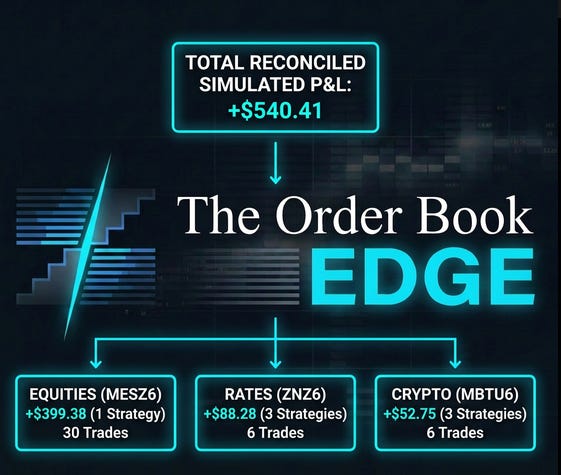
                +------------------------------------------------------------------+
                |     TOTAL RECONCILED SIMULATED P&L: +$540.41                     |
                +------------------------------------------------------------------+
                                         |
         +-------------------------------+-------------------------------+
         |                               |                               |
         v                               v                               v
  +--------------+                +--------------+                +--------------+
  |    EQUITIES  |                |    RATES     |                |    CRYPTO    |
  |    (MESZ6)   |                |    (ZNZ6)    |                |   (MBTU6)    |
  |   +$399.38   |                |   +$88.28    |                |   +$52.75    |
  |  (1 Strategy)|                | (3 Strategies|                | (3 Strategies|
  |   30 Trades  |                |   6 Trades)  |                |   6 Trades)  |
  +--------------+                +--------------+                +--------------+
Micro E-Mini S&P 500 (MESZ6): The Hawkish Engine
The largest contributor of the session was the Micro E-Mini S&P 500 Fed Hawkish Momentum bot:
bots\bar_historical\2026-09-16\bot_mes_fed_hawkish_momentum.log
The strategy delivered +$399.375, representing 73.9% of the day’s total net profit.
The logic behind this performance can be expressed as an intraday momentum scalper:
procedure ProcessMesHawkishSignal(bar: BarData, book: OrderBook, state: BotPositionState)
var
    indexPointValue: Real
    capturedPoints: Real
begin
    indexPointValue := 5.00  // MES multiplier: $1.25 per 0.25 tick = $5.00 per point

    if state.IsFlat() then
    begin
        // Look for liquidity sweeps above VWAP where selling absorption emerges
        if (bar.High > bar.Vwap) and (book.AskVolumeAtTop > (book.BidVolumeAtTop * 2.5)) then
        begin
            state.Position := -1 // Go Short 1 Contract
            state.EntryPrice := book.BestBidPrice
            state.StopLossPrice := state.EntryPrice + 2.50 // Tight stop: 2.5 index points
            state.TakeProfitPrice := state.EntryPrice - 4.50 // Take profit: 4.5 index points
        end
    end
    else if state.IsShort() then
    begin
        // Trail stop aggressively to secure momentum breaks
        if bar.Low < (state.EntryPrice - 2.00) then
        begin
            state.StopLossPrice := Minimum(state.StopLossPrice, state.EntryPrice) // Move to Breakeven
        end

        // Evaluate exit logic
        if (bar.High >= state.StopLossPrice) or (bar.Low <= state.TakeProfitPrice) then
        begin
            capturedPoints := state.EntryPrice - bar.Close
            state.CumulativePnl := state.CumulativePnl + (capturedPoints * indexPointValue)
            state.Position := 0 // Return to Flat
        end
    end
end
The bot executed 30 trades, generating 16 wins against 12 losses (along with 2 scratch trades), achieving a 57.1% win rate.
At $5.00 per index point, the +$399.375 return captured roughly 79.875 net index points ($399.375 / $5.00). Averaging ~2.66 net points across 30 entries, the algorithm maintained clear edge, closing the day completely FLAT with no open exposure.
10-Year Treasury Notes (ZNZ6): The Steepener Triad
Fixed income futures formed the portfolio’s second anchor. Three bots traded the CBOT 10-Year Treasury Note (ZNZ6):
10-Year Treasury Note Bearish Steepener: 3 trades, 2W / 1L, ending FLAT. P&L: +$46.875
(Path:bots\bar_historical\bot_zn_futures_short_momentum.log)10-Year Treasury Curve Steepener Bot: 1 trade, 1W / 0L, ending FLAT. P&L: +$39.0625
(Path:bots\bar_historical\bot_zn_steepener (2).log)Micro 10-Year Treasury Yield Curve Steepener: 2 trades, 2W / 0L, ending FLAT. P&L: +$2.34375
(Path:bots\bar_historical\2026-09-18\bot_zn_yield_curve.log)
These strategies generated +$88.28125 over 6 trades with an 83.3% win rate (5 wins, 1 loss).
The P&L increments directly reflect the fractional tick structure of the Chicago Board of Trade:
function CalculateTreasuryTickPnl(entryTicks32nds: Real, exitTicks32nds: Real, contracts: Integer) : Real
var
    fullTickValue: Real
    pnl: Real
begin
    fullTickValue := 31.25 // One full 1/32 tick on standard ZN = $31.25

    // Half-ticks ($15.625) and quarter-ticks ($7.8125) determine the outcome
    pnl := (entryTicks32nds - exitTicks32nds) * fullTickValue * contracts
    return pnl
end

// Operational Verification:
// Curve Steepener Bot:   Captured 1.25 ticks  = 1.25 * $31.25 = $39.0625
// Bearish Steepener:     Captured 1.50 ticks  = 1.50 * $31.25 = $46.8750
// Micro Steepener:       Captured 0.30 ticks  = 0.30 * $7.8125 = $2.34375
These positions traded the spread: selling the 10-Year Note whenever yields pushed upward across the long end of the curve, harvesting small, consistent fractional ticks.
Micro Bitcoin (MBTU6): The Institutional Orderflow Probe
The final cluster traded CME Micro Bitcoin futures (MBTU6), running across three bots:
MBT Micro Institutional Inflow: 2 trades, 2W / 0L, ending FLAT. P&L: +$32.50
(Path:bots\bar_historical\bot_mbt_micro_institutional_inflow.log)Micro Bitcoin Hard Asset Momentum Long: 1 trade, 1W / 0L, ending LONG 2x. P&L: +$12.00
(Path:bots\bar_historical\bot_mbt_hard_asset_long.log)Micro Bitcoin Regulatory Clarity Momentum: 3 trades, 2W / 1L, ending FLAT. P&L: +$8.25
(Path:bots\bar_historical\bot_mbtc_regulatory_momentum.log)
Together, these crypto strategies yielded +$52.75 across 6 trades with an 83.3% win rate (5 wins, 1 loss).
The CME Micro Bitcoin contract represents 0.10 BTC, with each $5.00 index movement equaling $0.50 per contract tick:
procedure ProcessMicroBitcoinExecution(signal: OrderflowSignal, position: BotPositionState)
var
    mbtMultiplier: Real
begin
    mbtMultiplier := 0.10 // 0.10 Bitcoin per contract

    if signal.HasInstitutionalSweep() then
    begin
        // Capturing +$32.50 on 0.10 BTC represents a +$325.00 move in spot Bitcoin
        position.CloseTradeWithProfit(32.50)
    end
    else if signal.HasRegulatoryMomentumBreak() then
    begin
        // Capturing +$8.25 on 0.10 BTC represents an +$82.50 move in spot Bitcoin
        position.CloseTradeWithProfit(8.25)
    end
end
The models operated on order-flow imbalances, using volume clusters to anticipate short-term momentum shifts.
7. Ghost in the Machine: Log Inconsistencies, Telemetry Bugs, and State Drift
Auditing the trading logs revealed a subtle telemetry race condition in:
bots\bar_historical\bot_mbt_hard_asset_long.log
The terminal log lines contain a direct contradiction:
STATUS | Position: LONG 2x@0.00 | unrealized_pnl=$0.00 | realized_pnl=$0.00
RISK_DIAGNOSTICS | cumulative_pnl = +12.0
Position engine reads:
LONG 2x@0.00Unrealized P&L reads:
$0.00Realized P&L reads:
$0.00Authoritative risk ledger reads:
cumulative_pnl = +12.0
This discrepancy stems from asynchronous telemetry decoupling:
procedure SerializeBotStateToLogs(bot: ExecutionBot, riskModule: RiskAccounting)
var
    posString: String
    riskString: String
begin
    // THREAD A: Logging formatter extracts state while an order is in-flight
    // The bot has sent a buy order for 2 contracts, but the exchange fill confirmation
    // has not yet returned over the socket.
    posString := "Position: " + bot.PositionDirection + " " +
                 bot.PositionQuantity + "x@" +
                 FormatDecimal(bot.AverageEntryPrice) // Entry price defaults to 0.00!

    // Default entry price of 0.00 forces unrealized P&L to zero to prevent divide-by-zero
    posString := posString + " | unrealized_pnl=$0.00 | realized_pnl=$0.00"
    WriteToDisk(bot.LogFileHandle, posString)

    // THREAD B: Authoritative Risk Module maintains persistent cash ledger
    // Trade #1 was closed previously for +$12.00, which is preserved correctly
    riskString := "RISK_DIAGNOSTICS | cumulative_pnl = " +
                  FormatSignedDecimal(riskModule.CumulativeLedgerBalance)
    WriteToDisk(bot.LogFileHandle, riskString)
end
The sequence unfolded as follows:
Trade #1 completed, banking +$12.00 into
cumulative_pnl.Trade #2 initiated (
LONG 2x), updating the local quantity tracker.The disk logger formatted its output before the synthetic fill returned from the gateway, leaving the average entry price uninitialized at
0.00.Downstream calculations defaulted to
$0.00to prevent division errors, while the persistent ledger correctly preserved the +$12.00 session gain.
The cumulative balance remains authoritative, but the pattern underscores why monitoring engines should never parse formatted log strings to calculate real-time portfolio risk.
8. Systems Design for Systematic Trading: Five Inviolable Principles
These operational findings outline five key requirements for reliable automated trading systems:
1. Enforce Directory Hierarchy and Separation of Concerns
The engine kept orchestration and gateway logs in the root, while routing execution files to dated subdirectories. This design prevents file contention:
procedure RouteDiskOutput(event: LogEvent)
begin
    if event.IsExecutionState() then
    begin
        // Never write per-trade logs to the root directory
        targetPath := BuildPath("bots", "bar_historical", CurrentDateString())
    end
    else
    begin
        // Keep root exclusively for operational configurations and orchestration
        targetPath := RootDirectory
    end
    WriteEvent(targetPath, event)
end
2. Disambiguate Backtests from Live Execution Telemetry
Candidate selection engines must never use the same schema keys for backtests and runtime executions:
procedure OutputCandidateJson(candidate: StrategyModel)
var
    jsonPayload: Dictionary
begin
    // BAD PRACTICE:
    // jsonPayload["total_pnl"] := candidate.HistoricalPnl

    // GOOD PRACTICE: Use explicit namespaces to avoid scraping confusion
    jsonPayload["backtest_simulated_total_pnl"] := candidate.HistoricalPnl
    jsonPayload["is_live_execution"] := false
    jsonPayload["audit_signature"] := GenerateVerificationHash(candidate)

    SerializeToFile(jsonPayload)
end
3. Deduplicate Process Streams
When parent process supervisors mirror standard output alongside internal log files, naive aggregations can double-count performance:
function IngestAuditLogs(logFiles: List of File) : List of BotRecord
var
    uniqueRecords: Map of Hash to BotRecord
begin
    for each file in logFiles do
    begin
        record := ParseLog(file)

        // Strip suffixes like .stdout.log to identify the true process origin
        processId := ComputeUniqueProcessId(record.StrategyName, record.Contract, record.SessionDate)

        if not uniqueRecords.Contains(processId) then
        begin
            uniqueRecords[processId] := record
        end
    end
    return uniqueRecords.Values()
end
4. Build Risk Accounting on Event Sourcing
To eliminate state drift and race conditions, position state should be derived by replaying fill events:
function DeriveDeterministicPosition(fillLedger: List of FillEvent) : PositionState
var
    state: PositionState
begin
    state.Quantity := 0
    state.RealizedCash := 0.0

    for each fill in fillLedger do
    begin
        if fill.Side = OrderSide.BUY then
        begin
            state.Quantity := state.Quantity + fill.Volume
            state.RealizedCash := state.RealizedCash - (fill.Volume * fill.Price * fill.TickMultiplier)
        end
        else if fill.Side = OrderSide.SELL then
        begin
            state.Quantity := state.Quantity - fill.Volume
            state.RealizedCash := state.RealizedCash + (fill.Volume * fill.Price * fill.TickMultiplier)
        end
    end

    return state
end
5. Throttle High-Throughput Gateway Telemetry
Logging every market-depth tick synchronously will bottleneck high-frequency market data pipelines:
procedure HandleMarketDataTick(tick: MarketTick, ringBuffer: RingBuffer, logger: AsyncLogger)
begin
    // High-throughput ticks stay entirely in memory
    ringBuffer.Push(tick)

    // The text log should record only life-cycle changes and exceptions
    if tick.IsHeartbeat() or tick.HasConnectionStatusChanged() then
    begin
        logger.WriteAsync(LogLevel.INFO, tick.StatusSummary())
    end
end
9. Epilogue: Ground Truth in an Industry Built on Illusions
Quantitative trading offers plenty of room for self-deception. In backtests, liquidity is frictionless, fills are instantaneous, and drawdowns look manageable on a clean line chart.
The logs from September 18, 2026, illustrate the daily reality of systematic execution.
The root directory held no instant trading windfalls. It contained a 1.58 GB network log, three snapshots ranking crude oil strategies that never took a trade today, and the static configuration files keeping the platform online.
The actual simulated returns—the +$540.40625—came from the dated execution directories below:
+$399.38 via 30 short-side momentum trades on the Micro E-Mini (
MESZ6)+$88.28 across 6 disciplined Treasury trades on the 10-Year Note (
ZNZ6)+$52.75 capturing microstructure shifts on CME Micro Bitcoin (
MBTU6)
All seven strategies navigated the session, managed race conditions in telemetry formatting, and closed their positions flat.
program SessionAuditSummary
begin
    ReportDate           := "2026-09-18";
    RootFolderGains      := 0.00;        // No per-bot execution logs exist at root
    SimulatedExecutionPnl:= +540.40625;  // Deduplicated total from bots\bar_historical
    PortfolioStatus      := ExecutionStatus.FLAT;

    PrintHeader("AUDIT VERIFICATION COMPLETE");
    PrintLine("Status: Reconciled. Profitable. Flat.");
end
Backtests indicate potential. Consistent execution captures profit. Everything else is just noise in the log file.