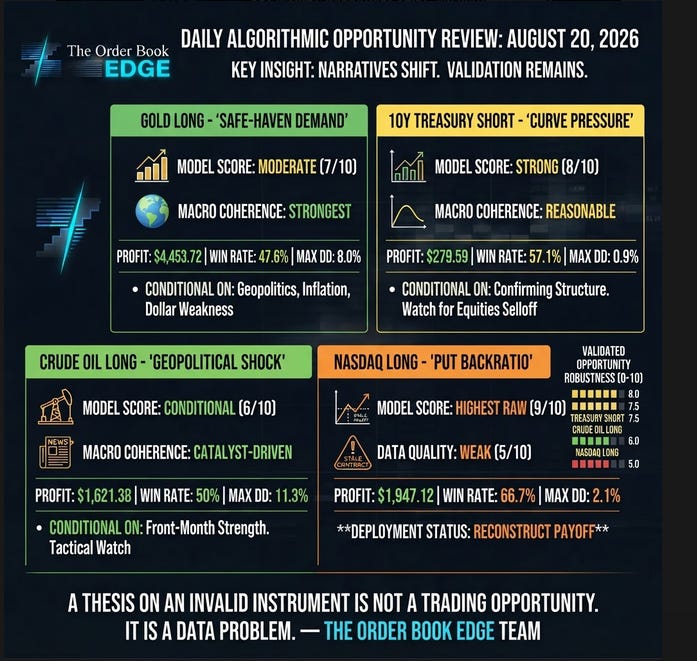

Market analysis for Thursday, August 20, 2026
Financial disclosure: This article is for educational and informational purposes only. It is not investment advice or a recommendation to buy or sell securities, futures, options, or digital assets. All performance figures discussed here come from hypothetical backtests supplied in the source reports. They do not represent actual trading results. Futures and options involve substantial risk, including the possibility of losing more than the initial investment.
Two algorithmic market reports were generated this morning.
The first, generated at 8:21 a.m., evaluated 340 strategies. The second, generated at 10:44 a.m., evaluated 331. Both filtered their broader universes down to 60 supposedly deployable systems and ranked those systems using a composite of hypothetical profitability, Sharpe ratio, trade count, recent consistency, directional alignment, and liquidity.
At first glance, the message appears simple:
Buy Nasdaq futures.
Buy gold.
Buy crude oil.
Sell 10-year Treasury futures.
The reports’ highest-rated individual model is a long Nasdaq strategy called NQ_Futures_PutBackratio_CrashHedge_G2. It has a reported Sharpe ratio of 2.89, a 66.7% win rate, and a composite score of 29.3.
Gold produces the largest aggregate hypothetical profit. Crude oil receives a bullish geopolitical signal. Treasury futures receive a bearish signal based on the risk that inflation keeps monetary policy restrictive.
Together, these trades describe a market regime characterized by:
Resilient nominal growth
Persistent inflation risk
Supportive risk-asset liquidity
Elevated geopolitical uncertainty
Less monetary easing than previously expected
That is a plausible macro package.
But it is not yet a tradeable package.
The reports contain stale futures contracts, questionable instrument labels, contradictory macro explanations, and news snippets attached to unrelated asset classes. The highest-ranked Nasdaq strategy remains the “highest-conviction signal” in the later report, yet it disappears from that report’s sector-level portfolio. A bullish gold thesis is partly justified with language that could actually be bearish for gold. Crude oil is linked to rate-market news rather than energy fundamentals. The fixed-income discussion sometimes mixes together flatteners, steepeners, outright duration trades, and options hedges as though they were interchangeable.
These are not merely editorial mistakes.
They reveal the central weakness of automated market analysis: a system can calculate a statistically attractive ranking while misunderstanding the actual instrument, contract, narrative, or execution environment.
The correct response is not to dismiss the reports. They contain useful information. The correct response is to separate the useful signal from the machine-generated noise.