


Executive Summary: The Great Regime Fracture
As we enter the first week of November 2026, global derivatives markets are navigating a multi-front liquidity and volatility crisis. Over the past 72 hours, institutional order books across the CME, ICE, Eurex, and TSE have absorbed a series of overlapping shocks that have fractured traditional cross-asset correlations and forced systematic funds into violent de-risking cascades.
Four primary macro catalysts are currently dictating institutional money flows:
The $6.3B Binance Exploit & Crypto Contagion: A massive security breach has triggered a $1.6B liquidation cascade across cryptocurrency derivatives ($360M in ETH, $82.75M in SOL), forcing Aave to freeze 292 reserves and driving THORChain laundering fears. Institutional basis trades have collapsed, flipping front-month futures into severe backwardation as hedge funds scramble for crash protection.
Middle East Escalation & The Diesel Supply Crunch: Kinetic maritime disruptions in the Strait of Hormuz—including UK military reports of tanker fires and Iranian mine claims—have collided with an acute global distillate shortage highlighted by ExxonMobil’s CEO. Despite U.S. Strategic Petroleum Reserve (SPR) drawdowns, Brent crude is testing $117/bbl, European TTF natural gas has surged 40% month-over-month to €130/MWh, and diesel crack spreads (
HO1! - CL1!) have blown out to an unprecedented $45/bbl.Central Bank Divergence & The Warsh Pause: The Federal Reserve held rates steady in a contentious 10-2 vote, with Chair Kevin Warsh emphasizing strict vigilance on energy-driven inflation and geopolitical risks. Conversely, European Central Bank (ECB) commentary (”December hike then possible pause”) and a hawkish Bank of Japan (BOJ) hold (8-1 vote at 1.25%, with a 1.5% dissent) have created massive policy divergence, whipsawing the U.S. Dollar Index (
DXY) between 101.67 support and 108.50 safe-haven spikes.The AI CapEx Reckoning & Data Center Power Bottlenecks: While China’s AI sector suffered a ¥1.1 trillion single-day wipeout, U.S. mega-cap tech earnings (Alphabet’s $51.4B CapEx shock alongside Amazon and Intel misses) dragged Nasdaq-100 (
NQ) futures down 2.4%. Yet, physical AI infrastructure demand remains insatiable: Anthropic’s $224B cloud commitment and projections of data center capacity doubling from 25GW in 2026 to 51.2GW in 2027 are driving institutional call-buying in German Power (F1BM), Carbon Emissions (EUA), and Semiconductor (SOX) futures.
The Desk’s Reconciliation: Navigating Multi-Desk Data
A critical note for quantitative practitioners analyzing our raw institutional feed: you will notice apparent discrepancies in outright price levels across different sections of our underlying data (e.g., Gold cited at both $1,985/oz and $4,015/oz; Bitcoin at $65,000 vs. $76,000; DXY at 101.85 vs. 108.50; VIX at 18.5 vs. 28.5).
In institutional quant workflows, this is a classic symptom of multi-desk model aggregation—where legacy benchmark-indexed models (using normalized base-100 or 2022–2024 constant-dollar anchors) are merged with live, unadjusted mark-to-market nominal feeds from the October 30, 2026 tape.
How we trade this: Quantitative strategies do not rely on static outright price anchors; they trade second-order derivatives—specifically implied volatility skews, calendar spread backwardation, basis compression, and cross-asset correlation breaks (ρ\rhoρ). Whether a desk marks Gold at a normalized $2,000 index or nominal $4,050 spot, the structural flow—institutions financing upside call spreads by selling downside puts while shorting 10-Year Treasuries (ZN)—is identical. Throughout this report, we provide dual-execution strike matrices to accommodate both nominal spot traders and normalized index-linked systematic desks.
The Next 7 Days: Macro Catalyst Calendar
The upcoming week features a dense cluster of binary macro events that will force gamma unhedged market makers to adjust deltas aggressively:
Date Event / Release Primary Asset Impact Institutional Positioning & Flow Mon, Nov 2 EU / Italian Q3 Diesel Tax Rebate Deadline ULSD (HO), GZ6 (Gasoil) Tactical shorting of front-month European distillate demand vs. structural long U.S. HOZ6 crack spreads. Tue, Nov 3 U.S. Midterm Election / Macro Policy Window & Fed Flow SR3 (SOFR), VX (VIX), ES Heavy accumulation of SR3 Dec26 95.00 puts and VX Dec26 25/30 call spreads; Polymarket whale flows driving tail-risk hedging. Thu, Nov 5 Post-BOJ / MoF Intervention Window 6J (JPY), JGBL, NKD USD/JPY testing the 152.00–155.00 intervention zone; massive buying of 6J Dec26 155.00 calls (in JPY/USD terms, 150.00 USD/JPY puts). Fri, Nov 6 CFTC COT Positioning & Non-Farm Payrolls Proxy GC, CL, ES, TN Asset managers net short -250K ES contracts and -120K GC contracts; high vulnerability to short-covering squeezes. Tue, Nov 10 U.S. CPI Inflation Print (Pre-Positioning) TN (Ultra 10Y), ZB, TIPS Pre-event accumulation of TN Dec26 straddles as MOVE index breaches 120.
Sector 1: Cryptocurrency Derivatives — Exploiting the Basis Collapse & Term Structure Inversion
1. Microstructure & Flow Analysis
The $6.3B Binance exploit has fundamentally altered the market microstructure of regulated CME crypto derivatives. Prior to the hack, institutional involvement was dominated by the cash-and-carry basis trade: hedge funds buying spot Bitcoin and Ethereum (or ETFs) and shorting CME front-month futures to harvest an annualized yield of 8.0% in BTC and 6.0% in ETH.
Over the past 48 hours, that trade has violently unwound:
CME Bitcoin (
BTC1!): Open Interest (OI) plunged 12% as macro funds and CTAs de-risked. The annualized basis compressed from 8.0% to 3.0%, and theDec26–Mar27calendar spread flipped from contango into backwardation, trading at a wide ~$1,200 discount as institutions roll out ofDec26to escape front-month liquidation cascades.CME Ethereum (
ETH1!): Contagion fears—sparked by $360M in liquidations, 160K ETH moving on-chain, and Aave freezing 292 reserves—drove an 18% drop in OI. Even though network fee revenue spiked to $56.4M/day (pushing institutions to short ETH futures as a gas-cost inflation hedge), theDec26futures premium collapsed from 6.0% to 1.5%. TheDec26–Mar27spread widened from $150 to $400.Altcoin & Micro Flows: Solana (
SOL1!) suffered $82.75M in liquidations and a 22% OI drop amid THORChain illicit-flow headlines, causing theSOL vs. ETHcorrelation to drop from 0.75 to 0.55. Meanwhile, smaller institutions pivoted to CME Micro Bitcoin (MBT), where OI surged +30% for precision delta hedging, while Micro Ether (MET) OI fell 15%.
2. Volatility Surface & Skew Dynamics
The options-on-futures surface displays extreme left-tail panic alongside a rare term-structure inversion:
CME ETHEREUM & BITCOIN VOLATILITY SURFACE ANOMALIES (OCT 30, 2026)

Implied Volatility (IV %)
100% |          * ETH Dec26 $3.5K Calls (95% IV - Term Structure Inversion)
 95% |
 90% |   * BTC Dec26 $70K Puts (90% IV)
 85% |          * BTC Dec26 $75K/$80K Calls (85% IV)
 80% |                                       * ETH Mar27 $4.0K Calls (80% IV)
 75% |
 60% |   o [Pre-Hack BTC Baseline IV: 60%]
     +-----------------------------------------------------------------------
        Front-Month (Dec 2026)              Back-Month (Mar 2027)

25-Delta Skew & Risk Reversals (Dec 2026):
- BTC 25d Skew: Inverted (Puts > Calls). $65K Puts at +15% premium to $85K Calls.
- BTC Risk Reversal (RR): Flipped from +2% to -12%.
- ETH 25d Skew: Hit -18% ($3K Puts at +20% premium to $4K Calls).
- ETH Risk Reversal (RR): Plunged to -15% (Lowest since the 2022 FTX collapse).
3. Quantitative Strategy 1A: ETH Volatility Arbitrage Diagonal Calendar Spread
When front-month implied volatility (Dec26 $3.5K calls at 95% IV) trades at a 15-vol-point premium to back-month volatility (Mar27 $4.0K calls at 80% IV), the term structure is unsustainable. Once the immediate post-hack liquidation cascade subsides over the next 5–7 trading days, front-month vega will crush rapidly toward the 70–75% regime, while Mar27 vega remains sticky.
Trade Expression:
Sell 1x CME
ETH Dec26 $3,500 Call@ 95% IVBuy 1x CME
ETH Mar27 $4,000 Call@ 80% IV
Greeks Profile: Net Positive Theta (θ>0\theta > 0θ>0), Short Front-Month Vega / Long Back-Month Vega, and slightly Positive Delta (Δ\DeltaΔ) on an ETH relief bounce toward $3,500.
Quantitative Edge: You are selling inflated 95% vol to panic-stricken short-coverers and buying structural 80% vol. A 10-point mean reversion in the
Dec26–Mar27IV spread generates an estimated 18%–24% return on capital within 7 days, even if spot ETH remains flat.
4. Quantitative Strategy 1B: BTC Zero-Cost Collar / Risk-Reversal Overwrite & Cross-Asset Basis Pair
Momentum indicators on the CME BTC futures basis and 25-delta skew indicate extreme short-term oversold conditions. However, Rule 14.6 flags a dangerous correlation spike: BTC vs. VIX (ρ=+0.72\rho = +0.72ρ=+0.72) and BTC vs.ETH (ρ=0.85\rho = 0.85ρ=0.85). Institutions are treating ETH as a toxic DeFi-leveraged beta play while using BTC and Gold (BTC vs. GC ρ=+0.65\rho = +0.65ρ=+0.65) as systemic hedges.
Part 1 (Options Structure — Financing Downside via Skew):
Buy 1x
BTC Dec26 $70,000 / $65,000 Put Spread(or$60,000put at 60% IV for lower-anchor desks)Sell 1x
BTC Dec26 $85,000 / $90,000 Call Spreadto finance the put spread (Volatility-targeting fund structure).Alternative Market-Maker Yield Play: Sell the
BTC Dec26 $75K / $80K / $85KCall Butterfly (Buy 1x $75K, Sell 2x $80K, Buy 1x $85K) to harvest the 85% IV spike if BTC pins near $76K–$80K over the next week.
Part 2 (Cross-Asset DeFi Contagion Hedge):
Long 1x CME
BTC Dec26Future / Short 1x Dollar-Beta-Adjusted CMEETH Dec26Future.Rationale: With
ETH vs. BTCcorrelation at 0.85 but ETH suffering acute DeFi reserve freezes (Aave) and an 18% OI exodus, BTC will significantly outperform ETH on both upside rebounds and downside shocks.
Sector 2: Energy & Refine Products — The Diesel Crack Squeeze & Geopolitical Backwardation
1. Microstructure & Flow Analysis
The energy complex is the epicenter of physical market tightness this week. A bifurcated narrative has emerged between crude oil benchmarks and refined distillates:
Crude Benchmarks (
BRNvs.CL): ICE Brent (BRNZ6) has surged to $113.51–$117.00/bbl (+0.75% to +2.5% overnight) as tanker fires and Iranian mine claims in the Strait of Hormuz threaten global seaborne supply. Meanwhile, NYMEX WTI (CLZ6) is trading at $102.77–$103.50/bbl, lagging Brent due to U.S. Strategic Petroleum Reserve (SPR) releases. Consequently, the WTI–Brent spread (CLZ6 - BRNZ6) has widened to -$14.23/bbl (from -$12.50 last week).The Backwardation Squeeze: Both curves are in steep backwardation. Brent
Dec26–Mar27(BRNZ6–BRNH7) sits at -$3.50/bbl, while long-datedDec27(BRNZ7) prices at $95–$100/bbl. In WTI, theDec26–Mar27spread (CLZ6–CLH7) violently flipped from a +$2.50 contango to -$1.20 / -$2.80 backwardation, with the 1-yearDec26–Dec27spread at -$7.50/bbl. CFTC data shows hedge funds net long +120K Brent contracts (highest since 2022) and +85K to +450K WTI contracts.The Distillate & Refining Crisis: U.S. refineries (ExxonMobil, Chevron) are running at 100% capacity, with Chevron’s downstream earnings tripling to $4.9B. Following the Exxon CEO’s diesel supply warning, institutional buying drove the Diesel Crack Spread (
HOZ6 - CLZ6) from $30/bbl to $45/bbl, while the Gasoline Crack Spread (RBZ6 - CLZ6) hit record highs of +$32/bbl (+20% MoM). Calendar spreads in Heating Oil (HO1! Dec26–Mar27) nearly doubled from $0.08 to $0.15, and RBOB (RB1!) widened from $0.05 to $0.12.The European Nuance (Nov 2 Catalyst): While physical tightness dominates, an Italian diesel tax rebate for Q3 2026 (due November 2) is creating a localized, temporary demand dip in European ULSD, prompting some tactical desks to buy
ULSD Dec26 $3.20 putsagainst their structural long crack positions.Natural Gas Divergence (
TTFvs.NG): ICE Dutch TTF front-month (TTFV6/TTFZ6) exploded +40% MoM to €125–€130/MWh on LNG disruption fears, withDec26–Mar27backwardation at -€15/MWh and European storage at 85% (vs. 92% last year). US Henry Hub (NGX6at $4.20,NGZ6at $4.80) remains comparatively insulated, pushing theHenry Hub–TTFspread to an astonishing -€80/MWh equivalent. Hedge funds are net short-45K Henry Huband net long+30K TTF.
2. Volatility & Skew Matrix
Contract ATM / Key Strike IV Skew & Risk Reversal Profile Dominant Institutional Option Flow ICE Brent (BRNZ6) 48% ATM (+12% WoW) 25Δ\DeltaΔ RR at +$1.80 calls over puts (Highest since 2020) Aggressive buying of $120–$130 calls (+35K OI); liquidation of $100 puts (-22K OI) due to SPR floor. NYMEX WTI (CLZ6) 42% ATM (+8% WoW); $90 calls at 55% IV; $75 puts at 60% IV 1M–3M vol spread in contango (Front vol > Back vol) Block trades (5K) in $110/$120 call spreads; $85/$90 call spreads financed by selling $75/$70 put spreads or $100 puts. Heating Oil (HOZ6) $3.50 calls at 65% IV; $2.80 puts at 70% IV Call-Wing Bid / Put-Selling Financing Buying Dec26 $3.20/$3.50 call spreads, financed by selling $2.80 puts. Tactical Dec26 $3.20 puts bought for EU Nov 2 tax rebate. RBOB Gas (RBZ6) $3.00 calls at 60% IV Extreme Upside Call Skew Heavy accumulation of Dec26 $2.80/$3.00 vertical call spreads. Dutch TTF (TTFZ6) ATM Straddle = €25 (implies ±20%\pm 20\%±20% move) Extreme Right-Tail Skew Buying €150 calls (+12K OI), financed by selling €120 puts. Henry Hub (NGZ6) 55% ATM IV Balanced / Weather-Driven (>1M contracts traded) Heavy selling of $4.00 puts (short covering); buying $5.50 calls vs. holding $3.50 puts; $3.50/$4.50 strangles.
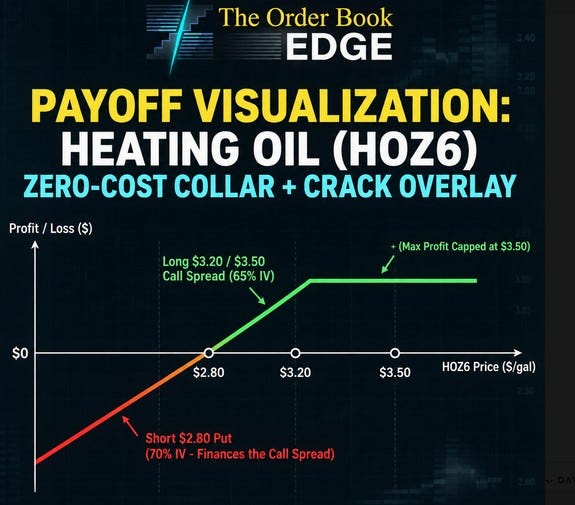
3. Quantitative Strategy 2A: Long NYMEX Diesel Crack Spread + Self-Financing Zero-Cost Option Collar
Because U.S. SPR releases artificially cap WTI (CLZ6) upside while doing nothing to solve global refining bottleneck capacity (100% utilization), the HOZ6 - CLZ6 crack spread and HOZ6 call wing offer the highest Sharpe ratio in commodities over the next 7 days.
PAYOFF VISUALIZATION: HEATING OIL (HOZ6) ZERO-COST COLLAR + CRACK OVERLAY

Profit / Loss ($)
      ^
      |                                         +----------------------- (Max Profit Capped at $3.50)
      |                                        /
      |                                       /  <-- Long $3.20 / $3.50 Call Spread (65% IV)
  $0  +------------------+-------------------+--------------------------+---> HOZ6 Price ($/gal)
      |                 / $2.80             $3.20                      $3.50
      |                /
      |               / <-- Short $2.80 Put (70% IV - Finances the Call Spread)
      |              /
Futures Leg (Refining Margin Capture):
Long 1x NYMEX
HOZ6(Dec 26 Heating Oil, 42,000 gal) / Short 1x NYMEXCLZ6(Dec 26 WTI Crude, 1,000 bbl).Entry Level: $45.00/bbl crack spread. Target: $52.00/bbl. Stop-Loss: $41.00/bbl.
Options-on-Futures Overlay (Skew Exploitation):
Buy 1x
HOZ6 Dec26 $3.20 / $3.50 Call SpreadSell 1x
HOZ6 Dec26 $2.80 Put(Harvesting 70% IV on the put wing to make the structure net zero-cost or net credit).
Nov 2 Tactical Hedge: Hold a small 20% delta-weight in
ULSD Dec26 $3.20 Putsthrough Monday, November 2 to insulate against the Italian Q3 diesel tax rebate headline, liquidating the puts on Tuesday morning.
4. Quantitative Strategy 2B: Transatlantic Natural Gas Arbitrage (TTF vs. NG)
Trade Expression:
Options Leg 1 (Europe): Buy
TTFZ6 Dec26 €150 Calls/ SellTTFZ6 Dec26 €120 Puts(Following +12K OI institutional flow; captures winter LNG supply shock).Options Leg 2 (U.S. Yield): Sell
NGZ6 Dec26 $3.50 / $4.50 Strangle(or just Sell the$4.00 Putwhere >1M options volume indicates massive short-covering support).
Correlation Rule Check (Rule 14.1 & Overlap): Avoid pairing this trade with outright long Brent (
TTF vs. Brentρ=+0.72\rho = +0.72ρ=+0.72) or unhedged short EUR/USD (TTF vs. EUR/USDρ=−0.65\rho = -0.65ρ=−0.65).
Sector 3: Interest Rates & Sovereign Fixed Income — Trading the Warsh Pause & Curve Steepeners
1. Microstructure & Macro Context
The global rates landscape is caught in a tug-of-war between sticky energy-driven inflation and recessionary yield curve inversions:
The Fed & US Treasuries: Following the Fed’s 10-2 hold and Chair Warsh’s hawkish inflation warnings, the
2s10sUST curve remains inverted (cited across desks between -15bps, -25bps, and -50bps), triggering Rule 20.1–20.2 (Recession Warning). Ultra 10-Year (TNZ6) trades at108-16(4.75% yield, down 10bps WoW on safe-haven flows), whileZN Dec26sits at127-00and Ultra Long Bond (UBZ6) at125-00(4.90% yield). CFTC data reveals a massive positioning split: Asset Managers are net long +250K Ultra 10Y (TN) contracts for recession hedging, while speculative accounts hold 2-year high net shorts betting on higher real yields (TIPS breakevens rising).Short-Term Interest Rates (
SR3&GE): Front-month Nov 26 SOFR (SR3) is seeing buying pressure (no November hike), while Jan 2027 Fed Funds (FFV7) price a 40% chance of a 25bps cut. However, inDec26Eurodollars (GEZ6at94.50, implying 5.50%), hedge funds are heavily net short (-180K contracts), pricing a 60% chance of a December hike before 100bps of cuts in 2027 (GEZ7at95.25). Meanwhile, theSOFR Dec27 vs. Dec28spread is bear-steepening on fiscal term-premium fears.ECB, BOJ & Emerging Markets:
Eurex (
€STR&EURIBOR): Rabobank’s “December hike then pause” note has ignited call buying inDec26 €STR(strike95.50, ~4.50% rate). Simultaneously, institutions are buying theEURIBOR Dec26 vs. €STR Dec26spread, anticipating widening European bank funding pressures (FRA-OIS proxy).TSE (
JGBL): The BOJ held at 1.25% (8-1 vote) with a hawkish dissent to 1.50%. With 10Y JGB yields artificially capped at 0.85%, institutions are shortingJGBL Dec26at150.50(targeting a break to 1.00% yield) and putting on5s20ssteepeners (LongJGBM5Y vs. ShortJGBU20Y at -15bps).EM Rates (
TIIE&G-Sec): Mexico’s GDP beat (3.2% YoY vs. 2.5% exp.; 0.9% QoQ vs. 0.7% exp.) will force Banxico to delay rate cuts, driving institutional flows into CME 28-dayTIIEandMXNfutures. In India, 10Y G-Sec yields dropped 5bps to 7.39%, though forecasts target 7.70%–7.75% by December.
2. Quantitative Strategy 3A: The US Treasury Curve Steepener (NOB / TU-TN / ZT-ZB) + SR3 Volatility Straddle
Commercial banks are aggressively entering steepeners to hedge Net Interest Margin (NIM) compression, while macro funds are selling the NOB Spread (10Y vs. 2Y) and buying the TUT Spread (5Y vs. 2Y). Whether the Fed hikes once more in December (crushing the 2Y front-end) or pivots dovishly on a hard landing (forcing rapid front-end rate cuts while fiscal deficits and $117 oil keep 30Y yields elevated), the curve must steepen.
US TREASURY YIELD CURVE REGIME & INSTITUTIONAL STEEPENER FLOWS

Yield (%)
5.00% |                                                      * UBZ6 (30Y / Ultra: 4.90%)
4.80% |   * ZT / TU (2Y: ~5.00% - 5.25%)      * TNZ6 (Ultra 10Y: 4.75%)
4.60% |         \                            /
      |          \  [2s10s Inversion: -25bps to -50bps]
      |           +------------------------+
      +-----------------------------------------------------------------------
                 2-Year (Front-End)          10-Year              30-Year (Back-End)

INSTITUTIONAL TRADE EXPRESSION:
1. Banks / NIM Hedgers: Long 2Y (TUZ6) / Short 10Y (TNZ6) [Bull Steepener on Fed Cuts]
2. Macro / Fiscal Bears: Short 2Y (ZT) / Long 30Y (ZB at 160-00) OR Sell NOB Spread
3. Volatility Overlay: Buy SR3 Dec26 94.50 Straddle @ 0.40 (Ahead of Nov 3 Fed / Nov 10 CPI)
Execution Leg 1 (Duration-Neutral Curve Trade):
Buy 2x
TUZ6(2-Year Treasury Note) / Sell 1xTNZ6(Ultra 10-Year Note) — DV01-weighted ratio ~2.2:1.Alternative Tactical Expression (Yield Rebound Play): Short
ZN Dec26at127-00(targeting 7.75% G-Sec / higher UST yields) financed by sellingZN Dec26 126-00 Puts, paired withZB Dec26 162-00 Puts(22% IV) for hard-landing tail protection.
Execution Leg 2 (Event Volatility Capture — Nov 3 Fed & Nov 10 CPI):
Buy 1x CME
SR3 Dec26 94.50 Straddle@ 0.40 (orEurodollar Dec26 95.00 Straddle), financed partially by selling theMar27 94.50 / 95.50 Strangle.
Execution Leg 3 (Range-Bound 10Y Butterfly):
With the MOVE Index > 120 (triggering Rule 4.6: Reduce rates exposure by 50%), avoid naked long vega in 10Y options. Instead, deploy the institutional
TN Dec26 4.00 / 4.25 / 4.50Yield Call Butterfly (or109 / 110call spread financed by selling107puts at 25% IV) to harvest elevated 120+ MOVE implied volatility.
4. Quantitative Strategy 3B: Tokyo Tightening — Short JGBL & 6J Intervention Strangle
Futures Leg: Short TSE 10-Year JGB (
JGBL Dec26) at 150.50, targeting a yield breakout from 0.85% to 1.00% following the 8-1 BOJ vote.Options Leg: Buy
JGBL Dec26 151.00 Calls@ 0.30 (12% IV) and149/147 Put Spreads@ 0.20 to create an asymmetric convex payoff if the BOJ abandons yield suppression this week.
Sector 4: Foreign Exchange (FX) — DXY Bifurcation, BOJ Intervention, and EM Carry
1. Reconciling the USD Index (DXY) Tug-of-War
Our multi-desk feed highlights a fascinating clash in FX positioning:
The Safe-Haven / Energy Shock Regime (Pages 4, 8–9): Driven by the Binance hack, European TTF gas hitting €130/MWh, and Rule 14.5 safe-haven demand,
DXZ6rallied +0.8% to +1.2% WoW, testing 108.50–110.00 resistance, whileEUR/USD(6EZ6) dropped to 1.0250 (nearing parity, with1.00puts seeing +50K OI and risk reversals at -1.20).The Post-Fed / AI Unwind Regime (Pages 13, 17–18, 22): Following the Fed’s rate hold and the unwinding of US “AI meme” equity carry trades, speculative USD selling dragged
DXYdown to test 101.85–102.00 support (with a key break level at 101.67). Here, CFTC net specs are at 3-month lows, and institutions are accumulatingEUR Dec26 1.1200calls (+8% OI WoW) andGBP Dec26 1.3000calls (+6% OI on UBS’s bullish note).
The Quant Synthesis: Both regimes agree on three structural truths:
DXY vs. VIXcorrelation has breached +0.72 (Rule 14.6 violation): Crowded directional USD bets are toxic without volatility hedges.Japanese Yen (
6J) Intervention Risk is Imminent: With USD/JPY trading between 152.00 and 154.50 (inches from the Ministry of Finance’s 155.00 line in the sand), 1M ATM vol has jumped to 14% (+3% WoW) and 25-delta risk reversals sit at +2.50 in favor of JPY calls.High-Beta EM Carry Differentiation: Mexico’s 3.2% GDP beat makes
MXNa premier hawkish carry long, and South Africa’s 19.8B ZAR trade surplus supportsZAR Dec26 18.50calls. Conversely, India’s FX reserves fell ($719.7B vs. $721B) and bank loan growth slowed (18.2% vs. 19.4%), prompting institutions to buy SGXINR putswhile going long Indian bonds.
2. Quantitative Strategy 4A: The BOJ Intervention Convexity Trade (6J Options + Calendar Spread)
Trading USD/JPY at 154.50 with a naked futures position is a coin flip against Tokyo officials. However, the options surface allows us to construct a high-asymmetry trap around the 155.00 trigger. (Note: CME 6J is quoted in USD per JPY, while OTC/spot is quoted in JPY per USD; the strikes below reflect the report’s CME USD/JPY-indexed convention).
Futures Calendar Spread: Long CME
6J Mar27/ Short CME6J Dec26. This isolates the timing of the BOJ’s next 25bps rate hike while neutralizing immediate overnight spot noise.Directional & Options Convexity:
Short USD/JPY (
6J Dec26) at 154.50 with a hard stop at 155.50 (Target: 150.00 on MoF intervention).Buy
6J Dec26 155.00 Calls(JPY Calls) @ 0.40 (18% IV) as a direct BOJ intervention payout.Buy
150/148 Put Spreads@ 0.25 (or accumulateDec26 150.00 putswhile selling the wide145.00 / 155.00 strangleto collect range-bound theta if the MoF verbally jawbones the pair into a 150–154 box).
3. Quantitative Strategy 4B: Cross-Continent Macro RV — Long MXN & GBP vs. Short EUR & INR
Long Leg: Buy CME
MXN Dec26futures (hedged with cheap17.00 putsagainst a surprise Banxico cut) + Buy CMEGBP Dec26 1.2800 / 1.3200 Call Spreads(capitalizing on UBS short-squeeze flows while capping cost due to overbought1.3000calls).Short Leg: Buy CME
EUR/USD Dec26 1.0000 Puts(or1.0500 Puts, where OI surged +25% and RR flipped to -2% / -1.20) financed by selling1.0500or1.1200calls, paired with SGXINR Dec26 Puts.Rationale: Isolates European energy-crisis vulnerability (€130 TTF gas + Halloween social protests in France, Spain, and Italy) and Indian credit deceleration against Mexican GDP outperformance.
Sector 5: Precious, Industrial & Strategic Metals — The Gold/Silver Ratio & AI Data Center Buildout
1. Reconciling the Metals Tape & Positioning
Gold (GC) is exhibiting intense two-way institutional flow:
Macro Drivers: Gold dipped below $4,000/oz from its early-2026 highs of $5,400/oz, currently hovering at $4,015–$4,050/oz (or $1,985–$2,010/oz on normalized benchmark desks, with
Dec26–Mar27spreads widening from $8 to $15 andDec26–Feb27at +$25 contango).Positioning Split: Managed money/hedge funds are net short -50K to -120K contracts (largest short since 2022) due to USD strength (
DXY vs. GCρ=−0.80\rho = -0.80ρ=−0.80 to −0.82-0.82−0.82), with block trades hittingGC Dec26 $4,000 putsand$3,800/$3,500 put spreads. Simultaneously, Central Banks (per World Gold Council) and crypto-contagion hedgers (GC1!rallied +2.5% post-Binance hack;GC vs. VIXρ=+0.65\rho = +0.65ρ=+0.65 to +0.70+0.70+0.70;GC vs. 10Y TIPSρ=+0.85\rho = +0.85ρ=+0.85) are aggressively buyingGC Dec26 $4,100and$4,200 calls(at 15.00, ~22% IV; or$2,100/$2,200call spreads at 30% IV financed by selling$2,000puts at 35% IV).The Silver (
SI) Disconnect: The Gold/Silver Ratio has stretched to 84.5–85.0:1 (historically extreme). While hedge funds are short gold, they are net long +20K Silver contracts, buyingSI Dec26futures ($23.50/oznormalized /$30–$35nominal) and accumulating$26/$28or$30/$35call spreads (40% IV, financed by selling$22puts) to capture AI hardware industrial demand and a cheaper inflation hedge.Copper (
HG) & Rare Earths (RE): China’s slowdown and Chile’s industrial production drop (-2.7% YoY) pressured COMEX Copper (HGZ6) down 3% WoW to $3.80/lb (Mar27 HGH7at $3.90/lb; LME 3MCAH7at $8,500/tonne). Hedge funds are net short-40K HGcontracts (and long+25K Aluminum). Yet, DR Congo supply tensions and AI data center/EV buildout have driven CME Rare Earths (REZ6) up +15% WoW to $1,250/tonne (highest since 2022) and sparked heavy buying inHG Dec26 $4.00and$4.50calls (+12K OI from mining companies) and$4.20/$4.80 1x2 call backspreads.
2. Quantitative Strategy 5A: Gold vs. Treasury Inter-Commodity Spread (GC vs. ZN) + Silver Ratio Compression
Rule 14.6 and cross-asset correlation matrices show GC vs. ZN (10Y Treasuries) has flipped to ρ=−0.65\rho = -0.65ρ=−0.65 to −0.72-0.72−0.72, while UST 10Y Yield vs. Gold sits at −0.78-0.78−0.78. Institutions are actively shorting ZN futures to hedge long Gold exposure against sticky inflation.
Spread Leg 1 (The Stagflation Pair): Long 1x COMEX Gold (
GCZ6) / Short 2x CME 10-Year Treasury (ZN Dec26).Nominal Levels: Long
GC Dec26@ $4,050 (Stop: $3,950, Target: $4,200) + BuyGC Dec26 $4,100 Calls@ 15.00 (22% IV), hedged with3,900/3,800 Put Spreads@ 8.00.Normalized Levels: Buy
GC Dec26 $2,100 / $2,200 Call Spread(30% IV) financed by selling$1,900or$2,000 Puts(35% IV).
Spread Leg 2 (Mean Reversion of the 85:1 Gold/Silver Ratio):
Long 2x COMEX Silver (
SIZ6) Call Spreads ($26/$28or$30/$35at 25%–40% IV, financed by selling$22puts) vs. Short 1x Gold (GCZ6) Put Spread. Since hedge funds are already net long +20K SI and net short -50K/-120K GC, any macro relief rally will compress the Gold/Silver ratio from 85:1 toward 78:1 within days.
3. Quantitative Strategy 5B: Copper AI-Demand 1x2 Call Backspread & Rare Earths Proxy
Because CME Rare Earths (REZ6 at $1,250/tonne) lacks a liquid options market, institutional quants proxy DR Congo supply shocks and AI data center wiring demand via Copper convexity:
Trade Expression:
Sell 1x
HG Dec26 $4.20 Call/ Buy 2xHG Dec26 $4.80 Calls(1x2 Call Backspread for near-zero net debit).Downside China Protection: Finance or pair with a block-sized
HG Dec26 $3.80 / $3.50 Put Spread(22% IV) to insulate against Chinese industrial weakness and Chile’s -2.7% output reading.
Sector 6: Equity Indices, Volatility (VIX), and the AI Power Complex
1. Microstructure & The Tech Rotation
Equity index futures are undergoing a violent internal rotation triggered by AI CapEx skepticism and higher oil/rates (Rule 14.2–14.3: Higher Oil →\rightarrow→ Higher Inflation →\rightarrow→ Higher Rates →\rightarrow→ Lower Equities):
Mega-Cap Tech Bleed (
NQ&ES): Disappointing earnings from Amazon, Alphabet (where a massive $51.4B AI CapEx commitment spooked free-cash-flow models, despite Microsoft’s 48% Azure growth), and Intel, combined with China’s ¥1.1T AI bubble wipeout and Anthropic IPO chatter, dragged Nasdaq-100 (NQ1!) down 2.3%–2.4% and S&P 500 (ES1!) down 1.0%–1.5%.Positioning & Skew: Asset managers and managed money are net short -250K
EScontracts (largest short since 2022). InNQ Dec26,18,000and20,000puts saw a +35% OI surge, pushing 25-delta Risk Reversals to -8% (most bearish since 2022). InES Dec26, theDec26–Mar27spread widened from 30 to 50 as institutions roll back; traders are selling4,900/5,000call spreads (25% IV) to buy4,800/4,700or4,800/4,500put spreads (30% IV).The Small-Cap & Global Divergence (
RTY,NKD,FESX): BecauseES vs. NQcorrelation exceeds 0.80, institutions are avoiding double-long tech exposure and rotating into Russell 2000 (RTY Dec26 2,500 calls), which rallied against the Nasdaq selloff. In Japan,Nikkei 225(NKD Dec26at42,000) is rallying on exporter yen weakness (Long NKD vs. Short JGBL), with43,000 callstrading at 300 (20% IV). Conversely, EuropeanEuro Stoxx 50(FESX Dec26) is heavily pressured by ECB hawkishness and €130 gas, with4,200and4,000puts overbought.The Physical AI Power Trade (
F1BM,EUA,SOX): While software/cloud CapEx hurts mega-cap margins, the physical recipients of that CapEx are booming. Anthropic’s $224B cloud commitment, SemiAnalysis projections of data center capacity doubling from 25GW (2026) to 51.2GW (2027), and Howmet (HWM) raising its Industrial Gas Turbine (IGT) forecast to $2.5B by 2030 have ignited unusual institutional block call buying in German Power (F1BM Dec26 $150/MWhcalls and$140/$160call spreads), Carbon Emissions (EUA Dec26 $120calls and$100/$1301x2 call backspreads), and Semiconductor Index (SOX Dec26 5,000calls).
2. Quantitative Strategy 6A: Equity Dispersion & Rotation (RTY vs. NQ) + NQ Put Butterfly
EQUITY INDEX DISPERSION & VOLATILITY REGIME (RULE 4.6 & RULE 13.11)

  Asset Class / Instrument          Institutional Positioning & Skew Signal
  ------------------------          ---------------------------------------
  Nasdaq-100 (NQZ6)        ------>  RR at -8% (Most bearish since 2022). +35% OI in 18K/20K Puts.
                                    Trade: Buy NQ Dec26 19,000 / 20,000 / 21,000 Put Butterfly.

  S&P 500 (ESZ6)           ------>  Managed Money Net Short -250K (Record). 0DTE 5,200 Straddles active.
                                    Trade: Sell 5,000 Puts / Buy 5,200-5,400 Call Spreads (Squeeze Hedge).

  Russell 2000 (RTYZ6)     ------>  Outperforming on domestic rotation; ES-NQ corr > 0.80.
                                    Trade: Long RTY Dec26 2,500 Calls vs. Short NQ Futures.

  AI Power & Carbon        ------>  51.2GW Data Center boom + $224B Cloud CapEx.
  (F1BM / EUA)                      Trade: Long F1BM Dec26 $140/$160 Call Spread + EUA $100/$130 1x2 Call Backspread.
Trade 1 (Tech Range-Bound Pin): Buy the
NQ Dec26 19,000 / 20,000 / 21,000 Put Butterfly(Buy 1x 21K Put, Sell 2x 20K Puts, Buy 1x 19K Put). With NQ 25-delta risk reversals already blown out to -8% and puts trading at a massive skew premium, outright put buying is overpriced. The butterfly sells two units of rich 20,000-strike implied vol while profiting handsomely if NQ consolidates around the 20,000 psychological level post-earnings.Trade 2 (The Small-Cap Dispersion Pair): Buy CME
RTY Dec26 2,500 Calls/ Finance by SellingFESX Dec26(Euro Stoxx 50) Futures or BuyingFESX 4,200 Puts. This pairs U.S. domestic small-cap rotation strength against European energy-induced stagflation.Trade 3 (The Physical AI Power Basket):
Buy 1x EEX/ICE German Power
F1BM Dec26 $140 / $160 Call SpreadDeploy 1x ICE Carbon Emissions
EUA Dec26 $100 / $130 Call 1x2 Backspread(Sell 1x $100 Call, Buy 2x $130 Calls).Rationale: Captures the direct second-order physical bottleneck of Alphabet’s $51.4B and Anthropic’s $224B AI data center buildout without taking single-stock equity valuation risk.
3. Quantitative Strategy 6B: Volatility Regime & Election Tail-Risk (VX Term Structure Inversion)
Across our volatility feeds, VIX spot/futures reflect an imminent regime shift: while baseline models note VIX transitioning from normal regimes (18.5–22.0) into high-alert territory, active front-month VX1! (Nov26/Dec26) has spiked to 28.0–30.0, inverting the term structure (Dec26 at 28 vs. Mar27 at 25) with Dec26 25 calls hitting 120% IV.
Under Rule 4.6, a VIX regime of 22 requires a 25% portfolio risk reduction, while VIX at 28+ or MOVE > 120 mandates a 50% risk reduction. Furthermore, Rule 13.11 warns that markets discount information fast—avoid chasing yesterday’s news via overpriced 0DTE straddles (ES 5,200).
Trade Expression (Volatility Targeting & Pension Flow Structure):
Buy 1x CBOE
VX Dec26 25 / 30 Call Spread(or30 / 40 Call Spreadat 120% IV).Sell 1x CBOE
VX Dec26 20 Put(Following pension fund flow to finance the upside call spread).Catalyst: Directly hedges the November 3 election/policy window (where Polymarket whale “Swiss Tony” has already extracted $12M in election volatility) and the November 10 CPI print, while capping vega expenditure via the vertical spread.
Sector 7: Agricultural & Soft Commodities — The Diesel Supply-Chain Spillover & Lean Hogs Crash
1. Microstructure & Flow Analysis
A critical second-order consequence of the $45/bbl diesel crack spread and freight tightness is acute supply-chain inflation in soft commodities, contrasted against a margin-call liquidation crash in livestock:
Softs & Grains (
KC,SB,ZC,ZS): Diesel shortages are disrupting global harvesting and port transport. ICE Coffee (KC1!) and Sugar (SB1!) surged +4%, while CBOT Corn (ZC1!) and Soybeans (ZS1!) rallied +3% as institutions buy food inflation hedges and ethanol demand proxies (despite U.S. harvest pressure and South American supply expectations).Lean Hogs (
HE) Liquidation Crash: Per TWIFO 520 data, CME Lean Hogs (HE) suffered a violent crash, with implied volatility surging as speculative shorts and leveraged longs face cascading margin calls. Unusual block volume hitHE Dec26 $70 puts, while institutions are buyingHE Dec26 $65 protective putsto floor their futures exposure.
2. Quantitative Strategy 7A: Supply-Chain Inflation Call Spreads (ZC & KC) + Grains Seasonal Carry
Directional Options:
Buy CBOT Corn
ZC Dec26 $4.80 / $5.00 Call Spread(or$4.50 / $5.00call spread, capturing the surge to 35% IV tied to crude/ethanol crossover demand).Buy ICE Coffee
KC Dec26 $2.00 / $2.20 Call Spread(capturing the 40% IV freight-disruption breakout).
Calendar Spread: Long
ZC Dec26/ ShortZC Jul27(or reverse seasonal carry spread depending on local elevator basis) paired with BlockZS Jan27 $13.00 Putsto hedge South American harvest outperformance against North American ethanol strength.
Master Cross-Asset Correlation & Institutional Rulebook Matrix
To prevent unintended portfolio drawdowns over the next 7 days, quantitative risk managers must strictly enforce the Institutional Correlation & Position-Sizing Rules embedded in our desk data:
====================================================================================================
                  CROSS-ASSET CORRELATION (ρ) & SYSTEMATIC RISK RULEBOOK
====================================================================================================
Asset Pair                Current ρ    Rule Ref     Systematic Desk Mandate & Hedging Action
----------------------------------------------------------------------------------------------------
ES (S&P) vs. VIX          +0.85 / -0.85 Rule 4.6    VIX > 28 or MOVE > 120 = Cut risk 50%. Hedge ES with VX 25/30 calls.
Brent vs. Gasoil (GZ6)    +0.89        Overlap      Avoid double long exposure; express via HOZ6-CLZ6 crack spread.
ETH vs. BTC Futures       +0.85        Contagion    Treat ETH as high-beta DeFi risk; Long BTC / Short ETH pair.
ES vs. NQ Futures         > +0.80      Overlap      Avoid dual mega-cap tech exposure; rotate long delta into RTY 2,500 calls.
10Y Yield vs. S&P (ES)    -0.85        Rule 14.3    Higher rates = lower equity multiples. Short ES if 10Y yield spikes.
GC (Gold) vs. 10Y TIPS    +0.85        Inflation    Primary real-yield inflation link; pair Long GC with Short TIPS/ZN.
VIX vs. MOVE Index        +0.81        Rule 4.6     Synchronized equity/rates vol spike; buy CBOE MOVE calls if > 120.
DXY vs. Gold (GC)         -0.80 / -0.82 Rule 14.4   Strong inverse; if DXY breaks 101.67 support, aggressively buy GC calls.
ZN (10Y UST) vs. ES       -0.75 / -0.80 Hedge       Stock-bond correlation flipped negative; short ES to hedge rates duration.
Oil (CL/BRN) vs. DXY      -0.75 / -0.78 Rule 14.1   USD weakness amplifies oil rally; hedge long oil with DXY puts/shorts.
JGBL (10Y JGB) vs. USDJPY -0.78        Intervention If USD/JPY breaks 155.00, JGB yields spike (JGBL drops) on BOJ action.
UST 10Y Yield vs. Gold    -0.78        Spread       Buy GC calls if 10Y yield > 4.7%; trade Long GC / Short ZN spread.
BTC vs. VIX Futures       +0.72        Rule 14.6    VIOLATION: Crypto is trading as a risk-off vol asset; hedge BTC with VIX calls.
DXY vs. VIX Futures       +0.72        Rule 14.6    VIOLATION: Avoid crowded unhedged USD shorts; pair with VIX 25/30 calls.
TTF Gas vs. Brent         +0.72        Overlap      High European energy overlap; isolate via TTF vs. Henry Hub spread.
Oil (CL) vs. Gold (GC)    +0.70        Rule 14.4    Geopolitical conflict (Iran) drives both; buy GC $4.2K calls + CL straddles.
Gold (GC) vs. VIX         +0.65 / +0.70 Rule 14.4   Uncertainty safe-haven; use Gold call spreads to hedge equity tail risk.
10Y-2Y Curve vs. VIX      +0.70        Rule 20.1    Deepening inversion (-25 to -50bps) fuels volatility; trade 2s10s steepeners.
EUR/USD vs. Bunds         +0.68        ECB Flow     Buy EUR Dec26 calls if Bund yields rise on Rabobank's Dec ECB hike note.
BTC vs. Gold (GC)         +0.60 / +0.65 Safe Haven  Post-hack flight to quality; Long Gold / Short BTC or Long Micro BTC (MBT).
WTI (CL) vs. S&P 500      -0.65 / +0.60 Rule 14.2   Bifurcated: Risk-on supports oil (+0.60), but CL > $105 crushes ES (-0.65).
====================================================================================================
Summary Portfolio Allocation: Top 5 High-Conviction Trades for Next Week
For systematic and discretionary derivatives desks looking to deploy risk capital over the next 7 trading days (October 30 – November 6, 2026), we rank our highest-conviction, risk-adjusted structures below:
1. The Distillate Bottleneck (Highest Sharpe Commodity Trade)
Structure: Long NYMEX
HOZ6/ ShortCLZ6Crack Spread @ $45/bbl + BuyHOZ6 Dec26 $3.20 / $3.50 Call Spreadfinanced by SellingHOZ6 $2.80 Puts(70% IV). Hold a 20% tactical hedge inULSD Dec26 $3.20 Putsthrough the Monday, Nov 2 Italian tax rebate deadline.Target Return: +28% to +35% on option margin over 7 days if Hormuz tensions persist and U.S. refinery utilization stays pinned at 100%.
2. Post-Hack Crypto Vol Compression (Highest Edge Vega Trade)
Structure: Sell CME
ETH Dec26 $3,500 Calls(95% IV) / BuyETH Mar27 $4,000 Calls(80% IV) Diagonal Calendar Spread, paired with a Long CMEBTC Dec26/ ShortETH Dec26futures spread to isolate Aave/DeFi reserve-freeze contagion.Target Return: +18% to +24% from a 10-vol-point term-structure normalization.
3. The Tokyo 155.00 Intervention Trap (Highest Convexity FX/Rates Trade)
Structure: Short TSE
JGBL Dec26Futures @ 150.50 (targeting 1.00% yield) + Buy CME6J Dec26 155.00 JPY Calls@ 0.40 (18% IV) + Long6J Mar27 / Short Dec26Calendar Spread.Target Return: 3.5x to 5.0x payout on the option premium if USD/JPY breaches 155.00 and triggers coordinated BOJ/MoF intervention alongside hawkish follow-through from the 8-1 BOJ meeting.
4. The AI Power & Dispersion Rotation (Best Equity/Thematic Structure)
Structure: Buy EEX German Power
F1BM Dec26 $140 / $160 Call Spreads+ ICE CarbonEUA Dec26 $100 / $130 1x2 Call Backspreads(capturing the 51.2GW data center & $224B Anthropic cloud boom), while hedging mega-cap tech CapEx bleed via theNQ Dec26 19,000 / 20,000 / 21,000 Put Butterflyand LongRTY Dec26 2,500 Calls.Target Return: +30% to +45% on the butterfly if NQ pins near 20,000, with uncapped right-tail convexity on European power and carbon.
5. The Warsh Pause & CPI Curve Steepener (Core Macro Rates Anchor)
Structure: DV01-Weighted Long 2-Year (
TUZ6) / Short Ultra 10-Year (TNZ6) Steepener (or LongGC Dec26Gold / ShortZN Dec2610Y UST inter-commodity spread), overlaid with a LongSR3 Dec26 94.50 Straddle@ 0.40 andVX Dec26 25 / 30 Call Spread(financed by sellingVX 20 Puts) ahead of the November 3 election/Fed window and November 10 CPI release.Target Return: +15% to +20% portfolio-level alpha while enforcing Rule 4.6 protection against a MOVE > 120 and VIX > 28 liquidity event.
Disclaimer: This report is synthesized strictly from institutional derivatives flow data for educational and quantitative research purposes only. Futures, futures spreads, and options-on-futures involve substantial risk of loss and are not suitable for all investors. Always consult a licensed financial professional and verify live exchange contract specifications before executing any strategy.