

If you trade futures on Interactive Brokers (IBKR), there is a high probability that your software is lying to you.
Not out of malice, but by design.
For multi-asset retail investors—those rebalancing an ETF portfolio on Monday, selling covered calls on Wednesday, and hedging currency exposure on Friday—Interactive Brokers is arguably the finest brokerage platform ever built. It offers unmatched global reach, rock-bottom foreign exchange fees, and institutional-grade portfolio margin.
However, when you pivot to active futures trading—scalping the E-mini S&P 500 (ES), deploying market-making bots in the Nasdaq (NQ), or reading the microstructure of the Treasury yield curve via the Depth of Market (DOM)—Interactive Brokers transforms from an asset into a severe architectural bottleneck.
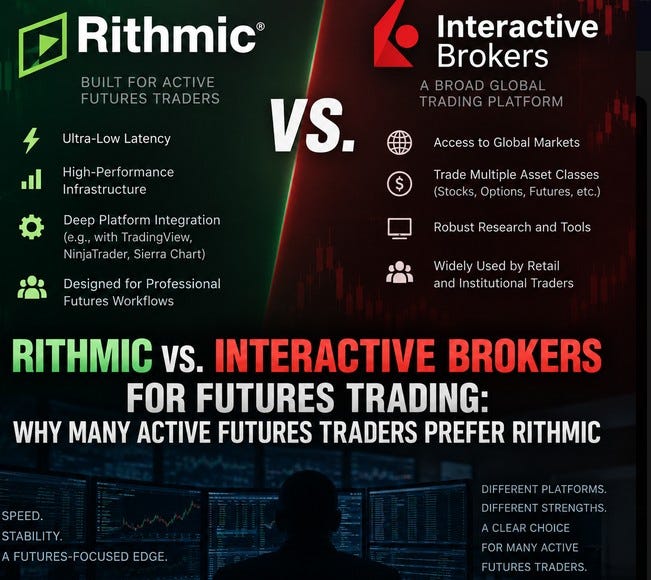
Active futures traders, systematic algorithmic funds, and order flow purists almost invariably end up migrating to a specialized setup: an Introducing Broker (IB) powered by Rithmic.
This article explores the architectural, execution-based, and financial reasons for making that transition. We will examine the microstructure of market data conflation, identify the top introducing brokers supporting Rithmic, break down the exact costs of market data and APIs, and evaluate how quantitative traders can deploy automated strategies in Python without choking their execution pipe.
1. The Microstructure Divide: Aggregated Snapshots vs. Raw Tick Streams
The most fundamental divergence between Interactive Brokers and Rithmic lies in how market data moves from the exchange matching engine to your screen or algorithm.
[ CME Matching Engine (Aurora, IL) ]
                 |
      +----------+----------+
      |                     |
      v                     v
[ Rithmic Pipe ]      [ IBKR Pipe ]
  (Raw Ticks)           (Conflated Snapshots)
  - Nanosecond ts       - 200–250ms samples
  - Unfiltered          - Skipped volumes
  - CME Aurora co-lo    - Paced packets
      |                     |
      v                     v
[ True Order Flow ]   [ Distorted Tape ]
The Interactive Brokers Reality: Conflated Snapshots
Interactive Brokers routes its futures market data through its unified market data server network. To conserve global server bandwidth across hundreds of thousands of concurrent users, IBKR aggregates and throttles data.
By default, IBKR delivers updates in snapshots paced at roughly 200 to 250 milliseconds (ms). While they offer a “tick-by-tick” streaming API feed for select instruments, it is subject to strict throttling ceilings, historical pacing violations, and network overhead.
Consider what transpires during a high-volatility event, such as an FOMC rate decision or a Non-Farm Payrolls (NFP) release:
In a 250ms window on the E-mini S&P 500 or Micro Nasdaq (MNQ), several thousand individual orders, cancellations, and executions hit the Central Limit Order Book (CLOB).
IBKR’s feed packages this frenzy into a single snapshot update.
You do not see the sequential micro-bursts of aggressive buying sweeping the ask; you see an aggregate jump in price.
If your strategy relies on Cumulative Volume Delta (CVD), Volume-Weighted Average Price (VWAP), Footprint Charts, or Time & Sales, IBKR’s conflation ruins your edge. If 1,500 contracts are bought on the ask and 1,200 are sold on the bid within 200ms, a conflated feed might register only the net change or the closing price state of that window. Your delta engine is essentially operating on guesswork.
The Rithmic Reality: Raw, Unfiltered Tick-by-Tick Feed
Rithmic was architected from inception for ultra-low latency futures execution. It connects directly to the CME Group matching engines at the CyrusOne data center in Aurora, Illinois, as well as Eurex in Frankfurt and ICE in Atlanta.
Every single transaction (an aggressive market order lifting an offer or hitting a bid) is pushed to the client immediately.
Rithmic exposes the exchange’s nanosecond-precision matching engine timestamps rather than a local client receipt timestamp.
Market depth (Level 2) reflects actual order additions, modifications, and cancellations in real-time.
When you look at a DOM or an order-flow footprint chart powered by Rithmic, you observe the true mechanical heartbeat of the exchange. For automated strategies, this enables precise calculations of:
Queue position dynamics
Microstructure sweep detection
Institutional icebergs and passive order absorption
2. Execution Latency and Server-Side Risk Management
Data integrity is only half the battle; the other half is execution routing and trade management.
CLIENT-SIDE EXECUTION (Interactive Brokers TWS):
[ Trader's PC ] ---(Trigger Stop)---> [ Public Internet ] ---> [ IBKR Gateway ] ---> [ CME Engine ]
* Risk: If your internet drops or latency spikes, your stop never fires.

SERVER-SIDE EXECUTION (Rithmic Engine):
[ Trader's PC ] ---(Define OCO Bracket)---> [ Rithmic Engine (Aurora Data Center) ]
                                                            |
                                               (Sub-millisecond local loop)
                                                            v
                                                   [ CME Matching Engine ]
* Protection: Stops live on the co-located server. Zero local latency.
Server-Side Brackets (OCOs)
In active futures trading, an unmanaged open position can wipe out a week of profits in seconds. Most traders employ bracket orders: a profit target and a protective stop (One-Cancels-the-Other / OCO).
On Interactive Brokers: Depending on your setup (TWS vs. API), trailing stops and certain synthetic bracket logic frequently execute client-side or at an intermediary gateway layer. If your local machine freezes, your domestic ISP stutters, or your local Python script encounters an unhandled exception, your stop order may fail to route to the exchange.
On Rithmic: Bracket logic and risk constraints are executed by the R | Trade Execution Engine, which sits inside the CME’s data center in Aurora. Once you send an order with an associated bracket, the entry order, stop-loss, and take-profit instructions are held server-side.
If your laptop shuts down, your cat unplugs your Ethernet cable, or your local VPS crashes, your stop-loss remains active on Rithmic’s co-located infrastructure, ready to cross the spread and protect your capital the microsecond your parameter is breached.
Latency Profiles
Interactive Brokers routes orders through its central clearing and compliance engine before passing them to the CME. For multi-asset risk checks, margin cross-collateralization, and account-wide compliance, this internal trip often adds 15 to 50+ milliseconds of transit time.
Rithmic’s proprietary routing protocol bypasses generic retail layers. When deployed from a co-located cross-connected server in Aurora, Illinois, Rithmic execution round-trips can drop into the sub-millisecond or low-single-digit millisecond range. For intraday traders fighting for queue priority on a crowded passive price tier, that difference dictates whether you get filled or left behind.
3. The Unbundled Futures Ecosystem: Introducing Brokers (IBs)
To trade through Rithmic, you do not open an account with “Rithmic the Broker.” Rithmic is a pure financial technology and infrastructure firm. Instead, you enter the professional futures ecosystem, which is traditionally unbundled:
+-------------------------------------------------------------+
|                     TRADER / ALGO                           |
+-------------------------------------------------------------+
                               |
                               v
+-------------------------------------------------------------+
|              INTRODUCING BROKER (IB)                        |
|   (Customer Support, Custom Rates, Platform Provisioning)   |
|   Examples: Edge Clear, Optimus, AMP, Stage 5               |
+-------------------------------------------------------------+
          |                                        |
          v                                        v
+------------------------+      +-----------------------------+
|  TECH INFRASTRUCTURE   |      |  FUTURES COMMISSION         |
|  (Rithmic Data & API)  |      |  MERCHANT (FCM / Clearing)  |
|  - Raw CME Market Data |      |  - Segregated Funds         |
|  - R | API+ Engine     |      |  - Margin Enforcement       |
+------------------------+      |  Examples: Dorman, Phillip, |
          |                     |            StoneX, Ironbeam |
          |                     +-----------------------------+
          \                                   /
           \                                 /
            v                               v
       +-----------------------------------------+
       |           CME / EUREX / ICE             |
       +-----------------------------------------+
The Technology Provider (Rithmic): Handles the data feeds, execution gateways, and API layers.
The Futures Commission Merchant (FCM): Holds your segregated funds, processes clearing, handles end-of-day settlement, and interfaces with the exchange clearinghouse (e.g., Dorman Trading, Phillip Capital, StoneX, Ironbeam).
The Introducing Broker (IB): Your primary point of contact for customer service, technical support, customized commission schedules, and risk parameter management.
Unlike IBKR’s monolithic model—where Interactive Brokers is simultaneously the broker, the clearer, the software vendor, and the customer service department—the unbundled model allows you to tailor your trading infrastructure.
Premier Introducing Brokers Supporting Rithmic
1. Edge Clear
Target Audience: Professional discretionary order flow traders, proprietary teams, and systematic traders.
Why They Stand Out: Founded by veteran futures traders, Edge Clear provides personalized support. They understand market microstructure, do not panic when you ask for specific routing flags, and provide their own proprietary front-end (EdgeProX) built natively on Rithmic technology.
Clearing Partners: Phillip Capital, Dorman Trading, StoneX, Ironbeam.
2. Optimus Futures
Target Audience: Retail-to-institutional systematic and quantitative traders.
Why They Stand Out: Led by industry veteran Matt Zimberg, Optimus is renowned for transparency, low-latency consulting, and deep API support. If you are developing custom Python scripts against Rithmic, their technical desk understands connection configurations and can help troubleshoot connection drops or FCM-side margin overrides.
Clearing Partners: Ironbeam, StoneX, Phillip Capital.
3. AMP Futures
Target Audience: Self-directed, cost-sensitive algorithmic traders.
Why They Stand Out: AMP is a high-volume, discount provider offering automated online onboarding and low intraday margins. If you do not need hand-holding and simply want low commissions paired with a Rithmic data credentials feed, AMP is a popular entry point.
Clearing Partners: Self-clearing / multiple clearing channels.
4. Stage 5 Trading Corp
Target Audience: Professional traders focused on structured risk management and psychological drawdown protection.
Why They Stand Out: Stage 5 focuses heavily on customized broker-assisted risk parameters. Their trade desk can set hard mechanical trailing drawdowns, maximum intraday contract sizes, and programmatic kill-switches directly at the gateway layer.
Clearing Partners: Dorman Trading, Phillip Capital.
5. Cannon Trading & Ironbeam
Target Audience: Diversified futures traders seeking custom algorithmic support or institutional clearing.
Why They Stand Out: Cannon Trading has been operating for decades with deep knowledge of routing solutions. Ironbeam operates as both a direct clearing firm (FCM) and a technology-focused broker, providing seamless Rithmic access.
4. Market Data Architecture and Pricing Comparison
A common misconception is that professional infrastructure like Rithmic is orders of magnitude more expensive than retail alternatives. While IBKR appears cheaper on the surface, a direct comparison reveals that specialized futures infrastructure remains cost-effective for active accounts.
CME Market Data Pricing (Non-Professional vs. Professional)
Exchange fees are set by the CME Group, but how the broker packages and passes those fees to you varies.
Data Type Interactive Brokers (IBKR) Rithmic (via FCM / IB) Microstructure Capability CME Level 1 (Top of Book) ~$1.50 – $3.00 / month ~$1.50 – $3.00 / month per exchange Basic price display, single bid/ask. Unusable for order flow. CME Level 2 (Full Depth of Market) ~$11.00 – $15.00 / month ~$15.00 – $16.50 / month per exchange (or ~$40–$55 bundle for CME, CBOT, NYMEX, COMEX) Complete order book depth (up to 10–20 levels). Footprint, CVD, and book analysis. Data Nature Conflated / Sampled (200–250ms) Raw, Unfiltered, Nanosecond Stream Essential for automated/algo execution. Professional Market Data Fees ~$130.00 – $145.00 / month per exchange Standard CME Pro Rate (~$135.00 – $145.00 / mo per exchange) Required if registered with regulatory bodies or trading firm capital.
Note: CME regulatory pricing adjusts periodically; verify current monthly figures with your clearing FCM.
Platform and Routing Fees
Here is where the pricing models diverge:
Interactive Brokers:
No monthly platform fee for TWS or IB Gateway.
No routing fee added on top of standard commissions (they monetize via execution spreads, internal order internalization, smart-routing spreads, and financing rates).
Rithmic:
R | Trader Pro Fee: Typically $20.00 to $25.00 per month (often waived or reduced by select IBs if commission targets are met).
Rithmic Routing / Transaction Fee: Typically $0.10 to $0.25 per contract (side).
Example: If you trade 1 contract of the E-mini S&P (ES) round-turn, Rithmic assesses a technology fee of roughly $0.20 to $0.50 for that complete round-turn trade.
The All-In Cost Reality
Let’s look at a standard round-turn transaction on a Micro E-mini (MES) or standard E-mini (ES):
ESTIMATED ALL-IN ROUND-TURN COST (ES Contract):

Interactive Brokers (Tiered):
  Exchange Fees:     ~$2.70
  Regulatory / NFA:  ~$0.04
  IBKR Commission:   ~$0.50 - $0.94 (per side)
  -----------------------------------------------
  TOTAL ALL-IN:      ~$3.94 - $4.82 per round turn

Rithmic via Discount FCM (e.g., AMP / Edge Clear / Optimus):
  Exchange Fees:     ~$2.70
  Regulatory / NFA:  ~$0.04
  FCM Clearing/IB:   ~$0.50 - $1.00 (round turn)
  Rithmic Tech Fee:  ~$0.20 - $0.50 (round turn)
  -----------------------------------------------
  TOTAL ALL-IN:      ~$3.44 - $4.24 per round turn
The Takeaway: Trading futures via Rithmic through an aggressive Introducing Broker is often cheaper or on par with Interactive Brokers on a per-contract basis, while providing higher-fidelity data and faster execution.
5. Python Development: TWS API vs. Rithmic’s R | API+ and Protobuf
For systematic and algorithmic traders, the choice of broker comes down to API stability, throughput limits, and ease of development.
INTERACTIVE BROKERS API ARCHITECTURE:
[ Python Strategy ] <--- TCP Socket ---> [ TWS or IB Gateway GUI ] <--- Proprietary Protocol ---> [ IBKR Servers ]
* Prone to daily 24h client restarts, connection timeouts, and strict pacing ceilings.

RITHMIC API ARCHITECTURE:
[ Python Strategy (Asyncio) ] <--- WebSockets / Protobuf ---> [ Rithmic Edge Server (Aurora) ]
* Pure headless network connection, direct binary streaming, no middle GUI required.
The Interactive Brokers Python Paradigm (ibapi / ib_insync)
IBKR provides an official Python package (ibapi), and the open-source community created ib_insync (and its modern continuation ib_async).
While accessible, deploying a systematic strategy on IBKR comes with structural hurdles:
The Desktop Gateway Bottleneck: You cannot connect directly to IBKR’s servers via a standalone Python script over raw sockets without running Trader Workstation (TWS) or the headless IB Gateway client software locally.
The Daily Restart Nightmare: IB Gateway and TWS are designed to disconnect and shut down once every 24 hours for server maintenance. Algorithmic engineers must build custom cron jobs, Docker automation containers, and auto-login GUI scripts (such as IBC) simply to keep their trading system alive through the week.
Pacing Violations: Requesting historical tick data or firing rapid execution bursts triggers immediate pacing violations (error code
162), causing your data streams to freeze.
The Rithmic Python Paradigm: Direct, High-Throughput Quantitative Execution
Rithmic has transformed its access models. Traditionally, Rithmic required deep C++ or .NET integration through R | API+. Today, quantitative developers have several distinct avenues for building systems in Python.
Option A: Rithmic Protocol Buffers (Protobuf) via WebSockets
Rithmic provides a high-speed, direct WebSocket API powered by Google Protocol Buffers (Protobuf).
This interface avoids the need to run local GUI software:
Your Python script establishes a secure direct WebSocket connection (
wss://) to Rithmic’s infrastructure.Market depth, account balances, and execution signals are serialized/deserialized efficiently using compiled
.protodefinitions.You can deploy a fully headless, containerized Python trading bot in an AWS, GCP, or Equinix colocation environment that stays connected indefinitely without arbitrary GUI software restarts.
Option B: C++ Shared Object Wrappers (pybind11 / ctypes)
For teams requiring microsecond latency, Rithmic’s R | API+ (C++ SDK) remains the benchmark:
Quantitative developers write high-performance C++ execution cores and expose endpoints to a Python runtime environment using
pybind11orCython.This setup provides access to nanosecond exchange timestamps, queue position markers, and hardware-accelerated memory-mapped calculations.
Option C: Native Rithmic Python SDKs and Open-Source Frameworks
Libraries such as pyrithmic and custom asynchronous (asyncio) community wrappers provide ready-made wrappers around Rithmic’s Protobuf gateway.
Handling Market Data Volume in Python
During market opens or major economic data releases, the CME can broadcast over 40,000 to 80,000 market depth events per second on high-volume products like the E-mini S&P 500 or 10-Year Treasury Notes.
In Interactive Brokers: The client application does not experience this load because IBKR throttles the feed. Your Python script remains responsive, but it is working with delayed, sampled data.
In Rithmic: The full firehose of tick data reaches your endpoint. A naive, single-threaded Python script relying on standard loops can quickly encounter Global Interpreter Lock (GIL) stalls and queue memory bloat.
To harness Rithmic’s feed in Python, engineers typically decouple the system architecture:
# Conceptual Architecture for a High-Throughput Rithmic Python Engine
import asyncio
import websockets
# Protobuf definitions generated via protoc
import rithmic_pb2

async def market_data_consumer(queue):
    """Listens directly to the Rithmic Protobuf WebSocket engine."""
    uri = "wss://rituz0100.rithmic.com:443"
    async with websockets.connect(uri) as ws:
        # Authentication and Subscription logic here...
        while True:
            raw_msg = await ws.recv()
            # Fast binary parse using compiled protobuf
            parsed_data = rithmic_pb2.ResponseMarketDataUpdate()
            parsed_data.ParseFromString(raw_msg)

            # Non-blocking handoff to strategy execution queue
            queue.put_nowait(parsed_data)

async def strategy_engine(queue):
    """Processes ticks and triggers execution logic independently."""
    while True:
        tick = await queue.get()
        # High-performance order flow / CVD / Queue positioning checks
        # Avoid blocking I/O calls here
        queue.task_done()

async def main():
    tick_queue = asyncio.Queue(maxsize=100000)
    await asyncio.gather(
        market_data_consumer(tick_queue),
        strategy_engine(tick_queue)
    )

if __name__ == "__main__":
    asyncio.run(main())
By decoupling raw data ingestion from signal generation, Python developers can harness institutional-grade feeds without risking socket-level buffer overruns.
6. The Intraday Margin Contrast
Another major distinction between retail brokers like IBKR and Rithmic-supported FCMs is margin treatment.
Federal regulations allow futures exchanges to set baseline “overnight maintenance margins” (SPAN margin). However, exchanges grant individual brokers the authority to determine their own intraday margin requirements for clients who close positions before the daily cash session close.
Contract IBKR Intraday Margin (Approx.) Typical FCM via Rithmic (AMP/Optimus/Edge Clear) Overnight SPAN Margin (Exchange Level) E-mini S&P 500 (ES) ~$6,000 – $12,000+ $400 – $500 ~$12,000+ Micro E-mini S&P (MES) ~$600 – $1,200+ $40 – $50 ~$1,200+ E-mini Nasdaq (NQ) ~$9,000 – $18,000+ $500 – $1,000 ~$18,000+ Micro E-mini Nasdaq (MNQ) ~$900 – $1,800+ $50 – $100 ~$1,800+
Why This Matters for Quantitative Portfolio Deployment
Interactive Brokers enforces conservative intraday margin rules—often set at 50% to 100% of the full exchange overnight requirement. If an unexpected volatility spike occurs, IBKR’s automated liquidation algorithm may abruptly liquidate positions across your portfolio without a margin call.
For an algorithmic trader running diversified strategies across multiple micro-contracts, IBKR requires significant operational capital. Conversely, Rithmic-supported FCMs permit intraday margins as low as $50 per micro-contract and $500 per mini-contract.
A Note on Risk Management: Extreme leverage is a double-edged sword. While $500 intraday ES margins allow for flexible capital allocation, trading full-size contracts without tight, server-side stop management can wipe out an account quickly. Professional introducing brokers expect clients to maintain adequate capital reserves regardless of minimum requirements.
7. The Architectural Tradeoffs: Where Interactive Brokers Still Wins
A balanced analysis requires acknowledging where Interactive Brokers holds an advantage. Transitioning exclusively to Rithmic is not ideal for every operating model.
THE DECISION MATRIX:

               TRADING OBJECTIVE
                       |
       +---------------+---------------+
       |                               |
       v                               v
[ Multi-Asset & Hedging ]      [ Active Futures Focus ]
- Stocks, Options, FX, Bonds   - Scalping / Order Flow
- Cross-asset margin           - Algorithmic execution
- Long-term trend-following    - Microstructure analytics
- Set-and-forget logic         - Server-side OCO brackets
       |                               |
       v                               v
[ Interactive Brokers ]         [ Rithmic + FCM ]
1. Cross-Asset Portfolios and Collateralization
If you run a multi-asset hedge fund or personal portfolio that holds long equities, writes equity index options, trades spot currency pairs, and hedges with Treasury futures, Interactive Brokers is unmatched. At IBKR, your global assets sit in a unified portfolio margin pool. You can use your long stock portfolio to collateralize short futures positions automatically.
With Rithmic, your funds sit in a dedicated, segregated futures account at an FCM. You cannot trade cash equities or multi-leg equity options through Rithmic.
2. Multi-Currency Global Banking Rails
IBKR functions much like an international bank. You can deposit Euros, convert them to Japanese Yen at spot interbank rates with zero markup, and use those funds to trade DAX or Nikkei futures within the same master interface. With an FCM via Rithmic, cross-currency deposits and foreign exchange clearing involve manual treasury requests and conversion markups.
3. Long-Term Position Holding
If your strategy operates on multi-week or multi-month time horizons—such as macro trend-following—the latency benefits of Rithmic become largely irrelevant. For a position trade held for three months, a 250ms data snapshot delay and a 15ms routing path have zero impact on your execution outcome. In that scenario, avoiding monthly platform fees and data add-ons on IBKR is often the simpler approach.
8. Summary Comparison: Interactive Brokers vs. Rithmic
Dimension Interactive Brokers (IBKR) Rithmic (via Specialized Introducing Broker) Market Data Fidelity Conflated / Sampled (200–250ms intervals). Volume aggregations. Raw, unaggregated, tick-by-tick. Nanosecond exchange timestamps. Order Book Depth Level 1 & Level 2 available, but strictly throttled/aggregated. Complete, unfiltered Level 2 Depth of Market (DOM) with queue positioning. Colocation & Server-Side OCO Gateway routing. Brackets often managed client-side/locally. Native server-side bracket execution directly inside the CME Aurora facility. Execution Latency Retail routed: ~15–50ms internal broker transit time. Ultra-low latency: Sub-millisecond to ~5ms achievable near Chicago matching engines. Intraday Margins High (~50%–100% of overnight SPAN; ~$6,000–$12,000+ for ES). Ultra-low (~$400–$500 for ES, ~$40–$50 for MES). Python Development ibapi / ib_insync. Requires running local TWS or IB Gateway GUI software. Daily restarts. Direct WebSocket / Protobuf API or C++ `R Platform / Routing Fees Zero platform fee. Standard tiered/fixed commissions. ~$20–$25/mo platform fee + ~$0.10–$0.25/contract routing fee. Customer Support Structure Standardized corporate retail call centers and ticketing queues. Dedicated Introducing Broker trade desks (Edge Clear, Optimus, etc.) with personalized service. Best For Multi-asset investors, portfolio margin hedging, swing/macro futures traders. Day traders, scalpers, order-flow analysts, and systematic algo developers.
The Verdict: When Should You Make the Shift?
The decision to move from Interactive Brokers to Rithmic comes down to your trading horizon, technological requirements, and execution sensitivity.
Stay with Interactive Brokers if: Futures represent an ancillary hedging tool for your equity or fixed-income portfolio; you rely on unified portfolio margin across multiple asset classes; you trade long-term macro swings; or you want to avoid dedicated futures infrastructure costs.
Migrate to Rithmic if: You trade intraday; you calculate delta, footprint charts, or volume profiles; you trade directly from the Depth of Market (DOM); or you are writing Python algorithms that demand unthrottled streaming ticks, headless stability, and sub-millisecond execution.
In market microstructure, seconds are an eternity, and 250 milliseconds is a massive window. If you are attempting to trade modern electronic futures markets using conflated retail data streams, you are effectively trading with a lag against the rest of the market.
Partnering with an established Introducing Broker like Edge Clear, Optimus Futures, or AMP, backed by a clearinghouse such as Dorman, Phillip Capital, or Ironbeam, and powered by Rithmic’s execution engine puts institutional-grade infrastructure directly into your hands.