


Disclaimer: The following report is compiled strictly for educational and informational purposes. It synthesizes institutional futures positioning, quantitative volatility metrics, and options-on-futures order flow. Nothing herein constitutes investment advice. Always seek professional financial counsel before executing derivative strategies.
Executive Summary: The Macro Chessboard in Late October 2026
Welcome to this week’s deep-dive institutional strategy briefing. As we cross the mid-point of October 2026, global derivatives markets are caught in a violent tug-of-war between cooling domestic labor metrics, resurgent geopolitical inflation, and structural shifts in digital asset market microstructure.
If there is one overarching theme governing institutional order flow this week, it is recalibration. Across prime brokerage desks, systematic macro funds, and volatility-targeting portfolios, the narrative has shifted away from immediate monetary easing toward a fortified “Higher-for-Longer” interest rate regime—complicated immensely by physical supply shocks in the Middle East and sovereign debt fractures in Europe.
With the Federal Reserve entering its pre-FOMC blackout period ahead of the pivotal October 27–28 policy meeting, CME FedWatch probabilities are currently pricing in an 84% chance of a rate hold. Yet, beneath that calm surface, options-on-futures skews are flashing bright amber. A sunk container ship and Iran-linked tanker attacks in the Strait of Hormuz—a critical maritime chokepoint handling roughly 20% of global petroleum liquids—have propelled Brent crude past $110/bbl and WTI into the $97.90–$100+ range, up nearly 20% month-to-date.
Meanwhile, the volatility regime has transitioned. With the VIX hovering in the 20–22 zone (elevated, though not yet at the >35 tail-risk threshold), quantitative risk models (specifically Rule 4.6) are forcing institutional desks to reduce outright option and rate-sensitive position sizing by 25%, Rotating aggressively out of naked short-volatility trades and into defined-risk structures: call spreads, put butterflies, and cross-asset calendar spreads.
In this breakdown, we will dissect the exact futures contracts, spread architectures, and options-on-futures flows that smart money is deploying right now across Interest Rates, the Energy Complex, Precious & Industrial Metals, Foreign Exchange, Equity Indices, and the rapidly expanding regulated Cryptocurrency derivatives landscape.
1. Interest Rate & Sovereign Debt Futures: The Great Curve Recalibration
In institutional macro, rates are the gravity that dictates asset pricing everywhere else. This week, fixed income desks are navigating a classic macroeconomic contradiction: weakening domestic employment data colliding head-on with commodity-driven inflation.
U.S. Treasury Futures (CME: ZN, ZB, UB, FV, TU, FF)
Recent labor data—highlighted by a sluggish ADP employment 4-week average of just 18.5K—initially signaled labor market cooling. Under normal circumstances, this would ignite a massive rally across the Treasury complex. Indeed, front-end futures (FF Fed Funds and TU 2-Year Notes) experienced a wave of short-covering as the probability of an immediate October Fed rate hike evaporated to below 20%.
However, long-dated Treasuries (ZB 30-Year Bonds and UB Ultra Bonds) remain under relentless selling pressure. Why? Rule 14.2–14.3 is in full effect: Higher oil prices breed higher breakeven inflation expectations, which force long-term yields higher. With WTI crude testing triple digits, 10-year TIPS breakevens (CME: TIP) are expanding, driving a strong negative correlation between crude oil and 10-Year T-Note futures (ZN vs. CL correlation at r=−0.75r = -0.75r=−0.75).
Furthermore, the 2s10s Treasury yield curve (UST2Y10Y) remains deeply inverted between -20bps and -35bps—levels reminiscent of 2006—flashing a textbook recession warning (Rule 20.1–20.2). Yet, as institutions unwind pure recession trades to account for sticky inflation and upcoming 2027 U.S. fiscal tax changes, the curve is experiencing bouts of bear-steepening.
How Institutions Are Positioned in U.S. Treasuries:
Directional & Spread Trades: Desks are actively trading the NOB Spread (Notes over Bonds)—going Long ZN (10-Year) vs. Short UB (Ultra Bond) or ZB (30-Year) to capture curve steepening while insulating against long-end duration bleed. Meanwhile, 2s5s10s butterfly spreads are seeing heavy institutional volume as portfolio managers concentrate demand in the 5-year belly of the curve (FV).
Collateral Flows: In a fascinating intersection of TradFi and blockchain infrastructure, institutional adoption of JPM Coin on Ethereum as an institutional liquidity layer is generating structural demand for short-duration 2-Year Treasury futures (TU1!), which are increasingly utilized as high-grade collateral for tokenized settlement transactions.
Options-on-Futures Activity: In Dec 2026 10-Year T-Notes (ZN, trading near 128-00), implied volatility has jumped +2.5 points to 12.8%–18% (well above its 10-day moving average of 15%). Volatility skew heavily favors out-of-the-money (OTM) puts. Institutions are aggressively buying ZN Dec 2026 127-00 puts (priced around 1-16) and 95-00 strike OTM puts to hedge duration risk against an oil-induced inflation spike. To play pure FOMC event volatility, desks are buying FV Dec 2026 118-00/119-00 straddles (16% IV) and US Dec 2026 110/115 straddles.
Short-Term Interest Rates: SOFR & Eurodollars (CME: SR3, GE, FF)
The short-term interest rate (STIR) complex is where the battle over the Fed’s terminal rate and 2027 cutting cycle is being fought. While the October FOMC is widely expected to be a hold, hawkish Fed minutes due October 22 have traders on edge that policymakers could push the terminal rate projection toward 5.75% (up from ~5.50%), with December hike odds still hovering near 90% in some hawkish models.
SOFR Futures (SR3): Dec 2026 SOFR futures (SR3Z6) are trading at 94.50 (implying a ~5.50% rate), down from 94.75 last week. While the front-end repriced slightly dovishly post-ADP, the curve still prices in roughly 50bps of cumulative cuts by December 2027. Commercial banks are steadily increasing net-longs in SOFR futures while unwinding legacy SOFR-LIBOR basis trades as SOFR cements its role as the undisputed benchmark.
Fed Funds Futures (FF): The Jan 2027 contract (FFN7) sits at 94.65 (implied rate ~5.35%), pointing toward a ~25bps cut by Q1 2027. Institutions are executing FF Dec 94.75 / 95.00 call spreads and Jan 2027 94.75 / 95.25 call spreads to bet on steeper H1 2027 easing with strictly defined risk.
STIR Options Order Flow: The standout trade of the week in STIRs is in SOFR Dec 2026 94.50/95.00 strangles, where over 50,000+ contracts have traded as implied volatility expanded from 18% to 22%. Some income-focused desks are selling this strangle for a 12bps premium betting on Fed inaction during the blackout, while directional hedgers are buying 1x2 call spreads on SOFR or loading up on SOFR Dec 26 94.75 / 94.50 / 94.25 put butterflies ahead of the Fed minutes. Concurrently, Eurodollar (GEZ6) options are seeing heavy volume in 94.75 and 95.00 calls alongside protective 94.50 puts (with ADV hitting 800K contracts, the highest since 2022).
European, UK, & Asian Sovereign Debt (Eurex: FGBL, FOAT, FBTP | ICE: G, RX | NSE: GBIL)
Across the Atlantic, sovereign debt markets are fracturing along political and fiscal lines:
France’s OAT Crisis (Eurex: FOAT): Political instability in France—marked by far-right gains and street protests involving Le Pen and Mélenchon factions—has sent French 10-year yields to 24-year highs. Institutions are aggressively shorting FOAT futures, buying FOAT puts to hedge a full-blown French debt crisis, and executing the Bund-OAT spread (Long German FGBL vs. Short French FOAT). Similarly, Italian debt is underperforming, prompting shorts in BTP futures (FBTP) against Bunds.
German Bunds (Eurex: FGBL, FGBM, FGBS): Despite sticky inflation, growth concerns are dominating the Eurozone. A dismal Eurozone ZEW Sentiment print (18.5 vs. 24.2 expected) and slower growth have lowered 10Y Bund yields to 2.8% (down from 3.2% in September). Safe-haven flight-to-quality flows are pouring into Germany. Desks are Long FGBL Dec-26 futures, financing those longs by selling FGBL Dec-26 130.00 / 128.00 put spreads. Meanwhile, strong Construction Output (+1.8% MoM) triggered short-covering in 5Y Bobls (FGBM), making the Long 5Y (FGBM) / Short 10Y (FGBL) yield curve steepener a premier institutional trade ahead of the October 24 ECB Meeting.
UK Gilts (ICE: G / Liffe: RX, L): Sticky UK CPI at 4.5% is keeping Bank of England (BoE) hawkishness alive, holding 10Y Gilt yields elevated between 4.3% and 5.418% (recent auction). Short-sterling futures (L) now price a 5.75% rate by Dec 2026 (up from 5.50% a week ago). While the recent UK-Singapore Financial Dialogue offered stability, RX options IV is climbing (15%–18%), with desks buying OG 120.00 OTM calls and Bund vs. Gilt spreads (Long FGBL / Short Gilt, r=0.78r = 0.78r=0.78) to isolate UK inflation risk from European recession risk.
Indian Government Bonds (NSE: GBIL): On the Asian front, the crude oil spike has pushed 10Y Indian bond yields higher for nine consecutive weeks. Institutions are shorting GBIL futures and buying GBIL puts to hedge against Reserve Bank of India (RBI) rate hikes, while RBI FX interventions tighten domestic liquidity and support short-term MIFOR futures.
2. The Energy Complex: Hormuz Chokepoints, Backwardation, and Crack Spreads
If interest rates are the gravity of this market, the Energy Complex is the accelerant. Geopolitical supply shocks and seasonal winter transitions have made crude oil, refined products, and natural gas the highest-octane arenas for institutional capital this week.
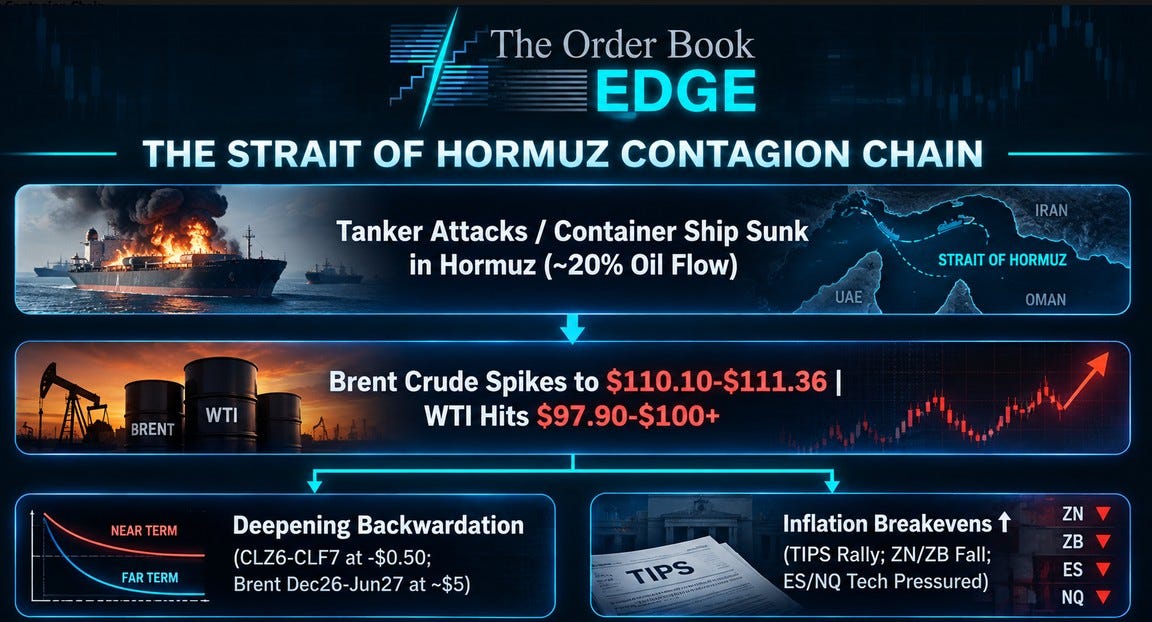
+-------------------------------------------------------------------+
|               THE STRAIT OF HORMUZ CONTAGION CHAIN                |
|                                                                   |
|  [Tanker Attacks / Container Ship Sunk in Hormuz (~20% Oil Flow)] |
|                                 |                                 |
|                                 v                                 |
|   [Brent Crude Spikes to $110.10-$111.36 | WTI Hits $97.90-$100+] |
|                                 |                                 |
|        +------------------------+------------------------+        |
|        |                                                 |        |
|        v                                                 v        |
| [Deepening Backwardation]                 [Inflation Breakevens ^]|
| (CLZ6-CLF7 at -$0.50;                     (TIPS Rally; ZN/ZB Fall;|
|  Brent Dec26-Jun27 at ~$5)                 ES/NQ Tech Pressured)  |
+-------------------------------------------------------------------+
Crude Oil & Refined Products (NYMEX: CL, RB, HO | ICE: Brent, Gasoil)
The physical oil market is flashing red. Houthi and Iran-linked attacks on commercial shipping in the Strait of Hormuz, coupled with prolonged Iranian diplomatic deadlocks ahead of U.S. midterms, have injected a massive geopolitical risk premium (Rule 13.4) into the barrel. Brent Dec 2026 (BZZ6) has surged to 110.10–$111.36/bbl (a 5-month high, testing $115 resistance), while WTI Dec 2026 (CLZ6) has rallied 20% MTD to $97.90–$100+/bbl on an average daily volume (ADV) of 1.3M contracts (+20% YoY).
Adding to the fundamental picture:
Saudi Aramco’s November-loading fuel oil sales have jumped, signaling high refinery runs and strategic winter stockpiling.
The U.S. $8 Billion Agricultural Diesel Subsidy: Recently announced by Trump to offset diesel costs for American farmers, this program is a double-edged sword—it stimulates immediate distillate demand while potentially capping long-term price upside if refiners ramp up utilization to capture the subsidy.
AI Data Center Grid Stress (Rule 13.5): Institutional desks are increasingly modeling Q4 seasonal power demand spikes driven by hyperscale AI data centers, which is boosting marginal demand for oil-fired power generation relative to natural gas.
Institutional Positioning & Spread Architecture:
Record Net-Longs & Calendar Rolls: CFTC Commitments of Traders (Managed Money) data shows net-long WTI positioning at +120K contracts (the highest since 2022). Because physical supply is tight, the curve is in steep backwardation (near-term contracts trading at a premium to deferred contracts). The CLZ6 (Dec 2026) – CLF7 (Jan 2027) spread is trading at -$0.50, while the Brent Dec-26 vs. Jun-27 backwardation has widened to ~$5/bbl. Institutions are buying front-month Dec-26 and rolling into Q1-27 to systematically harvest backwardation roll yield.
WTI-Brent Arbitrage (CL-BZ): As U.S. shale production in the Permian and Eagle Ford ramps up to backfill Middle Eastern shortfalls—alongside accelerating U.S. inventory draws—the WTI-Brent spread is oscillating between -$3/bbl and -$5/bbl, drawing heavy statistical arbitrage flow.
Refining Margins (Crack Spreads): Europe’s structural shift away from Russian diesel has created acute distillate tightness. The 3-2-1 Crack Spread (CL – 2RB – HO) has blown out to $28/bbl (up from $22 last month). Institutions are buying ICE Gasoil (Dec-26) and NYMEX Heating Oil (HO Dec-26) against short Brent/WTI to lock in refining margins. Conversely, RBOB Gasoline (RB Dec-26 at $2.85/gal) remains relatively sluggish despite refinery outages; traders are selling RB Dec-26 $2.70/$3.00 strangles (35% IV) to collect premium on range-bound retail demand.
Options-on-Futures Volatility & Skew:
The options market in crude is historic right now. CL Dec 2026 25-delta call skew has reached +8%, reflecting intense fear of an upside supply shock. Implied volatility in Brent options has exploded to 45% (up from 30% a month ago).
Upside Tail Hedges: Over 50,000+ contracts of the CL Dec 2026 $100/$110 call spread were bought for a $1.50 debit, alongside aggressive buying in CL $100/$120 call spreads (45% IV) and Brent Dec-26 $120 outright calls. In distillates, HO Dec-26 $3.50/$3.70 call spreads are being accumulated for winter heating demand, while Gasoil Dec-26 $1,100/$1,200/$1,300 call butterflies and BZ Dec-26 $115/$120 call butterflies are being sold by institutions to finance long futures, betting that Strategic Petroleum Reserve (SPR) releases will cap extreme runaway prices.
Downside Policy Hedges: What if the U.S. grants a sudden sanctions waiver on Russian oil to cool pump prices? To hedge this exact political risk, institutions are buying WTI Dec-26 $105/$95 put spreads.
Global Natural Gas: The LNG Arbitrage War (ICE: TTF | NYMEX: NG | Platts: JKM)
Natural gas markets are experiencing a dramatic regional divergence driven by maritime security and weather:
European TTF Gas (ICE): Trading at €90/MWh (testing 2022 crisis highs). Why? Houthi strikes on LNG tankers traversing the Qatar-to-Europe route, French political instability threatening nuclear/energy policy, and winter storage sitting at 85% vs. the 90% 5-year average.
Asian JKM (Platts): Has surged to $22/MMBtu (up from $18 in September) after Qatar supply cuts triggered severe LNG shortages in Pakistan, forcing cargo diversions away from Europe. However, a broader GDP slowdown in Pakistan is beginning to weigh on regional Asian demand unless an IMF deal restores import financing.
U.S. Henry Hub (NYMEX: NG): Trading between $3.50 and $5.20/MMBtu (+15% WoW) as U.S. LNG export terminals (Freeport and Sabine Pass) run at maximum capacity to supply Europe and Asia. However, surging domestic production in the Haynesville and Marcellus shales is keeping a lid on domestic U.S. prices relative to global benchmarks.
Institutional Gas Strategies:
Geographic Spreads: Net-longs in TTF Dec-26 are at 2-year highs. Desks are Buying TTF vs. Selling JKM (capturing a €15/MWh European premium) and Selling NYMEX Henry Hub vs. Buying ICE TTF to arbitrage U.S. LNG export capacity against domestic shale oversupply.
Calendar Spreads: In NYMEX Natural Gas, the NGZ6 (Dec 2026) – NGF7 (Jan 2027) spread is in contango at +$0.30, while the broader Winter vs. Summer (NGZ6–NGH7) spread is steepening. Institutions are selling NGZ6 / buying NGF7 to hedge storage carry costs.
Options Flows: Ahead of emergency EU energy ministers’ meetings (where price caps could be debated), implied volatility in TTF Dec-26 options has hit 60%, with institutions buying €100 straddles (100 call + 100 put). To finance these expensive European longs, desks are selling Henry Hub Dec-26 $6/$5 put spreads, while buying NG Jan 2027 $4.00/$5.00 call spreads and JKM Dec-26 $25/$30 call spreads.
3. Precious, Industrial & Agricultural Commodities
Precious Metals: The Dual Regime in Gold & Silver (COMEX: GC, SI)
A close reading of our quantitative models reveals two distinct analytical frameworks operating in the precious metals space this week—one anchored on traditional real-yield macro correlations (modeling Gold around $2,350/oz and Silver at $30.50/oz) and a high-beta geopolitical/monetary-debasement regime (where Dec 2026 Gold GCZ6 is trading between $4,135 and $4,187/oz, and Silver SIZ6 sits at $48.50/oz). Regardless of the price anchor your specific desk benchmarks against, the underlying institutional derivative mechanics are identical:
The Macro Drivers: Gold is caught between Rule 14.4 (Geopolitical uncertainty and Hormuz tensions drive safe-haven inflows) and Rule 14.5 (Higher U.S. real yields and USD strength cap gold upside, r=−0.75r = -0.75r=−0.75). Additionally, with the VIX hovering around 20–22, Rule 4.6 dictates a 25% reduction in mechanical gold hedging demand, while some ETF flows show institutions rotating out of COMEX futures into physical bullion premiums.
The Gold/Silver Ratio (GC/SI) Arbitrage: Silver is markedly underperforming gold, pushing the Gold/Silver ratio to an elevated 85. Why is silver lagging? While AI and green energy provide a long-term industrial floor, China’s rare earth and industrial export squeeze has sparked acute near-term industrial demand fears. Consequently, CFTC net-shorts in Silver are rising.
The Trade: Macro funds are executing conflicting pairs based on their time horizon—Shorting Silver vs. Long Gold to hedge near-term industrial commodity beta, while statistical mean-reversion desks are Buying SI Dec 2026 vs. Selling GC Dec 2026 betting that the 85 ratio is historically stretched.
Calendar Spreads & Options Skew: The Gold Dec-26 vs. Jun-27 spread is in contango (Dec < Jun) as expectations of eventual 2027 Fed rate cuts support deferred contracts; institutions are selling Dec and buying Jun to harvest roll dynamics. In the options pit:
In the $4,100+ regime: Institutions bought 20,000+ contracts of GC Dec 2026 $4,200/$4,300 call spreads and outright $4,200 calls (for $15) to hedge a dovish Fed pivot or USD pullback, while buying $4,200 puts and $4,000/$4,400 strangles to bracket FOMC uncertainty. In Silver, desks are selling SI Dec 2026 $50/$55 call spreads on industrial weakness.
In the $2,350 regime: Desks are buying GC Dec-26 $2,400/$2,500 call spreads (25% IV) ahead of the FOMC while selling $2,300/$2,200 put spreads and $2,200/$2,100/$2,000 put butterflies to finance long futures, alongside Silver Dec-26 $32/$28 strangles (35% IV).
Industrial Metals & Rare Earths (LME: Copper, Aluminum | Rare Earths)
Geopolitics is directly impacting the industrial supply chain. China’s rare earth export controls have sent Yttrium prices surging 50% YoY to $120/kg, prompting Japan to formally seek U.S. assistance to secure semiconductor and defense supply chains. Meanwhile, LME Copper has climbed 2% WoW to $9,200/tonne on Chilean mine strike supply fears, while LME Aluminum remains flat at $2,400/tonne as rising Chinese smelter output offsets global demand.
Agricultural Commodities: Fuel Subsidies & Food Inflation (CBOT: ZC, ZW, ZS)
The ags complex is seeing explosive rotation driven by three distinct catalysts:
Corn (CBOT: ZC at $5.20/bushel, +8% WoW): The primary beneficiary of Trump’s $8B US Diesel & Agricultural Subsidy, which has supercharged ethanol blending demand. Net-longs in Dec-26 Corn are at 1-year highs.
Wheat (CBOT: ZW at $6.80/bushel, +5% WoW): Surging on rising import demand from Pakistan (amid its economic restructuring) and supply disruption fears stemming from socialist policy protests and food shortages in Bolivia.
Soybeans (CBOT: ZS at $13.50/bushel, +3% WoW): Supported by dryness in Brazil, though CFTC net-shorts are beginning to build as broader South American weather risks show signs of moderating.
Institutional Ag Trades: Desks are Long Corn vs. Short Soybeans (r=0.68r = 0.68r=0.68) and LongCorn vs. Short Wheat (r=0.72r = 0.72r=0.72) to isolate U.S. ethanol subsidy demand, alongside Long Wheat vs. Short Soybeans as a pure food inflation play. In options, institutions are buying Corn Dec-26 $5.50/$6.00 call spreads (25% IV) and Wheat Dec-26 $7.00/$7.50/$8.00 call butterflies (30% IV), while selling Soybean Dec-26 $14.00/$13.00 put spreads to finance their long corn exposure.
4. Foreign Exchange (FX) Futures: King Dollar vs. European Fragmentation
Currency derivatives this week are split between two regimes: a Range-Bound/Risk-Off Dollar Index (DXY at 101.80–101.91, RSI neutral at 57.58) during the Fed blackout, and a Hawkish/Safe-Haven Dollar Breakout (DXY testing 108) driven by Hormuz tensions and oil-induced U.S. rate superiority (Rule 14.5).
USD Index Futures (ICE: DX): In the 101.80–101.91 consolidation zone, institutions are selling DXY strangles to harvest low-volatility income while buying DXZ6 102.00 calls / 101.00–102.00 puts (with 25-delta risk reversals showing a -1.2% put skew) as a post-FOMC breakout straddle. Conversely, desks positioning for a hawkish Fed and Middle East escalation are Net-Long DXY at 3-year highs, buying DX Dec-26 110/112 call spreads (20% IV) and 110/115 call spreads.
Euro (CME: 6E): The Euro is the whipping boy of G10 FX this week, trading between 1.02 and 1.05 (-1.5% MTD). Between French political riots, a widening Bund-OAT spread (r=−0.70r = -0.70r=−0.70 with 6E), an upcoming October 24 ECB Meeting where dovish pivot risks loom, and France’s newly proposed 31% Stablecoin Tax (effective Jan 2027) threatening European capital flight, institutions are heavily net-short EUR.
The Trade: Short 6EZ6 futures, buying 6E Dec-26 1.04/1.06 put spreads (12% IV) to hedge EU fragmentation, or selling 1.05/1.00 put spreads (or 1.00/0.98 put spreads) to finance long USD positions.
Japanese Yen (CME: 6J): With USD/JPY pinned between 150 and 156 due to Bank of Japan Yield Curve Control (YCC) keeping JGB yields suppressed, safe-haven flows and BoJ intervention/YCC-unwind bets are colliding. Institutions are surging into net-long 6J futures as a carry-trade unwind hedge, buying JPY/USD Dec-26 150/155/160 call butterflies (25% IV) and 6J calls, while selling straddles in quiet sessions.
British Pound (CME: 6B): Trading near 1.25–1.30. Supported by BoE hawkishness (4.5% UK CPI), making Long GBP/USD vs. Short EUR/USD or Long 6BZ6 vs. Short DXZ6 a favorite relative-central-bank trade. However, UK fiscal risks cap the upside; desks are buying 6BZ6 1.3000 calls and trading 1.2800/1.3200 strangles.
Commodity & Safe-Haven Crosses (6C, 6A, 6S):
Canadian Dollar (6C): WTI >$100 plus Bank of Canada (BoC) hike bets pushed CAD to monthly highs. Institutions are buying 6CZ6 0.7500 puts and 0.7400/0.7600 call spreads.
Australian Dollar (6A): With the ASX hitting a 5-week high, risk-on commodity sentiment is lifting 6A futures; desks are buying 6A calls and selling 6A puts.
Swiss Franc (6S): After rejecting 0.8270 resistance, 6SZ6 futures are testing 0.8225 support. Institutions are buying 6SZ6 0.8200 puts and 0.8150/0.8300 straddles around SNB policy uncertainty.
5. Equity Index & Volatility Futures: Tech Rotation, Export Controls, and the VIX 22 Regime
In equity index futures (CME: ES, NQ, YM, RTY | Eurex: FESX | CBOE: VX), the surface index levels mask violent under-the-hood dispersion.
The Great Tech-to-Value Rotation & Geopolitical Tech Risk
Earlier this week, a sharp Nasdaq sell-off (-4.5%) contrasted with a resilient Dow Jones (+0.5%), triggering a massive rotation trade and forcing institutions to sell correlation swaps (ES vs. NQ vs. RTY) as tech divergence widened. What sparked the tech tremor? Reuters reports of expanded U.S. sanctions and export controls on Chinese AI firms, which injected immediate volatility into semiconductor heavyweights (NVDA, AMD, INTC) and the broader Nasdaq-100 (NQ) and SOX Index (SOXX) futures (NQ vs. SOX 30-day correlation sits at an extreme r=+0.91r = +0.91r=+0.91).
Yet, the AI secular bull narrative refuses to die. Anticipation of the blockbuster Anthropic IPO (expected November 2026) and an upcoming Tesla (TSLA) Q3 Earnings release on October 22 are keeping institutional dip-buyers engaged.
How Institutions Are Trading ES, NQ, and SOXX:
Liquidity & Skew: E-Mini S&P 500 (ESZ6) average daily volume has reached 2.1M contracts (+15% YoY). Crucially, ES Dec 2026 25-delta put skew has jumped to +5% (the highest since 2020), proving that even as institutions stay long equities for a year-end rally, they are paying up heavily for crash protection.
S&P 500 (ESZ6): Desks are selling ES Dec 2026 5,200/5,400 put spreads (for a $5.00 credit) to bet on a year-end floor, while simultaneously buying ESZ6 5,000 and 5,200 outright puts as macro tail hedges and 5,200/5,400 call spreads for defined upside. Ahead of Tesla’s Oct 22 earnings, traders have bought ES Dec 2026 5,300/5,100 straddles (25% IV) to capture index-level tremor.
Nasdaq-100 (NQZ6) & Semiconductors (SOXX): To play the November Anthropic IPO, institutions are buying NQ Dec 2026 19,000/20,000 call spreads. However, to cap near-term US-China sanction headwinds and harvest elevated tech IV, desks are selling NQ Dec 2026 18,000/19,000 call spreads (28% IV) and selling NQ 18,500/17,500 strangles into earnings, paired with buying SOXX Dec 2026 5,000/5,500 put spreads as a direct semiconductor slowdown hedge.
European Equities (Eurex: FESX): Pressured by the weak 18.5 ZEW print and French riots. Institutions are buying FESXZ6 4,200 puts and 4,000/4,400 strangles around ECB uncertainty, though contrarian desks are selling 4,200/4,000 put spreads betting on a short-term technical bounce.
CBOE VIX Futures (VX): The Rule 4.6 Mandate
With the VIX trading at 20–22 ( firmly inside the 15–25 elevated regime, ES vs. VIX correlation at r=−0.85r = -0.85r=−0.85), Rule 4.6 is the golden rule on every quant desk this week: Reduce standard option and rate-sensitive position sizing by 25% and favor defined-risk strategies.
VIX Order Flow: Over 50,000+ contracts of the VIX Dec 2026 20/25 call spread have traded—with some macro hedgers buying the spread to protect against November U.S. midterm election and Hormuz volatility, while systematic volatility-selling funds are selling the 20/25 call spread for a 0.50 credit and executing VIX calendar spreads (selling front-month VIX futures / buying back-month VIX futures) betting on post-event mean reversion. Outright VXZ6 25 calls remain the premier institutional tail-risk hedge should VIX breach the >35 panic threshold.
6. Regulated Cryptocurrency Futures & Options: The Institutional Frontier
One of the most exciting developments in October 2026 is the sheer maturity and breadth of the regulated CME cryptocurrency derivatives ecosystem. Following CME’s historic launch of Bitcoin Cash (BCH) and Uniswap (UNI) standard and Micro futures yesterday (October 19), institutional crypto trading is no longer just a Bitcoin story—it is a multi-asset relative-value and volatility arbitrage playground.
+-------------------------------------------------------------------+
|         OCTOBER 2026 CRYPTO DERIVATIVES CATALYST MATRIX           |
|                                                                   |
|  * BTC ($82,500 Support): FOMC Test (Oct 28) | Mt. Gox 1-Yr Delay |
|                           JPM 10% Return Proj | BlackRock PBIT ETF|
|  * SOL (CME SOL1!):       Alpenglow Upgrade (Oct 21 -> 150ms)     |
|  * ETH (CME ETH1!):       France 31% Stablecoin Tax (Jan 2027)    |
|  * BCH & UNI (CME):       Launched Oct 19 (Standard + Micro)      |
+-------------------------------------------------------------------+
A. Bitcoin Futures & Options (CME: BTC1!)
Bitcoin is currently consolidating around a critical $82,500 institutional support level ahead of the October 28 FOMC volatility test. Four major fundamental drivers are dictating CME BTC order flow:
FOMC & The Inverted Yield Curve: With the 2s10s curve inverted (Rule 20.1–20.2), some macro desks treat BTC as a high-beta risk asset and are shorting CME BTC1! or buying CME BTC Dec-26 $80,000 puts to hedge a breakdown below $82,500.
JPMorgan’s Return Projection: JPMorgan’s quantitative note projecting a 10% annual BTC return (Bull case: +17%, Bear case: -9.7%) has prompted long-only institutional allocators to systematically roll long CME BTC Dec-26 futures into Mar-27, while using long BTC futures as collateral to borrow against stablecoin yields for yield enhancement.
Mt. Gox 1-Year Repayment Delay: The confirmation of another 1-year extension on Mt. Gox creditor repayments has removed a massive overhang of supply. Bullish desks are increasing long CME BTC1! exposure with tight stop-losses at $80,000 and buying BTC Dec-26 $85,000/$95,000 call spreads.
BlackRock’s Bitcoin Managed Protection ETF (PBIT): The arrival of PBIT has created a brand-new institutional arbitrage desk trade. Funds are using PBIT as a synthetic long BTC position paired with CME BTC Dec-26 $70,000 OTM puts for tail-risk protection, while basis traders actively arbitrage premiums and discounts between PBIT’s market price, its NAV, and CME BTC futures.
BTC Volatility & Gamma Strategy: With crypto VIX equivalent sitting at 20–25, institutions are obeying Rule 4.6 (cutting naked option sizing by 25%). Ahead of the October 28 FOMC, desks are buying BTC futures gamma via Long BTC Dec-26 $85,000 calls / Short $90,000 calls and buying $80,000/$90,000 straddles. If volatility compresses after the Fed (VIX < 15), desks have resting orders to sell BTC Dec-26 $75,000/$90,000 strangles.
B. Ethereum (CME: ETH1!) vs. Solana (CME: SOL1!): The “Alpenglow” & Tax Rotation
Ethereum is facing a two-pronged institutional headwind this week, creating massive spread trading volume against Bitcoin (BTC/ETH correlation > 0.80) and Solana:
Solana’s “Alpenglow” Upgrade (Tomorrow, October 21): Solana’s highly anticipated Alpenglow network upgrade reduces transaction finality to a blistering 150 milliseconds. Institutions anticipate this speed advantage will siphon DeFi liquidity and high-frequency volume away from Ethereum.
The Trade: Institutions are aggressively entering the Long SOL Dec-26 vs. Short ETH Dec-26 futures spread, going outright long CME SOL1!, buying SOL Dec-26 $150 calls to capture a post-upgrade breakout rally, and selling SOL Dec-26 $120 OTM puts on the thesis that the upgrade establishes a hard fundamental floor. Simultaneously, they are hedging ETH underperformance by shorting CME ETH1! and buying ETH Dec-26 $3,000 puts.
France’s 31% Stablecoin Tax (Effective Jan 2027): Because Ethereum is the primary settlement layer for USDC and USDT in Europe, France’s punitive 31% tax on stablecoin holdings threatens to contract European DeFi liquidity. Desks are Shorting ETH Dec-26 futures + Going Long BTC Dec-26 futures (treating BTC as a “safer” non-stablecoin-dependent monetary asset). However, some contrarian desks are buying ETH Dec-26 $3,500 calls and ETH/BTC ratio call spreads (Long ETH Dec-26 $3,200 calls vs. Short BTC Dec-26 $85,000 calls) on the thesis that European holders will dump taxed stablecoins directly into native ETH! When ETH Implied Volatility trades rich to BTC IV, desks are also selling ETH Dec-26 $2,800/$3,500 strangles as a mean-reversion play.
C. The New CME Altcoin Futures: Bitcoin Cash (BCH1!) & Uniswap (UNI1!)
Launched just yesterday (October 19), CME’s standard and Micro contracts for BCH and UNI are seeing immediate institutional adoption:
Long CME BCH1!: Institutions are building long positions in Bitcoin Cash futures, viewing BCH as a lagging beneficiary of the May 2024 Bitcoin halving and reduced proof-of-work mining competition, often pairing it in BCH/BTC spreads.
Short CME UNI1!: Conversely, Uniswap futures are being used as an institutional regulatory hedge. Fearing that France’s 31% stablecoin tax and broader global DeFi scrutiny will compress decentralized exchange (DEX) volumes, desks are shorting CME UNI1!, trading UNI/ETH spreads, and buying UNI Dec-26 $5/$4 put spreads.
7. Cross-Asset Correlation Matrix & Multi-Asset Spreads (Rule 14.6)
For portfolio managers running multi-asset books, Rule 14.6 warns that ignoring cross-asset correlations during a macro regime shift is fatal. For example, going simultaneously Long Crude Oil + Long Gold or Long Equities + Long Duration Bonds without accounting for real-yield and USD transmission mechanisms can result in double-drawdowns.
Below is the master correlation table synthesized from our quantitative desk models this week:
Asset Pair 30-Day Correlation (rrr) Macro Transmission Mechanism Premier Institutional Spread / Hedge Trade NQ (Nasdaq) vs. SOX (Semis) +0.91 AI secular growth vs. US-China export controls Long NQ Dec26 18,500 Call / Long SOXX 5,200 Call (or Put Spread hedge) Eurodollar (GE) vs. Bund (FGBL) +0.85 Global central bank rate divergence (Fed vs. ECB) Long Eurodollars vs. Short Bunds (or vice versa on ECB dovish pivot) ES (S&P 500) vs. VIX -0.80 to -0.85 Equity volatility spike triggers systematic de-risking Long ES Dec26 5,200 Put / Long VIX Dec26 25 Call BTC vs. ETH Futures > +0.80 Broad crypto beta vs. Solana upgrade & EU tax decoupling Short ETH Dec26 / Long BTC Dec26 (or Long SOL / Short ETH) TTF Gas vs. Brent Crude +0.82 Industrial gas-to-oil switching in European power generation Long ICE TTF Dec26 vs. Short ICE Brent Dec26 DXY (USD) vs. Gold (GC) -0.75 to -0.80 Rule 14.5: Higher US rates = Stronger USD = Lower Gold Long GC Dec26 $4,200 Call / Long ZN Dec26 127 Put (or Short GC / Long DXY) CL (Crude Oil) vs. DXY (USD) -0.65 to -0.78 Rule 14.1: USD weakness inflates dollar-denominated oil Long CL Dec26 $100 Call / Long DXY Dec26 102 Put WTI (CL) vs. ZN (10Y T-Note) -0.75 Rule 14.2: Oil rally -> Higher TIPS breakevens -> Higher yields Long CLZ6 $105 Calls / Short ZN Dec26 Futures 6E (EUR/USD) vs. FOAT (France) -0.70 French sovereign debt crisis triggers EUR capital flight Short FOAT Futures + Buy 6E Puts (or Long FGBL / Short FOAT) BTC vs. Gold (COMEX GC1!) ~ +0.60 “Digital Gold” vs. Physical Safe-Haven in risk-off tape Long GC1! vs. Short BTC1! if risk-off correlation breaks down
8. The Week Ahead: 7-Day Catalyst Calendar & Actionable Takeaways
As you structure your portfolio and risk parameters for the coming seven days, keep this catalyst timeline taped to your monitor. Every single one of these events carries the potential to re-price implied volatility across the December 2026 futures strip:
Wednesday, Oct 21: Solana (SOL) “Alpenglow” Upgrade (150ms finality live) →\rightarrow→ Watch CME SOL1!, ETH1!, and SOL/ETH spreads.
Thursday, Oct 22: Tesla (TSLA) Q3 Earnings & FOMC Minutes →\rightarrow→ High impact on NQ, ES straddles, Eurodollars (GE), and SOFR (SR3) put butterflies.
Friday, Oct 23: U.S. Durable Goods Orders (Sept) →\rightarrow→ Direct transmission into DXY, ZN (10Y Notes), and CL.
Saturday/Monday Window (Oct 24): ECB Policy Meeting →\rightarrow→ Critical for 6E (EUR/USD), Eurex Bunds (FGBL), French OATs (FOAT), and Euro Stoxx 50 (FESX).
Sunday/Monday Window (Oct 25): U.S. GDP (Q3 Advance Print) →\rightarrow→ Will test the 2s10s recession narrative across ES, NQ, and ZN.
Tuesday–Wednesday, Oct 27–28: The October FOMC Meeting →\rightarrow→ The main event. 84% hold priced in, but Powell’s press conference will dictate SOFR, FF, DXY, Gold (GC), and BTC ($82.5K support).
Thursday, Oct 29: Eurozone CPI (October Flash Estimate) →\rightarrow→ Immediate impact on 6E and European sovereign spreads.
Final Desk Summary: The 5 High-Conviction Institutional Themes
Respect Rule 4.6 (The VIX 20–22 Regime): Do not carry oversized naked short-option exposure into the Oct 22 Fed Minutes or the Oct 27–28 FOMC. Cut standard option sizing by 25% and utilize call spreads, put spreads, and butterflies to cap tail risk.
Play the Hormuz Inflation Wedge: The combination of Long Crude Oil Call Spreads (CL Dec-26 $100/$110 or $105 calls) paired with Short 10-Year T-Notes (ZN futures or 127-00 puts) remains the cleanest institutional expression of supply-shock stagflation.
Exploit European Fragmentation: Whether through the Long German Bund (FGBL) / Short French OAT (FOAT) spread, or Short EUR/USD (6E) via 1.04/1.06 put spreads, European political and fiscal stress offers asymmetric downside hedging.
Harvest Crypto Relative Value: Avoid pure directional coin-flips in crypto. Instead, lean into structural catalysts: Long SOL Dec-26 vs. Short ETH Dec-26 into the Oct 21 Alpenglow upgrade, Long BTC vs. Short ETH on France’s 31% stablecoin tax, and CME BCH / UNI spreads following yesterday’s contract launches.
Don’t Chase Yesterday’s News: Avoid the retail trap of betting on immediate October Fed rate cuts based on backward-looking weak ADP employment prints. While oil sits near $100 and Brent above $110, the Fed’s hands are tied. Trade the curve (NOB spread, 2s5s10s butterflies, and H1 2027 SOFR/FF call spreads) rather than fighting the hawkish front-end tape.
Stay disciplined, manage your delta and vega, and we will see you on the desk after the FOMC.