

If you put ten discretionary traders in a room and ask them how they trade, you will get ten variations of the same core visual concepts: support and resistance, order blocks, moving averages, or price action. Their setups look roughly the same—usually a multi-monitor array glowing with candlestick charts.
If you put ten automated traders in a room and ask them the same question, you will get ten vastly different architectural blueprints.
One trader’s “setup” doesn’t have a single chart; it’s a headless Linux server running in an AWS data center in Virginia, executing statistical arbitrage scripts in Python via a WebSocket connection. Another trader is running a fleet of MetaTrader 5 terminals on a dedicated Windows VPS in London, managing a portfolio of trend-following Expert Advisors written in MQL5. A third is piping TradingView Pine Script alerts through a webhook middleware into an options brokerage API.
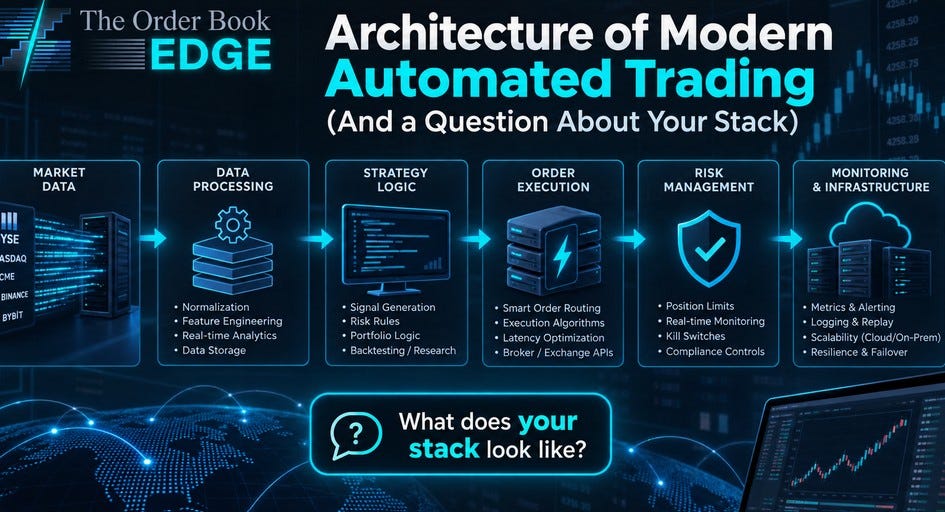
Algorithmic trading is one of the most fragmented, creative, and fiercely independent disciplines in the world. Because we sit at the intersection of quantitative finance, software engineering, and systems administration, no two trading operations look alike. We are all trying to solve the exact same puzzle—extracting systematic edge from market data while controlling downside variance—but the tools we use to build our machines vary wildly.
Today, I want to pull back the curtain on the current state of the retail and independent quantitative trading landscape. I want to break down the asset classes, the software stacks, the programming languages, and the execution infrastructure that define how we trade right now.
More importantly, I am writing this because I want to talk to you. At the end of this piece, I’m going to ask you to hit reply and tell me about your specific architecture.
Before we get to that, let’s deconstruct the modern automated trading stack. As you read through this, take note of where you fall on the spectrum—and where you might be looking to migrate next.
Part 1: The Battlefield (What Are We Trading?)
In discretionary trading, you can jump from a tech stock to a forex pair to a crypto token in the span of five minutes because a chart is just a chart. In systematic trading, the asset class you choose dictates your entire technological existence. It determines your data costs, your API structure, your execution hours, and how you handle structural market quirks.
Right now, the independent automated trading community is largely divided into five main arenas.
1. Futures (Indices, Commodities, Treasuries)
For decades, futures have been the gold standard for serious systematic traders. If you are trading the E-mini S&P 500 (ES), the Nasdaq (NQ), Crude Oil (CL), or Gold (GC), you are operating on a centralized exchange (like the CME).
From a systems perspective, centralized order books are a massive advantage. When you backtest a strategy on ES, you are looking at the exact same tick data and volume profile that every other participant in the world sees. There is no broker-specific pricing manipulation.
However, automating futures comes with a distinct engineering headache: contract rollovers. Unlike a stock or a spot currency pair that exists in perpetuity, futures contracts expire. If you are building a long-term trend-following system or training a machine learning model on five years of historical intraday data, how you stitch those contracts together (back-adjusting vs. non-back-adjusting, rolling on volume vs. rolling on a fixed date) will completely alter your backtest results. Furthermore, your live execution engine needs the logic to automatically close positions in the expiring front-month contract and re-open them in the next contract without dropping a beat.
2. Spot Forex and CFDs
On the other end of the spectrum is the decentralized world of Spot FX and Contracts for Difference (CFDs). Despite the rise of newer asset classes, FX remains a juggernaut in the retail algorithmic space for two reasons: deep liquidity in the majors (EUR/USD, USD/JPY) and the sheer ubiquity of out-of-the-box retail platforms built specifically for it.
The challenge here is the exact opposite of futures. Because FX is decentralized, the data feed from Broker A will look slightly different from Broker B. Spreads are variable and widen drastically during the daily 5:00 PM EST rollover window or during macroeconomic news releases. An automated mean-reversion scalper that looks like a smooth upward curve on fixed-spread historical data can get torn to shreds in a live environment if the system isn’t programmed to monitor live bid-ask spreads and halt execution when liquidity evaporates.
3. Digital Assets (Spot and Perpetual Swaps)
If you want to learn how to build robust, institutional-grade trading infrastructure without paying tens of thousands of dollars a month in exchange fees and market data licenses, crypto is the ultimate sandbox.
Because digital asset exchanges were built in the modern era of software development, their APIs are native, accessible, and extraordinarily well-documented. Any independent developer can spin up a WebSocket connection and stream live, tick-by-tick Level 2 or Level 3 order book data without filling out institutional compliance forms. Furthermore, the invention of the “perpetual swap” eliminated the futures rollover problem, allowing systematic traders to long or short assets continuously while introducing a whole new quantitative vector: funding rate arbitrage.
The catch? The market never closes. Traditional equities or futures traders have the weekend to run system maintenance, push code updates, retrain models, and reboot servers. When you automate in a 24/7/365 market, your error-handling, watchdogs, and auto-reconnection logic must be bulletproof. If a memory leak crashes your server at 3:00 AM on a Sunday, the market will happily move against your unmonitored open positions while you sleep.
4. Equities (Statistical Arbitrage and Momentum)
Automating stocks is a completely different beast than trading a single index or currency pair. While some traders run intraday bots on a handful of high-beta tech stocks, the real power of equities automation lies in cross-sectional breadth—scanning a universe of 3,000+ tickers simultaneously to rank factors, execute pairs trading, or capture overnight drift.
In recent years, the emergence of API-first brokerages has revitalized retail equity automation. You no longer need to wrestle with archaic banking interfaces to send an algorithmic order for 100 shares of a mid-cap stock. However, equities traders have to contend with strict regulatory mechanics (like the Pattern Day Trader rule in the US), short-locate availability (your bot wants to short a stock, but the broker has no shares to lend), and corporate actions. If your historical database doesn’t properly account for stock splits, dividends, and delisted companies (survivorship bias), your backtest is a work of fiction.
5. Options and Volatility
This is arguably the fastest-growing frontier for independent coders right now, especially with the explosion of short-dated options (0DTE). Automating options is exponentially more complex than linear assets (like stocks or futures).
Instead of monitoring a single price stream, your code has to ingest and process an entire options chain—hundreds of strikes across multiple expiration dates—while calculating the Greeks (Delta, Gamma, Theta, Vega) in real time. Furthermore, executing multi-leg strategies (like iron condors or calendar spreads) via an API requires complex order-routing logic. You cannot simply fire four market orders into illiquid option strikes; you have to program dynamic limit-order “walking” algorithms that work the mid-price to get filled without giving up your entire statistical edge to market makers.
Part 2: The Tech Stack (How Are We Doing It?)
Once you’ve chosen your asset class, you have to choose your weapon. Over the years, I’ve noticed that automated traders tend to fall into one of three distinct camps when it comes to their technology stack. None of these camps is inherently “better” than the others—each represents a trade-off between development speed, customization, and infrastructure maintenance.
Camp A: The All-in-One Monoliths
This camp uses legacy and modern desktop platforms where charting, backtesting, data management, and execution live under one roof. Think MetaTrader 4/5 (MQL4/5), NinjaTrader (C# / NinjaScript), TradeStation (EasyLanguage), cTrader (cAlgo), MultiCharts, or Sierra Chart.
There is a tendency among pure software engineers to look down on these platforms, which is a massive mistake. The beauty of the Monolith is that the plumbing is already built for you. You don’t have to spend three months writing an order-management system (OMS) from scratch, dealing with API rate limits, or figuring out how to parse raw TCP/IP packets. The broker connection is native. The backtesting engine is built-in. You can have an idea for a strategy at 9:00 AM, write 150 lines of MQL5 or C# by noon, run a multi-year optimization by 2:00 PM, and have it running on a virtual server by market close.
The limitation of the Monolith usually reveals itself when you want to step outside the box. If your strategy relies strictly on price and volume from a single chart, these platforms are incredible. But what if you want to pull alternative data from an external web API? What if you want to run a portfolio-level covariance matrix across 50 assets before sizing a trade? What if you want to use a modern machine learning library? While you can hack your way around these limitations using DLL imports or local file sharing, you eventually find yourself fighting the platform rather than the market.
Camp B: The Modular “Lego” Stack (Webhooks and Middleware)
Over the last few years, a massive wave of traders has bypassed traditional desktop platforms entirely in favor of cloud-based, modular workflows.
The undisputed king of the front-end here is TradingView (Pine Script). Pine Script is arguably one of the most brilliant domain-specific languages ever created for finance. It allows you to write complex time-series logic in a fraction of the lines of code required in Python or C++, and instantly visualize it on a chart.
Because TradingView isn’t a native automated execution engine for most brokers, traders in this camp build a bridge. A strategy triggers an alert in TradingView’s cloud, which fires a JSON payload via a Webhook to a middleware server. That middleware might be a commercial bridge (like TradersPost, Alertatron, or PineConnector), a low-code automation tool, or a custom-built lightweight Python Flask or FastAPI server running on AWS Lambda or Heroku. That server catches the webhook, validates the risk parameters, translates the message into the broker’s specific API format, and fires the order.
This stack is wildly popular because it decouples signal generation from execution. Your signal runs in the cloud, meaning you don’t have to maintain a 24/7 local computer. The downside? Latency and points of failure. If your signal goes from TradingView’s server, to a webhook router, to your middleware, to your broker’s API, there are four different places where a network hiccup can drop your trade. For a 4-hour swing system, it’s perfection. For a sub-second breakout scalper, it’s a non-starter.
Camp C: The Custom Quantitative Stack (From Scratch)
This is the domain of the purist. Traders in this camp don’t want a Graphical User Interface (GUI). They want a terminal window, an IDE (like VS Code or PyCharm), and total, uncompromising control over every byte of data.
The undisputed lingua franca here is Python. The ecosystem is simply too vast to ignore. A typical Python trader uses Pandas or Polars for data manipulation, NumPy and SciPy for math, VectorBT, Backtrader, or Zipline for backtesting, and Scikit-Learn, PyTorch, or XGBoost for statistical modeling. For execution, they connect directly to broker APIs (like Interactive Brokers via ib_insync, Alpaca, Tradier, or crypto exchanges via the CCXT library).
Some take it a step further, utilizing institutional-grade open-source frameworks like QuantConnect (Lean Engine) or NautilusTrader, which allow you to write strategies in Python or C# while leaning on an enterprise-grade, event-driven architecture that handles tick data and complex order routing out of the box.
And then, at the extreme end of Camp C, we have the C++, Rust, and Go developers. If you are trading high-frequency strategies, market making, or executing cross-exchange arbitrage where milliseconds determine whether you capture spread or eat slippage, Python’s Global Interpreter Lock (GIL) and garbage collection are too slow. These traders write bare-metal code, colocate their servers in the exact same data center as the exchange’s matching engine (like Equinix NY4 or LD4), and obsess over network card kernel bypassing.
Part 3: The Unseen Iceberg (Where the Real Work Happens)
One of the reasons I love talking to other automated traders is that outsiders think our job is all about finding “secret indicators” or magic predictive formulas.
Anyone who has actually put real capital behind a live algorithm knows that signal generation is only about 10% of the battle. The other 90% is the unseen iceberg beneath the surface: data hygiene, backtest integrity, and execution plumbing.
When two algo traders get together, they rarely talk about RSI settings. Instead, they talk about the scars they’ve earned dealing with the reality of live systems:
The Data Cleaning Nightmare: Dealing with bad ticks, missing bars, timezone shifts (Daylight Saving Time has blown up more trading bots than bad strategies ever have), and stitching together historical databases.
The Backtest Lie: Fighting the constant battle against overfitting and curve-fitting. Realizing that a vectorized backtest accidentally introduced look-ahead bias because it used the high of the current bar before the bar had actually closed. Implementing Walk-Forward Analysis and Monte Carlo simulations just to prove to yourself that your strategy isn’t a statistical fluke.
State Management: What happens when your bot places a limit order to enter a trade, and three seconds later, your VPS loses power? When the server reboots and your script restarts, does your bot know it already has a working order in the market? Or does it lose its memory and fire a duplicate order, doubling your risk exposure? Building a persistent database (using SQLite, PostgreSQL, or Redis) to track the exact state of positions and orders is what separates a toy script from a production trading system.
Part 4: Why I Am Writing This (I Want to Talk to You)
Writing this newsletter can sometimes feel like shouting into a void. I see the subscriber numbers grow, and I see the open rates, which I am incredibly grateful for.
However, I realized this week that while you know a lot about how I think about systematic trading, I don’t actually have a clear picture of what your day-to-day setup looks like.
Automated trading can be a remarkably isolating pursuit. We spend hours staring at code, log files, and equity curves by ourselves. You can’t exactly talk to your spouse, your neighbors, or your non-trading friends about how frustrated you are that your broker’s WebSocket keeps disconnecting every night at midnight, or how you’re trying to figure out the best way to dynamically scale position sizes based on rolling 30-day volatility.
I want to change that dynamic here. I don’t want this to just be a one-way broadcast where I send out articles and you read them passively. I want to build a genuine pulse on what the people in this community are actually building, testing, and trading—and I want to talk to you directly.
Whether you are a seasoned quant running a multi-strategy portfolio in the cloud, a discretionary trader who is just now writing their very first automated script to take the emotion out of your execution, or someone still in the research and backtesting phase trying to figure out which platform to commit to—I want to hear from you.
Here is my ask:
If you have two minutes right now, simply hit “Reply” to this email.
You don’t need to write an essay (unless you want to!), and don’t worry about formatting. Just shoot me a quick note answering these three questions:
What markets or assets are you currently trading (or working on automating)?
What does your tech stack look like? (What platforms, programming languages, data feeds, or broker APIs are you using?)
What is the biggest bottleneck or headache you are dealing with in your trading right now? (Is it finding new alpha, coding a specific feature, execution slippage, infrastructure stability, or just finding the time to build?)
Because this is coming straight to my personal inbox, I read every single reply that comes in, and I will reply back to you.
Not only will this help me tailor future articles to the exact tools, languages, and markets you actually care about, but I’m genuinely looking forward to geeking out over your setups and seeing what everyone is working on behind the scenes.
Hit reply and let me know what you’re building.
Talk soon,
Bryan