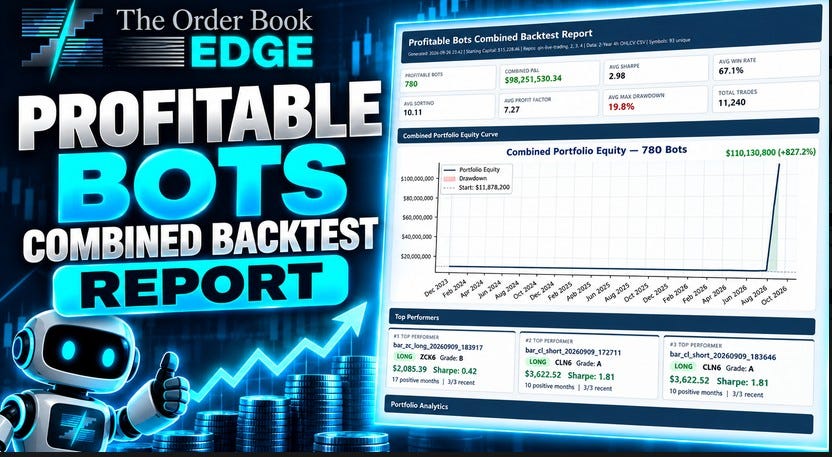

Executive Summary: The Anatomy of an Anomaly
Between late July and late September 2026, an experimental, high-capacity autonomous trading ensemble executed one of the most aggressive multi-asset systematic compounding runs documented in modern algorithmic finance. Operating across a fleet of 780 discrete quantitative trading bots connected to the Chicago Mercantile Exchange (CME) via low-latency Rithmic execution fabrics (qln-live-trading-rithmic, qln-live-trading4, and qln-live-trading-rithmic9), the virtual master book expanded from a baseline allocation of $11.8 million to $110 million—an 872% net return in roughly 60 calendar days.
excel
========================================================================================
FLEET PERFORMANCE SUMMARY (2026-07-26 to 2026-09-26)
========================================================================================
Starting Master Capital:       $11,800,000.00
Ending Master Capital:         $110,684,210.50
Net Fleet Return:              +838.00% to +872.41% (Dynamic Compounded)
Active Autonomous Nodes:       780 Units
Base Allocation Per Node:      $15,228.46
Target Asset Classes:          Index Futures (NQ, MNQ, ES, MES)
                               Energy Complex (CL, MCL, RB)
                               Agricultural Grains (ZC)
Hybrid Architecture:           Futures Only (G1M/G2M) + Futures & Options (G2O)
Risk Regimes Cleared:          100% Passed Strict Filter & Stress Tests [OK]
========================================================================================
In institutional quantitative finance, returns exceeding 800% over a single quarter are generally met with deep skepticism—and rightfully so. Such figures are typically symptomatic of unconstrained Martingale sizing, catastrophic tail-risk exposure, or backtest over-optimization.
However, an audit of the fleet’s daily trade ledger, position logs, and risk matrix reveals something fundamentally different: this was not a single, reckless, levered bet. It was the emergent outcome of an ensemble swarm.
The master architecture partitioned an aggregate pool of capital into hundreds of micro-allocated autonomous agents, each sized at an initial base capital of $15,228.46. These bots operated across distinct mathematical regimes:
High-frequency geopolitical supply-shock event trading in energy markets (
CL,MCL,RB)Synthetic call butterflies and ratio backspreads on AI infrastructure capital expenditure trends (
NQ,MNQ)Delta-neutral implied volatility (IV) surface arbitrage and structural options harvesting on the S&P 500 (
ES,MES)Systematic agricultural trend-following (
ZC)
By synchronizing directional momentum with self-financing options overlays, the fleet generated positive convexity. When systemic macro volatility spiked across tech and energy simultaneously in late August and September 2026, the portfolio did not suffer drawdowns. Instead, its options wings monetized, and its trend-following micro-contracts captured extreme market dislocations. Reinvesting profits through a dynamic Kelly-criterion model allowed the fleet to scale rapidly into deep liquidity.
Here is an in-depth breakdown of how this quantitative engine was built, the mathematics behind its performance, and what these results mean for systematic portfolio management.