


NVIDIA has become one of the most tightly watched single-name tapes in the futures pit. A micro contract on that name lets a trader express a short-term bearish view with a defined tick and a defined session calendar — and invites a familiar mistake: treating every headline as a trade.
The rule set described here is a short-only playbook for that contract. It does not hunt for longs and it does not scale in. It waits for a cluster of bearish conditions to agree, then puts on a modest short, places a stop above the market, and works the position on a faster clock.
Two points up front. This is an educational walkthrough of rule logic, not a record of results. The source of the rules includes no backtest, walk-forward study, or realized track record, so nothing below should be read as evidence that the playbook is profitable. Exact lookbacks, thresholds, multipliers and caps are treated as proprietary and are described only in general terms. What follows is the shape of the system, not a settings sheet.
This article is for education and discussion only. It is not investment, trading or tax advice, and it is not an offer or solicitation to buy or sell any security or futures contract. Trading NVIDIA-linked futures involves a substantial risk of loss, including losses larger than the margin you post. Nothing here is a guarantee of profit or a forecast of NVIDIA or any other market. If you need advice, speak with a qualified professional who knows your circumstances.
A micro contract, a short-only book, and a name that can mislead
The instrument is a CME-listed micro futures contract on NVIDIA. Direction is always short. There is a hard cap on how many contracts can be on at once, and it is a small number — not a system that pyramids into a trend.
The playbook also carries an event-inspired label, the sort of name that suggests a headline is what turns the system on. That is not how the rules fire. There is no news feed, no filing parser, and no scandal classifier in the logic. The rules are technical: they score trend, momentum, a range breakdown, a volume-weighted typical price, and volume confirmation, then they ask a separate momentum engine in the broader trading framework to agree. The name is a thesis label. The trigger is a market state. The exits later in this article follow the same idea: the short is abandoned when those measures stop confirming the downside, not when a headline is walked back.
The engine is event-driven: it listens for completed bars and incoming quotes, keeps a simulated position, and can notify a parent execution framework. Marks, entries, targets and the protective-stop check are all anchored to a bar midpoint — the midpoint of the high and low of the latest completed bar — not to a last-tick or bid/ask fill model.
Two clocks: a slower signal, a faster manager
The book is split across two timeframes.
The signal clock is a 15-minute bar. That is where a new short is approved or refused. Averages, a relative-strength reading, a short-cycle MACD-style histogram, a modest lookback channel, a volume-weighted typical price, and a volume comparison all live on that clock. New entries are considered only when a 15-minute bar closes, and only after a warmup period has left enough history for those measures to be meaningful.
The execution clock is a 5-minute bar. That is where an open short is managed: targets, a trailing stop, a minimum hold, and the time horizon. The faster clock lets the system scale out or abandon a thesis without waiting for the next signal bar.
Incoming quotes have a third, narrower job: they keep the last price, bid and ask fresh, feed a staleness check, and are the hook on which the protective stop is tested. They are not used to initiate a short. If quotes stop arriving, the staleness gate will refuse a new entry, and an open position’s stop is also only tested when the quote handler runs.
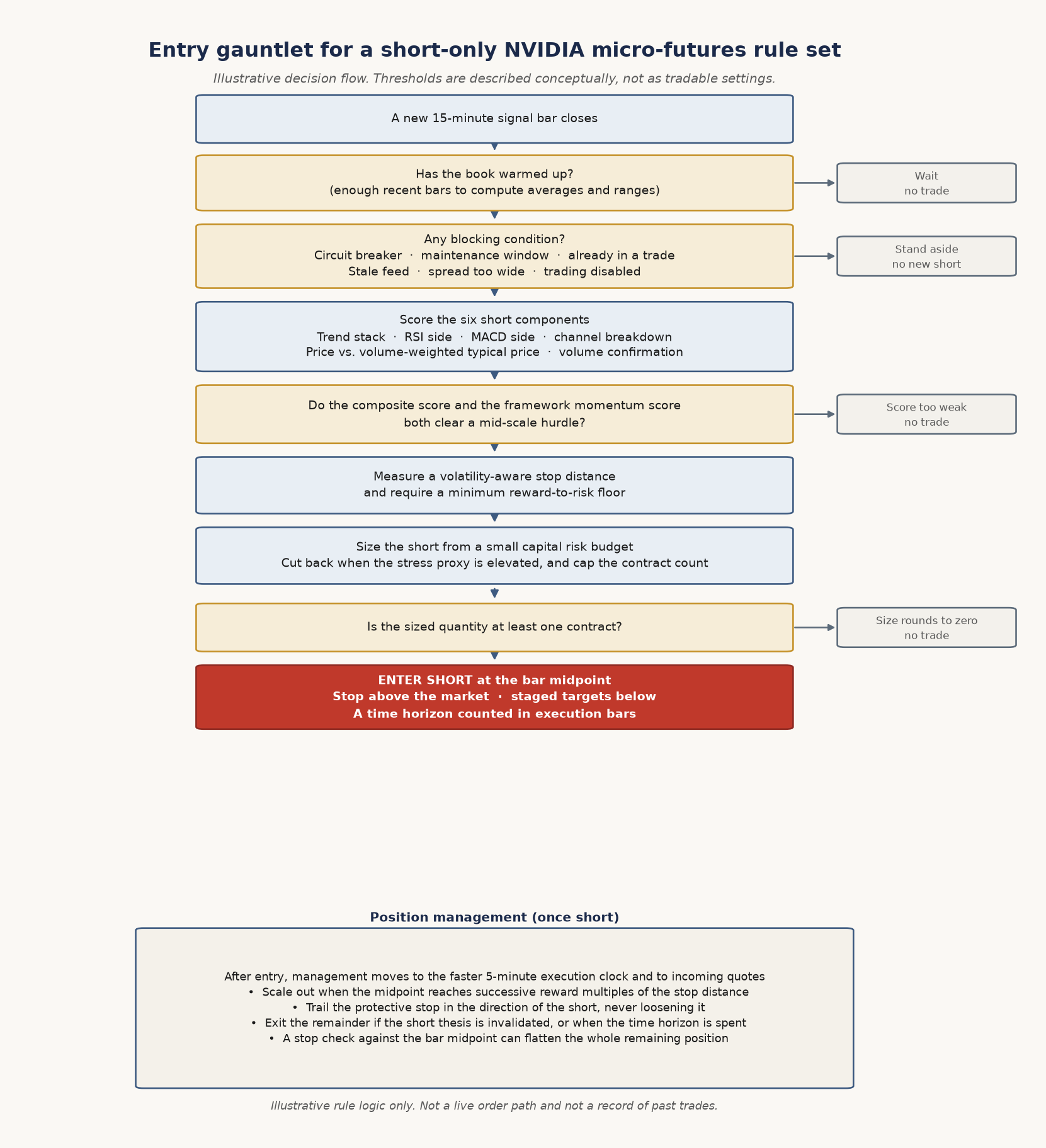
Figure 1. Illustrative decision flow for a new short. Side exits are “stand aside” states, not opposite trades. Thresholds are conceptual.
The short score: six components, then a second vote
At the heart of the entry is a composite short score. Each of six conditions is treated as present or absent. The share that are present is converted into a 0-to-100 style score, and a mid-scale hurdle has to be cleared. A perfect six-out-of-six is not required; a majority-flavored agreement is, plus one more vote from outside the six.
The six votes are:
A bearish trend stack. Price should be below a short-lookback average of recent closes, and that fast average should not be above a longer, still modest average, so the system does not short into a rising short-term trend.
A bearish RSI-style reading. A standard-lookback oscillator has to sit on the weak side of its midline. This is a regime filter, not an oversold fade: momentum should already be leaning down.
A negative short-cycle MACD-style histogram. A faster average minus a slower one, with a short signal smooth, must be below its signal. The cycles are short, so this vote can flip more often than a textbook MACD.
A breakdown through a recent channel low. The close has to be at or through the lowest low of a modest-lookback Donchian-style channel. Because the current bar’s low is part of that channel, this is a close at the window’s lows, not a mid-bar dip.
Price below a volume-weighted typical price over a similar lookback (high, low and close, weighted by volume). If volume is missing, the measure falls back to a simple average of closes.
Volume confirmation. This bar’s volume should be at least as heavy as a recent average. A quiet breakdown can still collect other votes, but not this one.
Those six votes are averaged into the composite score. Alongside them, the playbook reads a momentum score from the broader framework it sits inside. The exact construction of that second score is not in this rule file. The joint rule is what matters: both scores must clear a mid-scale hurdle. Either score failing is enough to stand aside.
when a 15-minute signal bar closes, and warmup is complete:

    compute a fast average and a slower average of recent closes
    compute a mid-length RSI-style reading
    compute a short-cycle MACD-style histogram
    compute a channel low over a modest lookback
    compute a volume-weighted typical price over a similar lookback
    compare this bar's volume with a recent average volume

    mark each of the following as present or absent:
        price is below the fast average, and the fast average is not above the slow average
        the RSI-style reading is on the bearish side of its midline
        the MACD-style histogram is negative
        price is at or through the channel low
        price is below the volume-weighted typical price
        this bar's volume is at least as heavy as the recent average

    turn the share of present components into a 0-to-100 style composite score
    also read the framework's separate momentum score

    if both scores clear a mid-scale hurdle
    and no blocking gate is on
        a short is eligible, subject to sizing and the reward-to-risk floor
    otherwise
        stand aside and wait for the next signal bar
This is a confirmation stack, not a single-indicator religion: even the channel breakdown cannot open a trade on its own.
The entry gauntlet: what can still say no
A passing score is necessary. It is not sufficient. Before a short is opened, a gauntlet of gates still has to clear.
Warmup. If there are not yet enough closed signal bars to compute the averages, the channel and the oscillators honestly, the score is treated as zero and the system waits.
One position at a time. If a short is already on, no new one is added. There is no pyramid.
A master tradeable switch. The book can be marked untradeable by configuration. Scores may still be logged, but no new short is opened.
Spread quality. A dynamic budget is built from a recent history of spreads and from recent return variability, and an inherited spread gate must pass. In a single-name micro contract, a wide spread is a silent widening of the stop, so this gate is not cosmetic.
Stale data. If the last usable quote is older than a short, poll-scale allowance, no new short is opened.
Reward-to-risk floor. The implied target distance must clear a minimum multiple of the stop distance, in the classic two-units-of-reward-for-one-unit-of-risk neighborhood. The floor is not relaxed when recent trades have been poor; recent results can only ask for a more ambitious multiple. If the floor cannot be met, the entry is abandoned.
Size must be at least one contract. After the risk reductions described below, the quantity is a whole number of contracts and is capped at a small maximum. If the math rounds to zero, the trade is skipped.
Risk circuit breakers and the maintenance window, treated later, also sit in this gauntlet. If the day or the week is already halted, or the clock is inside the late-afternoon exchange break, the score is irrelevant.
Only when the whole list is clear does the system mark a short at the current bar midpoint, place the initial stop above it, register staged targets below it, set a holding horizon in execution bars, and record the position as open.
Stops that widen when the tape is stressed
The initial stop for a short lives above the market. Its distance is the wider of a multiple of a recent average true range and a small minimum counted in estimated ticks. The tick floor keeps a quiet tape from collapsing the stop to a sliver; the range multiple keeps a violent tape from stopping the short out on ordinary noise.
That multiple is regime-aware. The playbook builds a stress proxy from the variability of recent returns and from the average true range as a fraction of the current midpoint. In a calm tape the multiple stays relatively tight; in a normal-stress band it is stepped up; when the proxy is clearly elevated it is stepped up again. In a hotter tape, the short gets more room — and, as the next section shows, less size, so the wider stop does not quietly inflate the dollar risk.
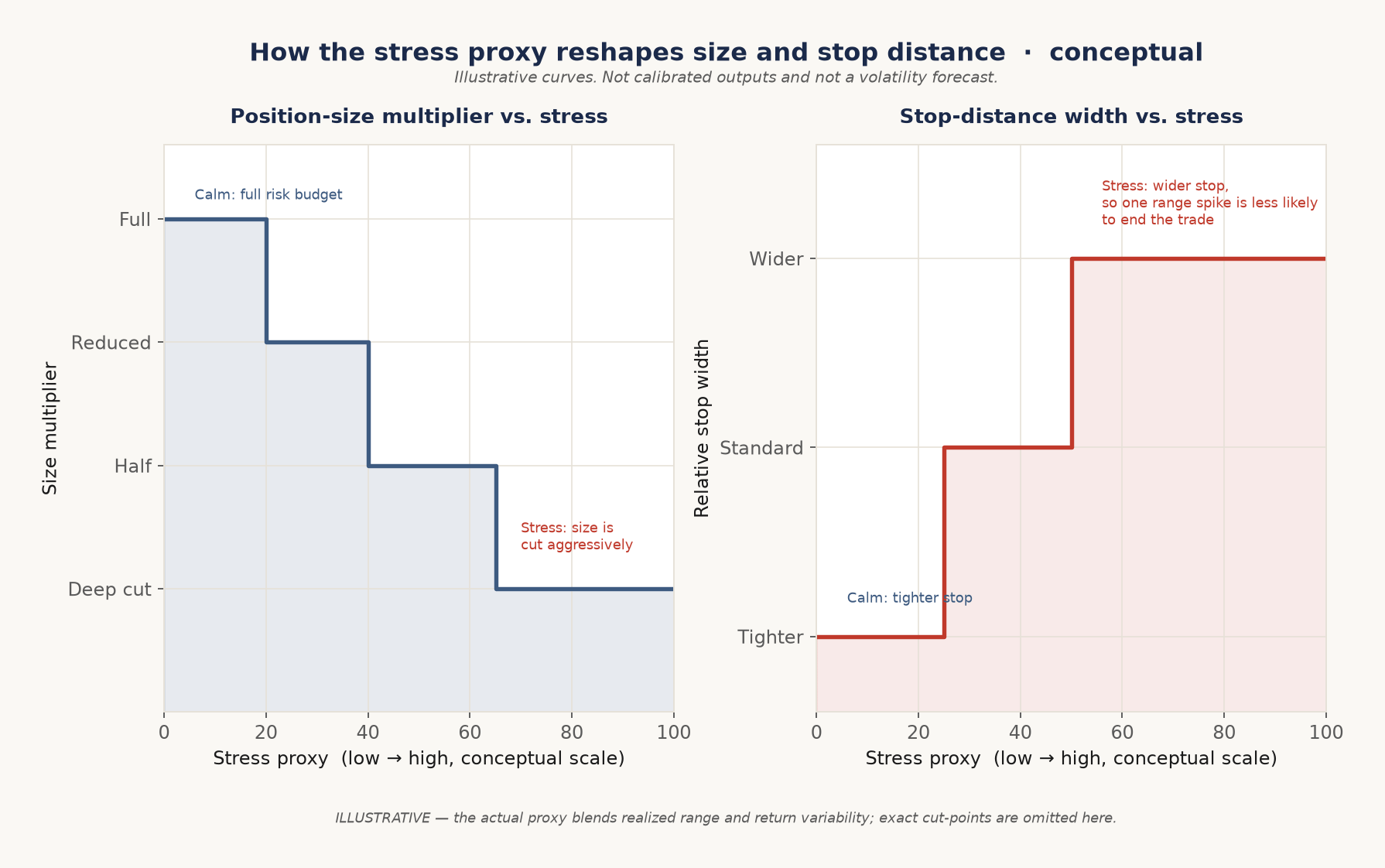
Figure 2. Conceptual only. As the stress proxy rises, size is cut in steps and the stop is allowed to widen. Exact cut-points are omitted.
Because entries and stop checks use a bar midpoint, a spike that does not leave the completed bar’s midpoint through the stop may not be treated as a stop-out. Tick-level protection is not part of this rule book.
Scaling out: bank a piece, leave a runner
The playbook does not treat a short as an all-or-nothing bet on a collapse. Once the short is on, it registers three targets below the entry, each a multiple of the same stop distance that defined the risk unit: 1R, 2R, and a 3R-or-better runner that can stretch farther if the dynamic reward-to-risk multiple has been allowed to rise.
The position is split into tranches that, in spirit, take a first piece off at 1R, a smaller piece at 2R, and leave a runner for the stretch target. On a large enough contract count, that looks like a half, a quarter, and a remainder. On a small contract count — and this book’s hard cap is small — a neat split may not be possible. The teaching sketch is the idea (reduce, reduce, run); the arithmetic on a one- or two-lot is necessarily lumpier.
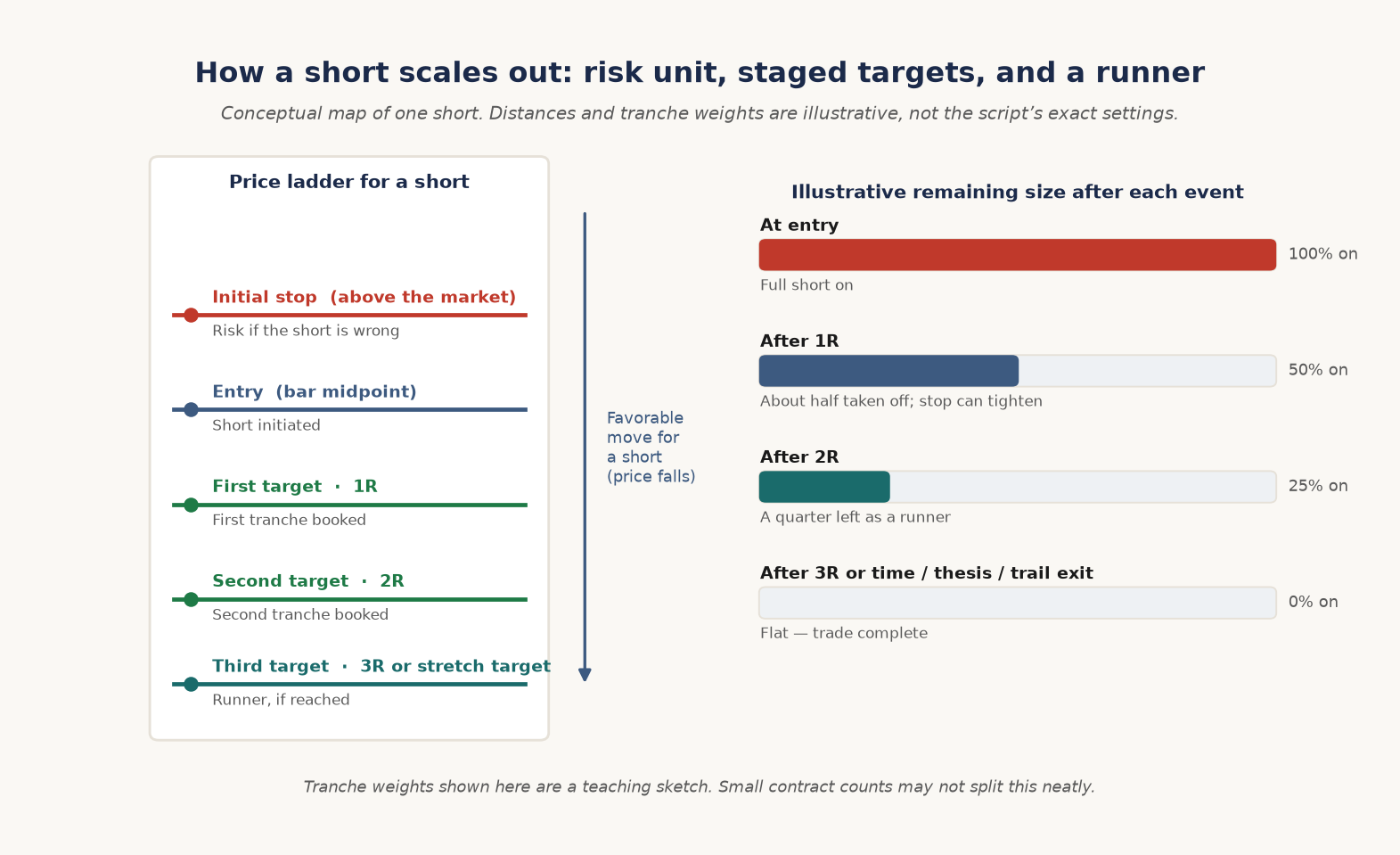
Figure 3. A teaching map of risk, entry and staged targets for a short. Tranche weights are illustrative. Small sizes may not split this neatly.
Scale-outs are evaluated on the 5-minute execution clock. When the midpoint reaches a target that has not yet been hit, the matching tranche is covered and the remainder stays on; a later stop, time exit, or thesis exit then applies only to what is left.
Trailing the remainder, and only in one direction
After entry, the playbook tracks how far the midpoint has travelled below the entry. A trailing stop is then proposed above the current midpoint, at a distance that scales with the recent average range and with a multiple that can widen a little when the book’s recent win rate has been better. A tick-based floor again prevents the trail from collapsing to nothing. The trail may tighten and never loosen: for a short, the stop can only move down. Early in the trade, the initial stop may be tighter than a brand-new trail and will stand until the trail actually improves it. After a clean move down, the trail can migrate below the entry, so the runner can be protected into a locked-in gain.
on each 5-minute execution bar, while a short is open:

    measure how far the midpoint has moved below the entry
    remember the best (most favorable) of those readings

    propose a new stop at
        current midpoint plus a range-based trail distance
        (the distance has a small tick floor)

    if no stop exists, adopt the proposal
    otherwise keep the lower of the current stop and the proposal
        so a short's stop can only tighten downward
In a well-behaved decline, the first two targets can be hit, the trail can step down beneath the entry, and a later bounce can take the runner off at the trail. The synthetic example below is built to show that sequence — not a historical NVIDIA chart, and not a claim that the rules produced this path.
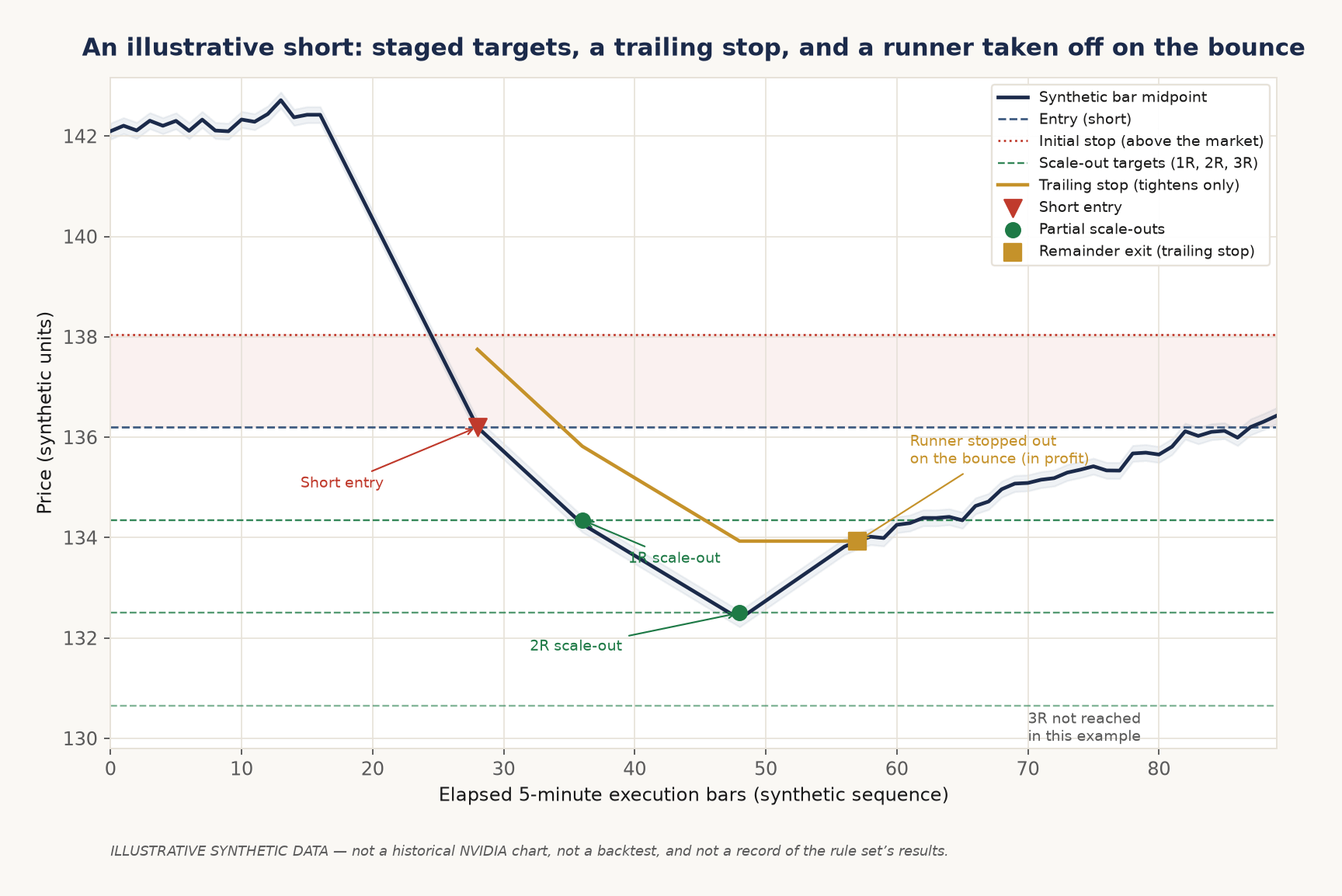
Figure 4. Synthetic data, clearly labelled. A short is entered, scaled at 1R and 2R, and the runner is taken off on a bounce into a tightened trail. The third target is not reached. Not a backtest.
When the thesis dies, and when time is up
Not every short will tag a target or a trail. Two discretionary exits can flatten whatever is left, and both respect a short minimum hold: at least one 5-minute execution bar must complete before they may fire. The system will not enter on a 15-minute close and immediately abandon the idea on the same management pass.
Thesis invalidation. The short is treated as wrong — not merely late — when three recovery conditions appear together on the execution book: the fast average has recrossed above the slow average, the RSI-style reading has moved back through the midline into modestly firm territory, and the short-cycle MACD-style line has turned positive. All three have to agree. When they do, the remainder is covered at the midpoint. Getting in was a majority of a six-vote committee; getting out for thesis reasons is a unanimous recovery vote from a smaller one.
A time horizon. At entry, the playbook also sets a holding period in execution bars. The length is modest — several bars at the short end, a couple of dozen at the long end — and it tightens when variability is higher. A hotter tape is given less time, not more. If the horizon is spent and a remainder is still on, that remainder is covered.
on each 5-minute execution bar, while a short is still open:

    update the trailing stop
    if the midpoint has reached any untouched target:
        cover the matching tranche

    after at least one execution bar has passed since entry:
        if the fast average is back above the slow average
        and the RSI-style reading has moved into modestly firm territory
        and the short-cycle MACD-style line is positive:
            cover the remainder  (thesis invalidated)
        else if the holding horizon, counted in execution bars, is spent:
            cover the remainder  (time exit)
The protective stop is not a discretionary exit and does not wait on that minimum hold. It is checked in the quote handler: if a short is on and the midpoint is at or through the current stop, the whole remainder is covered.
Sizing: a small risk budget, then three haircuts
Position size starts with a simple risk budget and then is talked down by the tape. The budget is a small percentage of account capital, in the low single-digit range, and it shrinks toward the lower end of that band when the stress proxy is elevated. Dollar risk is that percentage times capital. Per-contract risk is the stop distance times the contract’s point value (and a multiplier, if one is configured). Raw size is dollar risk divided by per-contract risk.
Then come the haircuts. A stress-proxy size adjustment leaves the multiplier at full size in a calm regime and steps it down — through a reduced fraction, then to half, then to a deep cut — as the proxy rises, so a hot tape cannot widen the stop and keep the contract count unchanged. A range adjustment compares a longer-lookback average range with the current one: quieter than baseline can allow a modest, capped increase; hotter than baseline reduces size, with a floor so the adjustment cannot vanish the trade by itself. A framework momentum scaler, whose exact formula is not in this rule file, can cut or lift size further. The result is converted to a whole number of contracts, must be at least one or else the trade is skipped, and is capped at the small maximum the book allows. The capital used in the budget is the configured starting capital, not marked-to-market equity, so wins do not automatically buy a larger next short.
risk fraction is a small share of starting capital
    and is cut toward the low end of its band when the stress proxy is high

dollar risk = starting capital times that risk fraction
per-contract risk = stop distance times point value
raw contracts = dollar risk divided by per-contract risk

apply a stress-proxy size multiplier  (full size in calm, deep cuts in stress)
apply a relative-range adjustment    (smaller when the current range is hot)
apply the framework's momentum size scale

round down to a whole number of contracts
if that number is less than one: skip the trade
otherwise cap it at the book's small maximum contract count
This is conservative sizing with several independent reasons to do less, and only a narrow, capped reason to do slightly more.
Circuit breakers, the daily calendar, and the maintenance window
The most important risk rules are the ones that refuse to trade.
A daily loss limit. Each session, a daily loss budget is computed from the recent average range, the maximum contract count, the point value, and a session multiplier that grows when variability is higher. If realized results reach that limit, trading is halted for the rest of the day. The limit is recomputed as new signal bars arrive, so a sudden expansion in range can loosen the budget and a compression can tighten it.
A weekly loss limit. A weekly budget is floored so that it cannot be looser than a modest fraction of starting capital would imply, and is typically at least as tight as a small multiple of the daily budget. Breach it, and the week is halted until the weekly calendar rolls.
A consecutive-loss circuit. A short streak of consecutive losing exits — a handful, not a dozen — halts trading for the rest of the day. A later winner resets the streak. Because scale-outs are recorded as separate exits, a profitable first tranche can reset the streak even if the runner is later stopped out at a loss.
A drawdown halt. If realized equity has fallen from its peak by a large double-digit percentage, the day is halted. The peak and the equity are realized, not marked-to-market, so an open short that is deeply underwater does not trip this halt until the loss is realized.
Day and week resets. Daily results, the consecutive-loss count, and the daily halt flag reset when the calendar day changes; weekly results and the weekly halt reset when the weekly calendar rolls. Those calendars are measured in coordinated universal time, not on the CME’s Chicago session clock, so a UTC date change can reset a daily halt in the middle of an American evening session.
The maintenance window. The playbook does not enter during a late-afternoon window meant to respect the exchange break: a one-hour window on Monday through Thursday, and a slightly earlier one-hour window on Friday, approximated in Eastern time with a fixed offset from UTC. That offset does not adjust for daylight time, so the window can drift by an hour across the year. There is no separate weekend close and no explicit “flatten everything before the weekend” rule. If a runner is still on into the Friday break, these rules will refuse new entries, but they will not automatically liquidate what is already open.
These are desk-style circuit breakers, meant to stop a bad afternoon from becoming a bad week.
What this playbook is, and what it is not
A last word on what “enter” and “exit” actually mean. The system keeps its own simulated position and midpoint-to-midpoint realized result, and it can notify a parent framework when a short is opened or covered. Incoming broker fill messages are logged, but they are not what advances that simulated book. There is no intra-bar limit-order model and no slippage budget beyond the spread gate at entry. In a fast tape, that midpoint and the price you would have been filled at can be very different numbers.
It is a short-only, confirmation-heavy, risk-capped way of selling weakness in an NVIDIA micro futures contract. It wants agreement across trend, momentum, a breakdown, a volume-weighted location, and volume, plus a second vote from a framework momentum score. It sizes from a small, stress-sensitive budget, scales out, trails what is left, and will abandon a short that has run out of time or been contradicted by a recovery in the same measures that justified it. It will also refuse to trade when the feed is stale, the spread is poor, the exchange is in its late-afternoon break, or a daily, weekly, streak, or drawdown circuit has tripped.
It is not a news trader, despite an event-inspired name. It is not a long/short rotation, a tick-stop scalper, or a weekend-flattening session bot, and it is not a fully specified system: part of the momentum vote, the spread, stale and warmup gates, and an average-range fallback live in a parent framework that this rule file does not define. And it is not, on the evidence available here, a proven edge. There is no backtest, no out-of-sample study, and no realized performance table to cite. The rules are shown so they can be understood and debated, not followed as a promise of profit.
Questions the file does not answer — how the rules behave around NVIDIA earnings, whether UTC calendar resets are the right clock for a CME session, whether bar-midpoint stops are acceptable in a name that can gap, and whether a small hard cap and a starting-capital budget still make sense as the account moves — remain research questions. They are not settled by a tidy rule book.
Again: this is not financial advice, not a solicitation, and not a performance claim. Futures trading can result in losses that exceed your margin. Treat the playbook as an educational description of a short-only rule set, and make no decision from it without independent judgment and, if appropriate, professional advice.