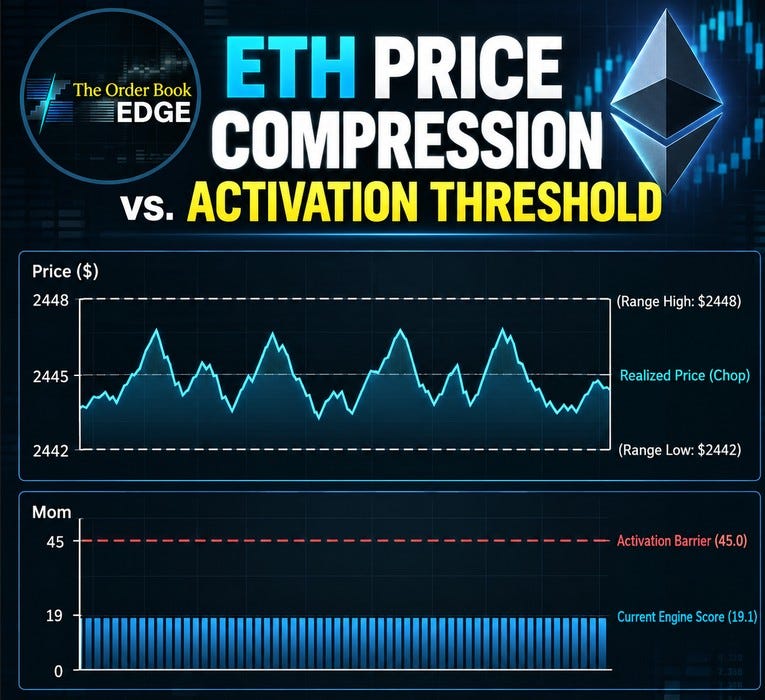

======================================================================================== PRODUCTION SYSTEM TELEMETRY MONITOR Engine Status: ONLINE | Active Runners: 4 | Global Orders: 0 | Capital at Risk: $0.00======================================================================================== Runner Timeframes Ticks Ingested Primary Gate Status---------------------------------------------------------------------------------------- Bot 1: HG (Copper) 1h Sig / 10m Exec 11,614 REJECT (Momentum < 48, Trend Down) Bot 2: ETH (Ether) 30m Sig / 5m Exec 18,510 REJECT (Magnitude Low: 19.1 < 45) Bot 3: CL (Crude) 30m Sig / 5m Exec 4,947 REJECT (Direction Mismatch: Bullish) Bot 4: RB (Gas) 10m Sig / 2m Exec 135 REJECT (Warmup: 0/60 Bars Hydrated)========================================================================================
1. The “Broken Bot” Syndrome
Few moments in systematic quantitative trading induce as much quiet anxiety as watching an automated runner sit completely flat while the market moves around it.
You deploy a suite of automated trading runners to production. Your infrastructure is green across all health checks. The WebSocket feeds are humming, raw tick data is streaming in by the tens of thousands, and your terminal outputs confirm that asynchronous event loops are processing inbound quotes every few milliseconds.
Yet, after hours of execution time across multiple liquid assets, your blotter reads:
Active Positions : 0
Open Orders      : 0
Executions Today : 0
Total Fills      : 0
The immediate psychological instinct—an instinct carried over from manual, discretionary trading—is panic:
Did the market data connection drop silent tick packets?
Is there an unhandled asynchronous exception silently swallowed inside an event handler?
Did a developer misconfigure the symbol mappings, contract tick sizes, or broker order parameters?
Are the strategy parameters absurdly over-fitted, locking the system in perpetual paralysis?
In quantitative and algorithmic execution, doing nothing is an active risk decision.
A well-architected execution harness does not exist to execute trades; it exists to veto trades. Its primary mandate is capital preservation through aggressive elimination: systematically filtering out high-frequency noise, identifying unfavorable market regimes, verifying liquidity, and rejecting marginal opportunities until a mathematically robust edge presents itself.
This article provides an end-to-end forensic autopsy of a real production telemetry snapshot across four algorithmic runners: High Grade Copper (HG), Ethereum (ETH), Crude Oil (CL), and RBOB Gasoline (RB).
Each bot runs an asynchronous, multi-timeframe (MTF) trend-following and momentum-breakout architecture. None of them have fired a trade. Through diagnostic logs, bar telemetry, state-machine tracking, and pseudocode, we will examine why every single one of these runners is behaving correctly—and how their refusal to pull the trigger is actively protecting capital.