


.
1. Introduction: The Evolution of Electronic Futures Infrastructure
Electronic trading in financial futures and derivatives operates under extreme operational constraints. In contemporary market microstructure, where market participants compete across microsecond thresholds, the physical and logical architecture separating a trading decision from an exchange matching engine dictates commercial viability. Market participants cannot afford the latency penalties, data conflation, or structural overhead introduced by consumer-tier brokerage conduits.
Within this high-stakes landscape, Rithmic has established itself as an institutional-grade pillar of derivatives infrastructure. Founded to address the specific performance bottlenecks that plagued first-generation electronic routing, Rithmic provides high-throughput, low-latency market data distribution, ultra-fast order routing, and deterministic pre-trade risk management. While retail retail traders recognize Rithmic through third-party platforms or front-end graphical interfaces, the core of the company’s enterprise footprint—as detailed across its primary technological nexus at rithmic.com—is its high-capacity proprietary transaction engine: the R | Trade Execution Platform™.
Historically, accessing direct-market-access (DMA) futures data and order execution required substantial capital outlays, complex co-location leases at matching engine data centers, and dedicated telecommunications infrastructure. Proprietary trading desks and quantitative developers often found themselves constrained by two suboptimal integration paradigms:
Clunky, desktop-centric software environments that mandated tethering proprietary logic to local graphical user interfaces (GUIs) running exclusively on legacy operating systems.
Opaque, heavily aggregated retail data pipes that smoothed over microstructural anomalies, masked liquidity gaps, and injected unpredictable latency into order routing.
Rithmic dismantled this dichotomy by building an institutional execution ecosystem accessible through standardized, modern integration pathways. Operating at the intersection of exchange matching engines and quantitative client applications, Rithmic acts as an ultra-high-speed translation, routing, and risk-enforcement fabric.
An essential architectural advancement in Rithmic’s design is platform independence. Modern algorithmic systems, proprietary quantitative models, and institutional back-testing engines operate almost exclusively in POSIX-compliant environments—predominantly enterprise Linux distributions and Unix-based systems such as macOS. For years, trading platforms compelled developers to maintain active Windows desktop sessions, forcing custom algorithms to route through desktop software hooks or local loopback inter-process communications (IPC).
As highlighted throughout rithmic.com, Rithmic’s network infrastructure bypasses this requirement completely. Through native, headless network connectivity, quantitative trading engines running directly on bare-metal Linux servers or macOS workstations communicate seamlessly with Rithmic’s global gateway clusters. There is no requirement to deploy, launch, or bridge through the Rithmic Windows desktop software.
Understanding Rithmic requires examining the structural elements of its ecosystem:
Its server-side risk management engines.
Its unaggregated tick distribution pipeline.
Its specialized API portfolio—comprising R | API+™, R | Protocol API™, and R | Diamond API™.
2. The Core Foundation: R | Trade Execution Platform™
At the core of Rithmic’s operational footprint is the R | Trade Execution Platform™. This purpose-built trading engine was designed from the ground up to eliminate non-deterministic delays in electronic order processing. The platform handles three primary functions:
+-----------------------------------------------------------------------+
|                    R | Trade Execution Platform™                      |
+-----------------------------------------------------------------------+
|  1. Ingestion of raw Multicast market data feeds directly from        |
|     exchange engines (CME, EUREX, ICE, etc.).                         |
|  2. Real-time normalization of market telemetry into unified data    |
|     formats without record drop or artificial conflation.            |
|  3. Microsecond-grade hardware and software timestamping at the      |
|     outermost edge of the routing fabric.                             |
|  4. Centralized, multi-broker, multi-account pre-trade risk          |
|     enforcement applied completely out-of-band on server hardware.    |
|  5. Low-latency protocol parsing and order serialization back to     |
|     exchange matching engines.                                       |
+-----------------------------------------------------------------------+
The Elimination of Intermediate Hops
In standard brokerage configurations, an order generated by an automated execution strategy passes through multiple serialization and validation layers:
[Strategy Algorithm]
         │
         ▼
[Local Client Interface / Bridging DLL]
         │
         ▼
[Brokerage Front-End Gateway]
         │
         ▼
[Brokerage Risk Server / Database Check]
         │
         ▼
[Clearing House Pre-Routing Hub]
         │
         ▼
[Exchange Native Gateway (e.g., CME iLink)]
         │
         ▼
[Exchange Matching Engine]
Every transition across physical network boundaries, software wrappers, and translation layers adds serialization delays, network buffer bloat, and thread contention. In volatile market events, these intermediary hops introduce queueing delays, resulting in severe price slippage and missed fills.
The R | Trade Execution Platform™ strips away these extraneous intermediate layers. Client applications communicate through direct TCP/IP or secure streaming sockets terminating directly into Rithmic’s exchange-proximate point of presence (PoP). From this entry point, the platform evaluates the order against its integrated, in-memory risk matrix and routes it straight through native exchange-facing protocols (such as CME iLink 3) to the matching engine.
By collapsing middle-tier translation hubs, database writes, and brokerage routing hops into a unified execution fabric, Rithmic delivers deterministic routing latencies that routinely measure in sub-millisecond ranges.
Global Colocation and Network Topology
Network latency is ultimately bound by physical distance and fiber propagation delay. To achieve competitive throughput, Rithmic operates an infrastructure footprint situated within the world’s most critical financial data centers:
Equinix NY4 (Secaucus, New Jersey): Serving US equity, index derivatives, and institutional multi-asset hubs.
CME Aurora Center (CyrusOne, Aurora, Illinois): Housing the CME Globex matching engines, where Rithmic maintains high-density infrastructure for direct cross-connect access to equity index, agricultural, energy, metals, and interest rate products.
Equinix FR2 (Frankfurt, Germany): Anchoring continental European trading venues, including Eurex derivatives.
Equinix LD4 (Slough, United Kingdom): Serving London-based global derivatives and international currency complexes.
Within these facilities, Rithmic connects its high-throughput switching architecture via single-mode optical fiber directly into exchange distribution panels. When a quantitative platform running on an infrastructure co-located within the Aurora data center communicates with Rithmic, the physical network path spans yards of glass rather than public internet backbones. This physical proximity, coupled with Rithmic’s streamlined protocol design, lowers round-trip latency close to the physical limits of hardware switching.
3. Market Data Purity: Unfiltered Precision and Microstructural Visibility
A trading algorithm is only as competent as the perceptual fidelity of its incoming data. In algorithmic trading, systems must accurately reconstruct the exchange order book in real-time to compute imbalances, calculate fair value vectors, and trace liquidity migration.
Unaggregated vs. Conflated Data Streams
Most consumer brokerage connections and retail charting applications employ data conflation (often referred to as aggregation or throttling). Under a conflated data model, the data provider’s server captures incoming ticks from an exchange, buffers them internally over a window of time (such as 100 milliseconds to 250 milliseconds), and transmits only a single summarized snapshot of price and volume to the client.
While conflation reduces bandwidth demands for the provider, it strips out critical market information:
It completely obscures the order in which trades occurred within the sampling window.
It hides brief price spikes, transient liquidity gaps, and immediate quote cancellations.
It presents an artificial, smoothed representation of market dynamics that renders microstructural analysis and order flow modeling impossible.
Rithmic takes the opposite approach. Across all its connectivity interfaces, as highlighted on rithmic.com, Rithmic distributes tick-by-tick, unaggregated market data. Every single trade, quote update, depth modification, and cancellation registered by the exchange matching engine is processed, normalized, and streamed downstream to the client without artificial delays or synthetic smoothing. If an exchange engine broadcasts twenty changes to the inside bid within a single millisecond, Rithmic delivers twenty discrete, serialized update events to the subscriber.
Microsecond Timestamping
The sequence of market events is essential for quantitative analysis. When multiple orders hit the market in rapid succession, knowing which event triggered a subsequent reaction determines the validity of a predictive model.
In conventional routing setups, timestamps are assigned when a packet is processed by a local operating system’s software layer. This introduces substantial timing jitter driven by local CPU scheduling, operating system interrupts, and local buffer processing.
Rithmic eliminates this ambiguity by exposing microsecond-precision timestamps generated directly at the gateway layer when market data leaves the exchange, and when inbound client orders cross Rithmic’s network edge. This level of precision enables quantitative strategies to:
Calculate accurate packet transit times and network flight latency.
Accurately correlate outbound order actions with prevailing market depths down to the microsecond.
Construct backtesting environments based on actual temporal market sequencing rather than synthetic intervals.
Market by Order (MBO) and Market Depth (L3)
Modern market microstructure increasingly prioritizes Market by Order (MBO) data—often referred to as Level 3 (L3) data—over traditional Market by Price (MBP) / Level 2 (L2) data feeds.
Market by Price (MBP): Aggregates all orders at a given price level into a single cumulative size figure. A trader or system can see that there are 500 contracts offered at a given level, but has no insight into how that volume is partitioned.
Market by Order (MBO): De-aggregates this data into individual, discrete orders, each accompanied by an exchange-assigned priority queue identifier.
MBO data allows an execution algorithm to pinpoint its exact location in the exchange queue. It can observe how many individual orders sit ahead of it, track queue-jumping behaviors, detect when large participants cancel or modify specific orders, and quantify the distribution of retail versus institutional lot sizes. Rithmic’s infrastructure supports full-depth, tick-by-tick MBO distribution directly across its API ecosystem, supplying algorithmic developers with deep microstructural visibility into modern electronic order books.
4. Server-Side Risk Management: The Enterprise Shield
In electronic futures trading, algorithmic execution systems can run into unexpected failure modes: network partitions, logic loops, unhandled edge-case events, or miscalculated position-sizing equations. Without strict risk controls, a misbehaving trading strategy can submit thousands of duplicate orders within seconds, draining account margin and exposing the firm or clearing broker to severe financial liability.
Many consumer-oriented trading systems handle risk management purely on the client side. In these architectures, risk parameters (such as maximum position size, maximum daily drawdown, or order frequency limits) are monitored by local desktop software or inside the client’s algorithmic code.
This model introduces severe systemic vulnerabilities:
If the client platform crashes, freezes, or loses network connectivity, its internal risk tracking state machine ceases to function.
If an algorithm enters an uncontrolled loop that swamps its local process memory, it can fail to halt its own trading.
Disconnected client systems cannot monitor server-side resting orders (such as working stops and limits), leaving open positions unprotected during market disruptions.
CLIENT-SIDE RISK FAILURE MODES:
[Algorithm Process] ──(Crash / Network Loss)──> [Risk Monitoring Drops]
                                                         │
                                                         ▼
                                          [Server Continues Unchecked /
                                           Resting Orders Abandoned]

RITHMIC SERVER-SIDE RISK TOPOLOGY:
[Algorithm Process] ──(Commands)──> [Rithmic Infrastructure RMS] ──> [Exchange]
                                                 │
                             (Applies Limits, Auto-Liquidates,
                              Enforces Drawdowns, Independent
                              of Client State)
Infrastructure-Layer Risk Enforcement
As documented on rithmic.com, Rithmic’s platform decouples risk management entirely from the client application, running it directly within its centralized Risk Management System (RMS) at the server infrastructure tier.
Rithmic’s RMS acts as a strict, non-bypassable checkpoint between the API connection and the exchange gateway. Every inbound transaction—whether to submit a new order, modify an existing working ticket, or cancel an open instruction—must clear the RMS rules engine before serialization to the matching engine.
Because this evaluation occurs entirely out-of-band on high-performance server hardware within the data center, it functions completely independent of the client application’s operational health:
Position and Quantity Limits: Strict caps on maximum open contracts per symbol, total aggregate contracts across an entire portfolio, and maximum permissible clip sizes on single order tickets.
Auto-Liquidation Thresholds: Centralized monitoring of real-time realized and unrealized profit-and-loss (PnL). If account equity breaches a predetermined trailing loss limit or dynamic intraday drawdown floor, the Rithmic RMS instantly intercepts order flow, cancels all working orders across all venues, and executes market orders to immediately flatten all open positions.
Loss-Limit Lockouts: When an auto-liquidation event triggers, the platform automatically locks the account profile, preventing algorithmic loops or manual override commands from establishing new market exposure until an administrative risk officer unlocks the account.
Network-Loss Safety Systems: If a client strategy experiences network interruption or loses socket connectivity, Rithmic’s server-side engine can automatically cancel all associated working bracket orders or resting limit orders, insulating the trader from unmonitored execution during structural communication outages.
Institutional Multi-Tier Risk Topology
Rithmic’s server-side RMS is designed to accommodate multi-tiered account hierarchies. This makes it a preferred infrastructure partner not only for individual high-volume traders, but also for Futures Commission Merchants (FCMs), introducing brokers, proprietary trading syndicates, and remote evaluation/prop-funding enterprises.
Within this hierarchy, risk administrators can establish global umbrella rules across an entire firm, subdivide them into desk-level profiles, and drill down to distinct, customized rulesets applied to individual trader accounts. A centralized risk desk can monitor thousands of active accounts concurrently through a unified management interface, adjusting parameters in real-time without interrupting trading processes.
5. Architectural Breakdown of the Three Rithmic APIs
To serve a diverse spectrum of market participants—ranging from traditional systems architects building compiled desktop platforms, to cross-platform quantitative funds, to ultra-low-latency market makers—Rithmic offers three distinct, specialized APIs.
While all three interfaces communicate with the same core R | Trade Execution Platform™ and route through the same underlying server-side risk framework, their internal protocols, integration models, and target performance profiles are configured for different operational requirements.
+-------------------------------------------------------------------------------+
|                      RITHMIC API ARCHITECTURAL SUITE                          |
+---------------------+-------------------------------+-------------------------+
|      R | API+™      |       R | Protocol API™       |    R | Diamond API™     |
+---------------------+-------------------------------+-------------------------+
| • Native C++ / .NET | • Language & OS Agnostic      | • Shared-Memory / DMA   |
| • Deep Client-Side  | • Protocol Buffers / Sockets  | • Sub-250 Microsecond   |
|   Server Features   | • Pure Headless Operation     | • Colocated Bare-Metal  |
| • Desktop Engines & | • Linux, macOS, Cloud Deploy  | • High-Frequency /      |
|   Complex Algorithmic| • Microservices, Web, Mobile  |   Proprietary Market    |
|   Platforms         |   & Quant Stacks              |   Makers                |
+---------------------+-------------------------------+-------------------------+
6. API Profile 1: R | API+™ (Native High-Throughput Engine)
Strategic Role and Architecture
R | API+™ is Rithmic’s classic, high-performance integration interface designed primarily for developers constructing native desktop applications, execution systems, and intensive quantitative algorithms within native C++ and Microsoft .NET ecosystems.
R | API+™ operates as a high-performance compiled dynamic interface that embeds directly within the memory space of the host trading platform. It is engineered to deliver direct, unmediated access to Rithmic’s engine, prioritizing high message-per-second processing capacity, minimal thread overhead, and optimized local memory usage.
Functional Capabilities
R | API+™ is a feature-rich, high-capability interface, providing deep access to both raw market telemetry and high-level execution features managed directly on Rithmic’s server infrastructure:
Server-Side Advanced Order Paradigms:
R | API+™ enables client software to instruct Rithmic’s servers to manage complex contingent orders off-site. This includes native server-side One-Cancels-the-Other (OCO) sequences, multi-tier bracket orders, dynamic trailing stops, and conditional trigger orders. Because these conditional orders reside directly on Rithmic’s high-speed servers, they execute with immediate proximity to the exchange, bypassing local client-side trigger latencies.Server-Side Bar and Aggregation Engines:
Beyond raw tick-by-tick streaming, applications integrating R | API+™ can offload computational tasks by requesting server-calculated time bars, tick-count bars, volume-aggregated bars, and range-based price bars. Instead of forcing client devices to spend CPU cycles building historical and real-time aggregate charts from billions of individual tick updates, Rithmic calculates these structures on its server clusters and serves them directly down to the calling application.Symbol Search and Granular Reference Data:
R | API+™ provides comprehensive capabilities for querying real-time product definitions, searching contract expiration calendars, retrieving intraday margin tables, and resolving front-month contract identifiers across global exchanges.Microsecond Latency Auditing:
Every execution update, fill event, and order state transition exposed through R | API+™ carries microsecond-precision temporal markers. This provides quantitative execution analysts with the raw operational data necessary to perform comprehensive post-trade execution analysis, isolate internal software delays, and measure structural queue-depletion mechanics across varied market environments.
Target Deployment Scenarios
R | API+™ is primarily suited for:
Independent Software Vendors (ISVs) developing commercial trading platforms designed for local Windows environments or compiled C++ installations.
Proprietary desks with established Windows-centric C# or C++ execution architectures requiring integrated, turn-key access to complex server-side synthetic order management.
Institutional back-testing software running on Windows servers that requires rapid, native-speed processing of large volumes of historical market depth data.
7. API Profile 2: R | Protocol API™ (Modern, Distributed, Multi-Platform Interface)
Strategic Role and Architecture
As the algorithmic trading landscape has modernized, reliance on proprietary, platform-specific dynamic libraries has diminished. Today’s quantitative developers, fund managers, and infrastructure architects demand modern, decoupled, network-native connectivity. They require systems that integrate easily into containerized microservices, distributed cloud backends, and high-performance computing clusters running on POSIX-compliant operating systems.
To meet this demand, Rithmic introduced R | Protocol API™. As noted on rithmic.com, R | Protocol API™ has rapidly become the flagship integration pathway for modern builders, systematic hedge funds, and bespoke algorithmic operations.
Instead of requiring developers to link proprietary compiled binary libraries into their software, R | Protocol API™ relies on a standards-based, lightweight, high-performance messaging paradigm: Google Protocol Buffers (Protobuf) streaming over high-speed WebSockets or direct TCP sockets.
+--------------------------------------------------------------------+
|               R | PROTOCOL API™ ARCHITECTURE                       |
+--------------------------------------------------------------------+
|                                                                    |
|  [Client Strategy: Linux / macOS / Cloud]                          |
|         │                                                          |
|         │ (Native TCP / WebSocket Connection)                      |
|         │ (Google Protocol Buffers Serialization)                  |
|         ▼                                                          |
|  [Rithmic Gateway Cloud / PoP Edge]                                |
|         │                                                          |
|         ▼                                                          |
|  [R | Trade Execution Platform™ & Server RMS]                      |
|         │                                                          |
|         ▼                                                          |
|  [Direct to Exchange Matching Engine (CME, EUREX, etc.)]          |
|                                                                    |
|  NO Windows host required.                                         |
|  NO R | Trader Pro desktop software required.                      |
|  NO local IPC / dynamic library wrappers.                          |
+--------------------------------------------------------------------+
The Serialization Framework: Protocol Buffers
Google Protocol Buffers provide a language-neutral, platform-neutral, extensible mechanism for serializing structured data. Protobuf compiles structural data schemas into compact, optimized binary wire-formats that are substantially smaller and faster to process than text-based protocols like JSON, XML, or standard character-delimited FIX engines.
By adopting Protobuf over direct network sockets, R | Protocol API™ delivers several core architectural benefits:
True Language Agnosticism: Developers can build their systems in any modern programming language capable of opening a socket and compiling a Protobuf schema—including Python, Go, Rust, Java, C++, TypeScript, or Elixir—without needing vendor-supplied wrappers or bridging layers.
Low Network Overhead: The compact binary serialization significantly reduces byte volume per packet, minimizing serialization latency, avoiding socket buffer congestion, and maximizing network throughput during heavy tick-flow events.
Forward and Backward Compatibility: The schema-driven design ensures that new field definitions or operational flags added to Rithmic’s global infrastructure integrate cleanly without breaking existing client deployments.
Complete Desktop Independence: The Linux and macOS Paradigm
A critical differentiator of R | Protocol API™ is that it operates as a pure headless network protocol.
In many historical retail and semi-institutional futures trading setups, programmatic access was dependent on consumer desktop trading software. Developers were forced into an awkward, fragile arrangement:
They had to spin up a dedicated Windows PC or Windows Server virtual machine.
They were required to install and launch the broker’s desktop software (such as R | Trader Pro) and authenticate through the local GUI.
Their trading algorithms had to communicate with that desktop software through local loopback network adapters, IPC pipes, or local file mappings.
This legacy model introduced major vulnerabilities:
Desktop client software is prone to memory leaks, spontaneous GUI crashes, and unintended operating system reboots driven by background updates.
Running a full GUI desktop consumes extensive CPU cycles, thread handles, and memory that should be dedicated entirely to market analysis and order execution.
Managing enterprise deployments across distributed cloud nodes or co-located servers becomes cumbersome when each instance requires an interactive Windows GUI desktop session.
R | Protocol API™ completely eliminates this desktop dependency.
Systems built on R | Protocol API™ communicate directly across the network with Rithmic’s edge gateways. There is no need to install, launch, or route through the Rithmic desktop software (such as R | Trader Pro) on Windows.
Because it operates as a pure network protocol, an automated execution engine built on R | Protocol API™ can be deployed:
Directly on bare-metal Linux enterprise servers (Ubuntu, Debian, RHEL, Rocky Linux) optimized with low-latency real-time kernels.
Inside lightweight, containerized environments managed by orchestration engines like Docker or Kubernetes.
On local macOS workstations, enabling quantitative analysts to run, debug, and monitor automated trading models natively on their development hardware without running virtualization tools or secondary Windows hardware.
Headless within remote cloud instances (AWS, Google Cloud Platform, Microsoft Azure) positioned directly at the internet exchange points nearest to Rithmic’s data centers.
This platform freedom transforms operational efficiency for algorithmic trading operations. Trading applications run as lightweight, headless system daemons (systemd services) that boot instantly, consume minimal system resources, and run continuously for months without maintenance interruptions.
8. API Profile 3: R | Diamond API™ (Ultra-Low Latency Institutional Co-Location)
Strategic Role and Architecture
At the extreme performance tier of financial engineering, where trading strategies operate on tick-to-trade intervals measured in microseconds, standard network socket layers and generalized application frameworks introduce unacceptable overhead. For market makers, high-frequency quantitative desks, and statistical arbitrageurs competing for top-of-queue priority on exchange order books, Rithmic provides R | Diamond API™.
As detailed on rithmic.com, R | Diamond API™ represents Rithmic’s ultra-low latency execution interface. It is designed specifically for client systems co-located in the same data centers that house Rithmic’s platform infrastructure and exchange matching engines—such as the CME Aurora Center in Illinois.
+-----------------------------------------------------------------------+
|                    R | DIAMOND API™ ARCHITECTURE                      |
+-----------------------------------------------------------------------+
|                                                                       |
|  [Co-Located Algorithmic Engine: Bare-Metal Linux Host]               |
|                                                                       |
|  ==================== Shared Memory / Zero-Copy ====================  |
|                                                                       |
|  [R | Diamond API™ In-Memory Interface Fabric]                        |
|                                                                       |
|  ==================== Direct Kernel Bypass / RoCE ==================  |
|                                                                       |
|  [R | Trade Execution Platform™ Core Kernel Driver]                   |
|                                                                       |
|  ==================== Optical Fiber Cross-Connect =================== |
|                                                                       |
|  [CME Globex / Exchange Matching Engines (Aurora Data Center)]        |
|                                                                       |
|  • Deterministic sub-250 microsecond tick-to-trade profiles.          |
|  • Optimized for co-located bare-metal Linux environments.            |
|  • Eliminates socket buffers and serialization latency.               |
+-----------------------------------------------------------------------+
High-Speed Architectural Principles
R | Diamond API™ achieves an exceptional performance profile—delivering tick-to-trade turnaround latencies below 250 microseconds—by overhauling the underlying data-exchange mechanics:
Shared-Memory IPC and Zero-Copy Data Pipelines:
Instead of marshaling, formatting, and transmitting data across conventional operating system network sockets, R | Diamond API™ uses direct shared-memory channels and zero-copy data architectures. When market data arrives from the exchange, it is populated directly into memory pages accessible by the client strategy. This eliminates memory copy operations, reduces CPU cache misses, and completely removes the serialization/deserialization cycle.Kernel-Bypass Integration:
Traditional network communication requires application data to pass through the host operating system kernel’s network stack, crossing multiple hardware protection boundaries and introducing operating system context switches. R | Diamond API™ is built to interface directly with kernel-bypass networking frameworks (such as Solarflare OpenOnload or DPDK). This architecture routes inbound network packets straight from the physical network interface card (NIC) into user-space application memory, cutting packet transit times to the absolute physical minimum.Optimized for Co-Located Bare-Metal Linux:
R | Diamond API™ is built specifically for bare-metal, high-frequency Linux computing configurations. The interface takes direct advantage of advanced Linux operating system tuning features:CPU Core Isolation (
isolcpus): Dedicating specific physical CPU cores exclusively to the trading thread, preventing the operating system kernel scheduler from preempting the trading strategy.Cache Line Alignment: Structuring data payloads to match hardware memory architectures, ensuring CPU pipelines process market state changes with minimum latency.
Lock-Free Concurrency Queues: Moving data between processing threads via lockless circular ring buffers, preventing thread contention delays when market volatility spikes.
Deterministic Pre-Trade Risk Evaluation:
Even at these high speeds, Rithmic’s risk management protocols remain active. R | Diamond API™ uses specialized, in-memory risk calculation logic configured directly within the local execution path. The engine validates credit boundaries, account quotas, and contract thresholds in nanoseconds, passing the order straight to the exchange gateway without disrupting execution determinism.
Target Deployment Scenarios
R | Diamond API™ is built for:
Quantitative proprietary trading desks executing high-frequency market making, rebate harvesting, and algorithmic spread-arbitrage strategies.
Systematic funds trading high-volume equity-index, interest rate, and commodity futures where queue position dominance directly determines profitability.
Advanced development teams with deep experience in C, compiled performance systems, kernel-bypass drivers, and specialized Linux hardware optimization.
9. Comprehensive Architectural Comparison of Rithmic APIs
To help systems architects and algorithmic traders choose the optimal integration path, the following matrix compares the architectural and functional characteristics of the three APIs offered on rithmic.com:
| Structural Dimension | R | API+™ | R | Protocol API™ | R | Diamond API™ |
| :--- | :--- | :--- | :--- |
| Primary Integration Model | Compiled Binary Interface (.NET / C++) | Structured Protobuf over TCP/WebSockets | Shared Memory / Kernel Bypass / DMA |
| Cross-Platform Compatibility | Windows, with limited compiled Unix libraries | Native Linux, macOS, Unix, Cloud Containers | Co-located Bare-Metal Enterprise Linux |
| Desktop Software Required? | No, but often paired with desktop GUI platforms | No. Pure headless network operation | No. Pure bare-metal headless engine |
| Latency Profile | Sub-millisecond (< 1 ms) | Low millisecond to sub-millisecond (< 1 ms) | Ultra-low latency (Sub-250 microseconds) |
| Language Portability | Restricted to C++, C#, VB.NET | Universal (Any language with Protobuf/Sockets) | C, C++, Assembly-optimized architectures |
| Server-Side Order Types | Extensive (Trailing Stops, OCOs, Brackets) | Full suite of native and synthetic order types | Raw Direct-Market-Access (DMA) Exchange Types |
| Server-Side Synthetic Data | Time, Tick, Volume, and Range aggregation bars | Normalized ticks, MBO, MBP, server aggregation | Raw unaggregated MBO/MBP tick streams |
| Infrastructure Deployment | Local workstations, institutional trading servers | Distributed Cloud, Linux Nodes, Local macOS | Direct Data Center Co-location (e.g., CME Aurora) |
| Primary Target Market | ISVs, Native Platform Builders, Desktop Desks | Modern Quants, Cloud Developers, Sys Admins | High-Frequency Market Makers, Quant Desks |
10. Running Headless on Linux and macOS: Practical Architectural Workflows
One of Rithmic’s most impactful contributions to the quantitative and systematic futures ecosystem is breaking the historical dependency on local Windows desktop software. Understanding how this operational shift works provides practical insight into modern systems design.
THE DISTRIBUTED MULTI-OS DEPLOYMENT MODEL

[macOS Workstation]
(Research, Prototyping, Strategy Monitoring)
         │
         │ (Secure Socket Channel / Protobuf)
         ▼
[Centralized Gateway Cloud: Rithmic Global Infrastructure]
         ▲
         │ (Direct Ultra-Low Latency Wire / Protobuf)
         │
[Linux Production Node (Bare-Metal / Docker)]
(Headless Algorithmic Execution Engine,
 Dedicated Execution Loop, POSIX Sockets)
The Architectural Problem with Desktop GUI Bridges
In legacy workflows, running automated algorithmic systems required maintaining an active desktop user session on a Windows workstation:
An operator logged into Windows and launched the platform’s desktop client.
The client opened a graphical display, loaded internal chart windows, and initialized a local COM, DLL, or WebSocket bridging server.
The algorithmic process connected to this local software bridge over loopback networking (
localhost).
This setup created numerous structural vulnerabilities:
Unintended Disconnections: If the desktop application’s GUI thread locked up while rendering heavy charts during high market volatility, the internal bridging loop froze as well. This stalled outbound algorithmic orders and blocked incoming market ticks.
Resource Inefficiencies: Operating a rich desktop interface consumes gigabytes of memory and burns valuable CPU time on graphics rendering—resources that should be dedicated to core algorithmic calculations.
Complex Remote Management: Managing Windows-based trading systems across remote servers requires remote desktop protocols (RDP) or VNC tools, both of which are bandwidth-heavy, fragile, and difficult to automate within modern DevOps workflows.
The Headless, Desktop-Free Reality
Using R | Protocol API™ (and for co-located operations, R | Diamond API™), quantitative teams can decouple their algorithmic execution logic entirely from Windows and desktop GUI environments.
Because communication is handled through standardized network protocols connecting directly to Rithmic’s institutional infrastructure, systems operate with complete platform autonomy:
Native Linux Production Environments
Quantitative trading systems can be compiled and deployed directly onto enterprise Linux servers (such as Ubuntu Server or Rocky Linux). The execution engine runs as a lightweight, background system service (daemon).
Engineers can manage these instances over secure shell (SSH) sessions, orchestrate deployments across multiple geographic locations using Ansible or Terraform, and package trading logic inside Docker containers. Because the system runs completely headless, the server’s entire hardware capacity—every CPU cycle, cache line, and memory channel—is focused solely on processing tick data and executing orders.
Native macOS Development and Execution
Developers working on macOS can run identical execution engines directly on their local development machines. There is no need to launch virtualization software (like Parallels or VMware), run Wine compatibility layers, or maintain a secondary Windows machine on their desk.
Strategies can be developed, tested against Rithmic’s live market data feeds, and deployed natively within macOS development environments. This unified development-to-production workflow significantly shortens development cycles and prevents cross-platform deployment bugs.
Robust Cloud Architectures
Trading strategies can run inside virtual private clouds (VPCs) hosted on AWS, Google Cloud Platform, or Microsoft Azure. These headless cloud nodes establish continuous, direct socket connections to Rithmic’s primary data centers. Even if a trader’s local development machine loses power or drops its internet connection, the remote cloud engine continues streaming data, evaluating strategy logic, and managing open market exposure without interruption.
11. Institutional Ecosystem Integration: Beyond Algorithmic Execution
Rithmic’s technological presence extends beyond low-latency API connections. The company’s platform functions as an industry-wide backbone, linking clearing firms, execution platforms, and market participants into a cohesive trading network.
+--------------------------------------------------------------------+
|                  RITHMIC INSTITUTIONAL ECOSYSTEM                   |
+--------------------------------------------------------------------+
|                                                                    |
|  [Global Derivatives Venues]                                       |
|  (CME Group, Eurex, ICE, Minneapolis Grain Exchange, etc.)         |
|         │                                                          |
|         ▼                                                          |
|  [R | Trade Execution Platform™ Central Processing Core]          |
|         │                                                          |
|    ┌────┴───────────────────────────┬─────────────────────────┐    |
|    ▼                                ▼                         ▼    |
| [FCMs & Clearing]          [Prop Firms & Evaluators]  [ISV Platforms] |
| Centralized Collateral,    Automated Drawdown Rules,  Certified Turn- |
| Omnipresent Risk Over-     Multi-Account Governance,  Key Data/Order  |
| sight, Margin Control.     Instant Liquidation.       Routing Pipes.  |
|                                                                    |
+--------------------------------------------------------------------+
The Institutional Brokerage Tier (FCMs and Clearing Firms)
For Futures Commission Merchants (FCMs) and retail clearing brokers, platform security and infrastructure reliability are paramount. A clearing firm is financially liable for systemic deficits generated by its customers’ accounts. If an algorithmic trader or retail customer incurs losses exceeding their deposited capital, the FCM must cover the difference to the exchange clearinghouse.
Rithmic gives clearing firms complete, multi-tenant administrative control over their financial exposure:
Centralized Collateral and Margin Governance: Clearing firms can establish global, real-time intraday margin calculations across their entire user base. As market volatility shifts, an FCM risk desk can dynamically adjust margin requirements across specific contracts globally.
Omnipresent Risk Oversight: Because Rithmic’s Risk Management System operates at the server tier, the clearing firm’s risk desk maintains immediate authority over all trading accounts. A risk officer can instantly view aggregate net positions across all connected systems, freeze compromised accounts, or liquidate open exposure across multiple venues simultaneously through a centralized management console.
Unified Omnibus Routing: Rithmic allows clearing entities to consolidate diverse order traffic—ranging from third-party commercial platform connections to proprietary custom API algorithms—through a centralized, audited execution architecture. This streamlines regulatory reporting, trade allocation, and back-office clearing reconciliation.
The Modern Evaluation and Proprietary Trading Complex
Over the past decade, a major shift in derivatives trading has been the emergence of remote funding evaluation entities (commonly referred to as prop firms or funding evaluators). These organizations evaluate independent traders across simulated or live market environments, providing trading capital to candidates who demonstrate consistent profitability within strict risk parameters.
As outlined on rithmic.com, Rithmic has become the dominant technology provider powering this sector:
Automated Rule Enforcement: Funding evaluators rely heavily on objective, automated rule enforcement. Rithmic’s server-side RMS monitors dynamic intraday trailing drawdowns, maximum contract limits, restricted trading time windows, and prohibited news-trading intervals with complete determinism.
Instantaneous Auto-Liquidation: If an evaluated trader violates a risk metric, Rithmic’s infrastructure automatically cancels all working orders and closes out open positions within milliseconds, eliminating the need for manual risk intervention.
Multi-Account Scalability: Rithmic’s account architecture scales efficiently, allowing administrators to manage tens of thousands of concurrent evaluation accounts without degrading order-routing throughput or data-distribution performance.
The ISV Software Ecosystem
Rithmic also serves as a foundational engine for Independent Software Vendors (ISVs). Developing enterprise-grade charting platforms, order flow visualization suites, and manual execution interfaces requires substantial engineering investment. Writing and maintaining custom, native connectivity drivers for every individual exchange matching engine (CME, Eurex, ICE, etc.) is cost-prohibitive for most software companies.
By integrating with Rithmic’s API suite, an ISV connects once to Rithmic and gains immediate, certified access to all supported global futures exchanges. The ISV can focus its engineering resources on building front-end analytical tools, volume profile visualizers, and user interfaces, relying entirely on Rithmic’s backend infrastructure to handle the complexities of exchange connectivity, data normalization, tick sequencing, and order state synchronization.
12. Strategic Technical Decisions: Choosing the Right Integration Architecture
Selecting the appropriate integration pathway within the Rithmic ecosystem requires balancing three core technical variables: latency tolerance, development complexity, and operational architecture.
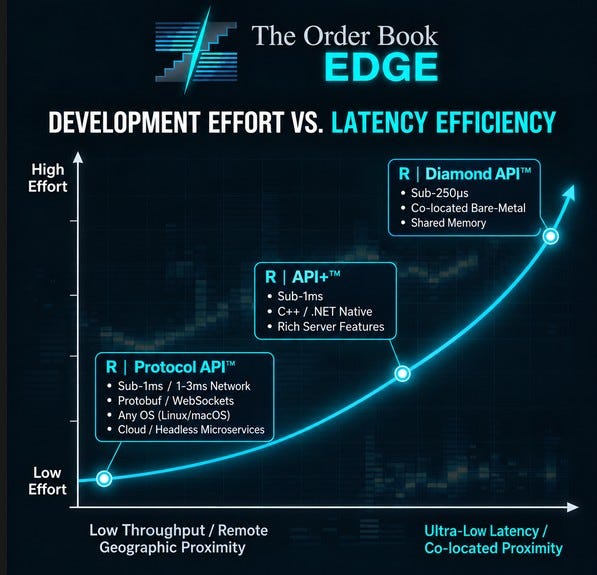
DEVELOPMENT EFFORT VS. LATENCY EFFICIENCY

High Effort │                                         [R | Diamond API™]
            │                                         • Sub-250µs
            │                                         • Co-located Bare-Metal
            │                                         • Shared Memory
            │
            │                  [R | API+™]
            │                  • Sub-1ms
            │                  • C++ / .NET Native
            │                  • Rich Server Features
            │
            │ [R | Protocol API™]
            │ • Sub-1ms / 1-3ms Network
            │ • Protobuf / WebSockets
            │ • Any OS (Linux/macOS)
 Low Effort │ • Cloud / Headless Microservices
            └─────────────────────────────────────────────────────────────
              Low Throughput / Remote                   Ultra-Low Latency /
              Geographic Proximity                      Co-located Proximity
When to Select R | Protocol API™
R | Protocol API™ is the optimal choice for modern algorithmic trading operations. It is best suited for development teams that:
Build and run their trading systems on Linux or macOS, and want to avoid running Windows machines or Windows GUI software entirely.
Utilize modern language ecosystems such as Python, Go, Rust, Java, or Node.js.
Deploy execution engines within containerized microservices architectures (Docker, Kubernetes) or distributed cloud infrastructure.
Want to build custom web applications, analytical dashboards, mobile interfaces, or centralized risk tools that connect directly to Rithmic’s infrastructure.
Require reliable, sub-millisecond execution speeds without the structural complexity of managing hardware co-location or low-level compiled memory systems.
When to Select R | API+™
R | API+™ is the right choice for organizations that:
Have established, production-tested codebases written in C++ or Microsoft .NET (C#).
Build standalone commercial desktop applications where the end-user expects a traditional GUI experience.
Want to offload complex order-handling logic—such as multi-stage trailing stops, bracket orders, and OCO sequences—directly to Rithmic’s high-speed servers rather than managing them within their own algorithmic code.
Require access to server-side bar aggregation engines to retrieve custom tick, volume, or range-bar data directly from the network edge.
When to Select R | Diamond API™
R | Diamond API™ is built exclusively for elite, low-latency execution environments. It is the correct choice for teams that:
Operate fully co-located bare-metal Linux servers deployed within the same data center housing Rithmic’s core infrastructure (e.g., CME Aurora).
Execute high-frequency strategies (such as automated market making, structural queue positioning, or statistical latency arbitrage) where competitive survival depends on tick-to-trade turnaround speeds below 250 microseconds.
Maintain dedicated low-latency systems engineering teams capable of managing kernel-bypass networking, lock-free memory architecture, and direct hardware optimization.
13. Conclusion: The Paradigm Shift in High-Performance Trading
The electronic futures landscape has transitioned away from the era of slow, aggregated retail brokerage pipes and fragile, desktop-dependent trading platforms. As institutional and quantitative trading strategies continue to compress operational timeframes, success depends on the speed, determinism, and architectural flexibility of the underlying trading infrastructure.
As detailed across rithmic.com, Rithmic addresses these performance demands directly through its R | Trade Execution Platform™. By combining raw, unaggregated tick-by-tick market data, microsecond-grade edge timestamping, and deterministic server-side risk enforcement, Rithmic provides an institutional-grade foundation for mission-critical trading operations.
Rithmic’s three-tier API suite provides tailored access models for every class of market participant:
R | API+™ provides native C++ and .NET developers with deep, high-speed access to advanced server-side execution and synthetic bar aggregation engines.
R | Protocol API™ breaks free from legacy operating system constraints, enabling modern quantitative engineers to deploy lightweight, headless execution engines natively across Linux and macOS environments—connecting directly to Rithmic’s global gateways without ever launching a Windows desktop client.
R | Diamond API™ pushes execution speeds into the sub-250 microsecond realm, supplying co-located high-frequency market makers with the bare-metal performance required to compete at the technological limits of the market.
Whether deployed in an institutional co-location rack in Aurora, running headless within a containerized Linux cluster, or powering quantitative models natively on an engineer’s macOS workstation, Rithmic’s platform delivers the data purity, execution speed, and architectural independence essential for modern electronic trading.
Rithmic Infrastructure, Broker Ecosystems, Protocol Parameters, and Conformance Testing
1. Introduction: High-Performance Infrastructure in Modern Derivatives Markets
The global futures market operates on microscopic margins of time. Unlike retail equities trading, where internalization and payment for order flow can introduce indeterminate delays, exchange-traded derivatives—such as those listed on the Chicago Mercantile Exchange (CME), the Intercontinental Exchange (ICE), and Eurex—require deterministic routing, transparent order queues, and direct exchange matching engine connectivity.
Within this competitive domain, Rithmic has established itself as one of the preeminent software and network infrastructure providers for high-frequency trading firms, institutional commodity trading advisors (CTAs), proprietary trading desks, and independent algorithmic traders. Rithmic’s architecture is engineered around a core principle: delivering raw, unadulterated market data and achieving the absolute minimum transit latency for order submission, modification, and cancellation.
The Problem of Data Filtering and Conflation
Many retail trading platforms rely on consolidated, conflated, or sampled market data streams. Conflation aggregates price updates occurring within a fixed time window (for instance, every 100 milliseconds) into a single packet to conserve bandwidth. While this approach suffices for long-term discretionary traders looking at static multi-minute charts, it is catastrophic for automated execution algorithms, order book imbalance strategies, and market-making systems.
When data is conflated:
Granular queue dynamics disappear.
Passive order positioning cannot be tracked accurately.
Hidden liquidity adjustments remain invisible until an execution occurs.
Rithmic circumvents conflation entirely. Its proprietary architecture delivers tick-by-tick market depth (Market by Price and Market by Order) directly from the exchange matching engines. Every bid, offer, modification, cancellation, and trade print is broadcast in real time across low-latency optical links.
The Decoupled Plant Architecture
At the heart of Rithmic’s connectivity model is a distributed, multi-plant topology. Rather than funneling all market activity through a monolithic gateway, Rithmic isolates protocol functions into specialized server clusters termed Plants:
The Market Data Plant: Exclusively handles outbound tick streaming, top-of-book quotes, full market depth, and trade execution notices from the exchange.
The Order Plant: Dedicated entirely to inbound transaction routing (new order placement, cancels, amends) and outbound execution reports, order state confirmations, and fill notices.
The History Plant: Manages retrieval of historical tick and aggregate bar data without degrading the performance of active real-time trading engines.
The PnL / Account Plant: Tracks real-time margin utilization, open equity, realized gains and losses, and account-level risk parameters across clearing accounts.
By separating the Market Data Plant from the Order Plant, an influx of high-volume market activity—such as during an unexpected Federal Reserve announcement—cannot saturate the network buffers responsible for transmitting critical cancellation requests or limit order executions.
2. The Futures Broker Ecosystem and Clearing Infrastructure
Rithmic does not operate as a financial broker; it is a technology and infrastructure vendor. To trade live capital in futures markets, a market participant must establish a relationship with a regulated entity that holds customer funds, manages risk, and provides clearing access to exchange matching engines.
The Structural Layers: Introducing Brokers, FCMs, and Technology Vendors
Understanding Rithmic’s position requires dissecting the traditional futures clearing hierarchy:
[ Algorithmic Client / Trader ]
             │
      (Protocol / API)
             ▼
    [ Rithmic Gateway ] ──── (Pre-Trade Risk Engine: R | Risk)
             │
             ▼
  [ Clearing Broker (FCM) ] ──── [ Introducing Broker (IB) ]
             │
             ▼
[ Central Exchange Matching Engine (CME, ICE, Eurex) ]
Futures Commission Merchants (FCMs):
An FCM is the primary entity authorized to hold customer segregated funds, clear transactions directly with exchange clearing houses, and assume credit risk for account holders. FCMs maintain master clearing accounts with institutions such as the CME Clearing House. Examples include Dorman Trading, Advantage Futures, Ironbeam, Phillip Capital, and StoneX.Introducing Brokers (IBs):
IBs act as customer-facing liaisons. They provide customer support, platform recommendations, and specialized trading tools, but partner with an FCM for account carrying and clearing operations. Examples include Edge Clear, Stage 5 Trading, Optimus Futures, and AMP Global Clearing.The Technology Provider (Rithmic):
The FCM or IB assigns trading credentials and credit limits within Rithmic’s centralized risk administration suite. Rithmic’s pre-trade risk engine then enforces those limits at the gateway layer, milliseconds before an order ever reaches the exchange matching engine.
Broker-Supported Market Data and Routing Models
Brokers supporting Rithmic generally provide two distinct execution models:
Rithmic Shared Infrastructure: The broker assigns user accounts to multi-tenant Rithmic routing gateways located in major financial colocation centers (such as Equinix NY4 in Secaucus, New Jersey, or Equinix CME Aurora CH2 in Illinois). Traders share optimized transit backbones while retaining individual cryptographic identities.
Dedicated Institutional Routing: For institutional clients, high-volume proprietary firms, and algorithmic desks, brokers provision dedicated cross-connects and dedicated IP routes. This approach bypasses shared network segments and terminates directly on dedicated Rithmic processing instances situated within the exchange’s local data center cage.
Market Data Entitlements and Exchange Fee Compliance
Because Rithmic delivers direct-from-exchange data, brokers operating on the platform must enforce strict regulatory and licensing frameworks established by global derivatives exchanges.
Exchange fees are segregated into two primary classifications:
Non-Professional Subscribers: Individuals trading personal capital who are not registered with financial regulatory bodies (such as the CFTC, NFA, or SEC) and do not act on behalf of third parties. They receive substantially discounted exchange data fees.
Professional Subscribers: Proprietary trading desks, hedge funds, registered commodity trading advisors, and corporate accounts. They pay full commercial exchange data tariffs per instrument family.
Brokers utilize Rithmic’s entitlement infrastructure to verify user self-certifications, collect required electronic exchange agreements, and activate specific market feeds (such as CME Equity Index, CME FX, CBOT Agricultural, NYMEX Energy, or COMEX Metals) on a per-instrument, per-month billing cycle.
3. Frequently Asked Questions: Operational, Technical, and Commercial Nuances
Working with Rithmic requires a clear understanding of its technical environment, authentication rules, administrative tools, and edge-case operational characteristics.
What is R | Trader Pro, and Why is it Essential?
While automated systems interact with Rithmic via raw sockets, Protocol Buffers, or native C++ APIs, R | Trader Pro serves as the graphical administrative console and master monitoring application for the user’s account.
Even pure algorithmic developers who never trade via a graphical user interface (GUI) must install and understand R | Trader Pro for several structural reasons:
Mandatory Exchange Agreement Signing: When a broker provisions a new Rithmic account, the exchange requires signed digital subscriber agreements. These legal documents can only be populated, accepted, and transmitted to the exchange through the R | Trader Pro interface during the initial login sequence.
Real-Time Risk and Position Auditing: If an automated script encounters an unhandled exception, crashes, or drops network connectivity, R | Trader Pro provides an out-of-band graphical dashboard to flatten positions, cancel working orders, or inspect account margin parameters.
Plugin Mode Architecture: R | Trader Pro can act as an intermediate proxy gateway. By establishing a local connection to R | Trader Pro via its internal plugin server, a developer can run external charting platforms, custom scripts, and third-party algorithmic execution tools simultaneously without paying for multiple concurrent gateway logins.
How Does Concurrent Session Licensing Operate?
A frequent source of confusion is the distinction between multiple open applications and multiple concurrent network sessions.
Rithmic tracks active connections by examining the user ID and the client session footprint across its server infrastructure:
If a user attempts to log directly into a production Rithmic gateway from a custom API script while simultaneously logging into a trading platform using the exact same credentials—without using Plugin Mode—the Rithmic authentication server will reject the secondary login with a session collision error, or automatically terminate the primary connection.
To execute through multiple platforms simultaneously, the trader must either request their broker to provision multiple sub-user logins (which incurs additional monthly exchange market data fees for each concurrent connection) or route traffic through R | Trader Pro’s local loopback plugin server.
Why Rithmic Is Better Than IBKR for Serious Futures Trading
Interactive Brokers is a powerful global brokerage platform. For stocks, options, portfolio margin, multi-asset investing, and broad international access, IBKR is often excellent. But futures trading—especially active, automated, order-flow-sensitive, low-latency futures trading—is a different problem. In that world, Rithmic is often the better infrastructure choice because it was built around futures market data purity, direct order routing, server-side risk controls, and professional API deployment rather than around being a universal retail brokerage.
The simplest distinction is this: IBKR is primarily a broker; Rithmic is primarily futures trading infrastructure. IBKR gives traders access to futures among many other asset classes and advertises global futures access across more than 30 market centers. Rithmic, by contrast, is broker/FCM-neutral infrastructure built around the Rithmic R | Trade Execution Platform, with separate hubs for market data, order management, and risk management. (interactivebrokers.com)
1. Rithmic is built for futures market microstructure
Futures markets reward speed, queue awareness, and clean order-book information. A trader using ES, NQ, CL, GC, 6E, MBT, or other exchange-traded derivatives is not merely asking, “What is the last price?” They are asking:
What did the exchange actually send?
Did my platform receive every tick?
Did I see the real depth change?
Did my order reach the matching engine quickly?
Did risk controls remain active if my bot crashed?
Can I run the system headless on Linux without a desktop platform in the middle?
Rithmic’s pitch maps directly to those questions. Its technology materials emphasize un-throttled feeds, Market-by-Order data, full market depth, top-of-book, microsecond timestamps, direct market access, advanced server-side order types, and infrastructure-level risk controls. (rithmic.com)
IBKR’s API, meanwhile, is extremely useful, but IBKR itself notes that it is not a specialized market data provider and imposes market-data restrictions to limit traffic not directly associated with trading. Its historical data documentation explicitly warns that if a strategy’s market-data needs are not met, users should consider a specialized provider. (interactivebrokers.github.io)
That single point captures the whole comparison: IBKR is a great broker with an API; Rithmic is a futures data, routing, and risk infrastructure stack.
2. Better market data: unfiltered, deeper, and more useful for order-flow trading
The attached document repeatedly emphasizes Rithmic’s “tick-by-tick,” “unaggregated,” and “unfiltered” data model. That matters because futures trading is heavily dependent on short-lived liquidity. If an ES or NQ order book changes twenty times in one millisecond, a serious order-flow system wants twenty events, not a smoothed snapshot.
Rithmic’s public materials align with that description. Rithmic says its market data hub provides un-throttled feeds, no filtering during volatility, Market-by-Order visibility, full market depth, best bid/ask, and microsecond-precision timestamps. Its exchange/platform materials also describe every tick being delivered as received from the exchange, without filtering or aggregation during peak volatility. (rithmic.com)
That is a major advantage over IBKR for high-frequency or order-flow-driven futures trading. IBKR does support real-time and historical data, and it has a tick-by-tick API feature. But IBKR also places limits on tick-by-tick requests, including that no more than one tick-by-tick request for the same instrument can be made within 15 seconds. IBKR’s own third-party FAQ also states that bars built from its real-time market data may not match historical bars because the real-time market data is not tick-by-tick in that context. (interactivebrokers.github.io)
For casual futures traders, this may not matter. For DOM traders, scalpers, footprint users, execution algos, and quantitative systems that care about queue behavior, it matters enormously. Rithmic’s data model is closer to what a futures specialist wants.
3. Rithmic’s plant architecture is cleaner for automated futures systems
The attached document gives a detailed explanation of Rithmic’s plant model: ticker/market data plant, order plant, history plant, and PnL/account plant. The async_rithmic documentation describes the same architecture: separate WebSocket endpoints for live market data, order routing and updates, historical data, and account PnL, with separate login and heartbeat management. (async-rithmic.readthedocs.io)
That separation is not just architectural trivia. It is operationally important. A futures bot should not have its order-routing loop blocked because market data is busy. During a CPI release, FOMC statement, crude inventory number, or unexpected geopolitical headline, market data can explode. A proper system separates the market-data stream from the order path so that cancel/replace and liquidation instructions remain responsive.
The attached Rithmic notes repeatedly stress this decoupling: Market Data Plant for ticks and depth, Order Plant for order routing and execution reports, History Plant for historical bars/ticks, and PnL Plant for account and margin state. That is exactly the topology a professional futures system wants.
IBKR’s TWS API is useful, but it is an interface to Trader Workstation or IB Gateway. IBKR’s own documentation states that TWS API requires a running instance of TWS or IB Gateway, and the TWS API has an order-rate limitation of 50 orders per second. (interactivebrokers.com)
That does not make IBKR “bad.” It means IBKR’s API is a brokerage gateway API. Rithmic’s model is a futures infrastructure API.
4. Rithmic’s server-side risk controls are a huge futures advantage
One of the strongest points in the attached document is Rithmic’s server-side risk architecture. The document correctly highlights a key failure mode in automated futures trading: client-side risk controls disappear when the client fails.
If your Python bot crashes, your home internet drops, your VPS freezes, or your GUI platform locks up, any risk logic running only in that process stops working. That is dangerous in leveraged futures. A local stop-loss rule inside a Python script is not the same thing as an exchange-side or server-side risk system.
Rithmic’s risk-management materials explicitly frame this problem. Rithmic says its RMS runs on Rithmic servers, independent of the client platform, evaluates every order before it reaches the exchange, monitors PnL, balance, and positions in real time, and can auto-liquidate regardless of the client connection state. (rithmic.com)
That is a major difference from many API-driven trading setups. In the attached bot audits, several strategy files had dangerous “synthetic bracket” behavior: the bot calculated stops and targets locally, but did not always submit true server-side protective orders. The document correctly identifies that as a critical risk. Rithmic is not magic; a developer still has to use the infrastructure properly. But Rithmic gives the futures trader the right building blocks: server-side brackets, OCOs, trailing stops, risk limits, auto-liquidation, quantity limits, and account states such as active, liquidate-only, and admin-only. (rithmic.com)
IBKR has margin controls, order precautions, and broker-level risk controls, but the developer experience is different. IBKR’s third-party FAQ notes that TWS precautionary settings may generate warnings or prevent API orders from transmitting unless configured correctly. (interactivebrokers.com)
For a futures trader running automated strategies, Rithmic’s infrastructure-level RMS is a more natural fit.
5. Rithmic is better for Linux, Python, and headless deployment
The attached document’s Debian 13 setup guide is important because it shows the kind of deployment Rithmic enables: Python, pip, virtual environments, async_rithmic, VS Code, and a clean project workspace. The guide walks through creating ~/btc-trading-bot, activating .venv, installing async_rithmic, and verifying imports.
That workflow matters. Modern trading systems are not always Windows desktop applications. Many serious traders want to run strategies as:
Linux
systemdservicesDocker containers
remote VPS daemons
colocated Linux processes
macOS research tools
Python asyncio applications
cloud-based monitoring services
Rithmic’s API suite is built for that world. Rithmic offers R | API+ for C++/.NET, R | Protocol API using WebSockets and Google Protocol Buffers that works in any language, and R | Diamond API for ultra-low-latency Linux colocated environments. (rithmic.com)
This is a big advantage over the classic IBKR TWS API workflow. IBKR’s TWS API requires a running TWS or IB Gateway session. IBKR notes that TWS and IB Gateway can auto-restart during the week, but after the Saturday night server reset, Sunday re-authentication is required. (interactivebrokers.com)
For discretionary users, that is acceptable. For unattended futures infrastructure, it is annoying. A true headless Rithmic Protocol deployment is cleaner for production-style futures bots.
6. Rithmic’s API tiers are more futures-specialized
The attached document gives a strong breakdown of Rithmic’s three API categories:
R | API+ for native C++/.NET systems.
R | Protocol API for WebSocket/Protobuf, language-agnostic systems.
R | Diamond API for colocated ultra-low-latency trading.
Rithmic’s own API materials confirm the same structure and describe R | Protocol API as a WebSocket/Protocol Buffers interface that works in any language, while R | Diamond API is Linux-only, requires colocation, and targets sub-250-microsecond tick-to-trade latency. (rithmic.com)
That API ladder is very different from IBKR’s. IBKR has a capable API, but it is designed to expose brokerage functions—market data, order placement, account data—through TWS or Gateway. Rithmic’s API suite is specifically designed for futures platform builders, systematic traders, market-data consumers, order-routing systems, and colocated execution engines.
The attached conformance-testing section also matters. Rithmic requires production API users to prove they can maintain connections, handle heartbeats, login properly, target the right plants, and shut down cleanly. The async_rithmic documentation similarly notes that production URLs require passing conformance testing and that the conformance process includes connecting to the Order Plant and leaving the app running. (async-rithmic.readthedocs.io)
That may sound burdensome, but it is a positive sign. Futures markets are leveraged and fast. A platform that requires conformance testing is enforcing a higher operational standard.
7. Historical futures data is more practical on Rithmic
The attached document highlights Rithmic’s History Plant and the value of historical tick and bar retrieval. Rithmic’s public technology and product pages also state that historical data is available back to December 2011 and that its History Plant supports historical data and charting. (rithmic.com)
This matters for futures because contracts expire. Backtesting futures strategies is already complicated because the trader must handle individual contract months, roll logic, liquidity migration, continuous contract construction, and exchange session schedules.
IBKR’s historical data limitations are a real obstacle for futures research. IBKR’s documentation lists pacing restrictions, step-size limits, unavailability of bars of 30 seconds or less older than six months, and unavailability of expired futures data older than two years from expiration. It also warns that excessive historical requests can lead to throttling and eventual API disconnection. (interactivebrokers.github.io)
That does not mean IBKR data is useless. For many swing traders, daily futures data, current contracts, and basic intraday history are enough. But for serious futures research, especially tick research, footprint-style research, or multi-year intraday model development, Rithmic is the more natural starting point.
8. Rithmic is better for DOM, scalping, and order-book traders
IBKR’s platforms can display market depth, and many users trade futures manually through TWS. But Rithmic’s ecosystem is deeply associated with professional DOM trading, order-flow platforms, and futures-specific front ends.
Rithmic’s product materials highlight full DOM ladders, one-click order entry, server-side brackets and OCOs, unfiltered exchange data, and platform compatibility with tools used by active futures traders. (rithmic.com)
The attached document repeatedly emphasizes Market-by-Order and Market-by-Price distinctions. This is critical. Market-by-Price shows aggregated size at a price level. Market-by-Order shows individual orders and queue-level granularity. For many retail-style trading workflows, MBP is sufficient. For advanced order-flow trading, MBO can be significantly more informative.
Rithmic’s public materials specifically emphasize Market-by-Order, individual orders in the book, full market depth, and unthrottled market data. (rithmic.com)
That is why Rithmic is commonly preferred by futures traders who care about DOM behavior, liquidity pulls, queue position, aggressive lifting/hitting, and microstructure.
9. Rithmic’s order path is designed around futures execution
The attached document’s architectural diagrams repeatedly compare a long chain of retail brokerage layers with Rithmic’s shorter path: strategy → Rithmic gateway → risk check → exchange.
Rithmic’s trader-facing materials make the same claim in plain language: un-throttled market data and direct market access help orders reach the exchange as fast as the infrastructure allows; the Order Management Hub routes orders directly to the exchange; risk checks happen inside Rithmic’s servers, not inside the user’s platform. (rithmic.com)
IBKR also offers low-latency futures access and professional execution tools. IBKR’s futures page advertises low commissions, global market access, and professional technology. (interactivebrokers.com)
But the IBKR model is still a universal brokerage model. It must serve stocks, options, ETFs, forex, bonds, funds, global accounts, advisors, retail investors, and institutions. Rithmic’s identity is narrower: futures trading infrastructure.
For futures traders, narrower can be better.
10. Rithmic’s paper trading model is better aligned with futures development
The attached document notes that Rithmic Paper Trading uses live market data but routes orders to an internal simulation engine. That distinction is important: a strategy can be tested against real exchange-driven price movement without sending real orders to the exchange.
Rithmic’s product page similarly describes its paper trading simulator as a full paper environment with live market data from supported venues and platform compatibility. (rithmic.com)
IBKR has paper trading as well, and for many traders it is perfectly adequate. But for futures-specific API development, Rithmic’s paper, test, and production separation fits the professional development lifecycle described in the attached document:
Build locally.
Install
async_rithmic.Connect to Rithmic Test.
Run conformance.
Use Paper Trading.
Only then move toward production.
That staged approach is ideal for futures bots, where mistakes can be expensive.
11. The attached bot examples show why Rithmic’s architecture matters
The document includes audits of multiple futures bots: MBT, ES, and NQ systems using dual-timeframe logic, asynchronous bar callbacks, Rithmic time-bar subscriptions, position tracking, dynamic stops, and drawdown guards.
Those audits reveal a crucial point: the trading strategy is only one layer. The infrastructure layer is equally important.
Several bugs identified in the attached document were not “alpha” problems. They were infrastructure and execution-safety problems:
warmup buffers not filling correctly
synthetic stops stored only in local memory
optimistic position state before confirmed fills
drawdown guards using stale or missing PnL
hardcoded expired contract months
client-side brackets instead of server-side orders
multiple bots competing for one market-data connection
These are exactly the problems a good futures infrastructure stack helps expose and control. Rithmic’s separate plants, order notifications, PnL plant, server-side brackets, server-side RMS, and conformance requirements all push the developer toward safer architecture.
IBKR can also support automated trading, but the developer has to work around TWS/Gateway behavior, pacing, session management, market-data limits, and the brokerage API model. For a futures-only project, Rithmic is the cleaner match.
12. Rithmic is broker-neutral; IBKR locks you into one broker ecosystem
Rithmic does not operate like IBKR. IBKR is the broker. Rithmic is infrastructure used through brokers, FCMs, prop firms, platforms, and institutional relationships. Rithmic describes itself as broker/FCM-neutral infrastructure with pre-trade and post-trade risk management, real-time/delayed/historical market data, and access through multiple platforms and APIs. (rithmic.com)
That is powerful. A trader can use a Rithmic-supported broker or prop-firm environment, connect through R | Trader Pro, Bookmap, MotiveWave, ATAS, Optimus Flow, custom Python, or another supported tool, while still relying on the same underlying Rithmic infrastructure. Rithmic’s trader materials also note compatibility with many platforms and funding-evaluator workflows. (rithmic.com)
IBKR’s advantage is that everything is unified inside one broker. That is convenient. But for futures specialists, broker neutrality can be more valuable. It lets the trader separate clearing, platform, data, order routing, and strategy logic.
13. Rithmic handles professional risk hierarchies better
The attached document spends significant space on Rithmic’s institutional ecosystem: FCMs, introducing brokers, prop firms, evaluation companies, multi-account administration, auto-liquidation, drawdown rules, and account lockouts.
This is one of Rithmic’s strongest differentiators. Futures trading is not only about individual accounts. It is also about:
introducing brokers managing customer relationships
FCMs controlling clearing risk
prop firms enforcing drawdown rules
evaluation firms liquidating rule violators
software vendors connecting many users
multi-account traders copying or allocating trades
Rithmic’s RMS materials describe configurable risk criteria, real-time PnL and position monitoring, quantity limits, liquidation triggers, and account modes such as active, liquidate-only, and admin-only. (rithmic.com)
For a one-person trader, that may sound excessive. For a serious futures operation, it is exactly what you want.
14. IBKR is better for some users—but not for the futures specialist described in the document
A fair comparison must admit where IBKR wins.
IBKR may be better if the trader wants:
one account for stocks, options, ETFs, bonds, mutual funds, forex, and futures
global market access from a single broker
low commissions and broad product coverage
portfolio-level financing and account management
a mature brokerage with extensive reporting
occasional futures trades rather than futures-specific infrastructure
IBKR’s futures page emphasizes global futures trading across more than 30 market centers, low commissions, and professional technology. (interactivebrokers.com)
So the argument is not “Rithmic is always better than IBKR.” The better argument is:
Rithmic is better than IBKR for traders whose main problem is futures execution infrastructure, not general brokerage access.
If you are building the kind of system described in the attached document—Python bots, async connections, Rithmic plants, conformance testing, dual-timeframe bar strategies, server-side risk, and exchange-specific futures execution—Rithmic is the more appropriate tool.
15. The practical bottom line
For serious futures trading, Rithmic is better than IBKR in five major ways.
First, Rithmic provides cleaner futures market data: unthrottled, unfiltered, order-book-aware, and designed for full-depth futures analysis. IBKR market data is useful, but its own documentation acknowledges pacing limits and the need for specialized providers when market-data requirements exceed IBKR’s service model. (interactivebrokers.github.io)
Second, Rithmic has a better architecture for automated execution. Separate plants for ticker, order, history, and PnL are exactly what event-driven futures bots need. async_rithmic mirrors this architecture with separate asynchronous plant connections. (async-rithmic.readthedocs.io)
Third, Rithmic’s server-side risk model is much stronger for leveraged futures. Risk controls that survive client crashes, internet outages, and platform failures are more valuable than risk rules trapped inside a local script. (rithmic.com)
Fourth, Rithmic’s API suite is more professional and futures-specific. R | API+, R | Protocol API, and R | Diamond API cover everything from desktop platforms to Python/Linux bots to colocated HFT systems. (rithmic.com)
Fifth, Rithmic fits the workflow of serious futures developers: conformance testing, paper trading, headless Linux deployment, exchange-specific contract handling, front-month futures logic, and production-grade connection management.
IBKR remains excellent for broad brokerage access. But if the mission is futures trading infrastructure—especially for active, automated, DOM-based, or low-latency futures trading—Rithmic is the stronger platform.
Learn more: