


Date of Analysis: October 14, 2026
Scope: Rates, Sovereign Fixed Income, Energy, Precious & Industrial Metals, Agriculture, Foreign Exchange, Equity Indices, and Digital Asset Derivatives (Single-Stock Equities Excluded)
DISCLAIMER: EDUCATIONAL PURPOSES ONLY — NOT INVESTMENT ADVICE. This report synthesizes multi-desk institutional positioning, clearinghouse flow data, and quantitative rule frameworks. Seek independent professional financial advice before executing any derivative strategies.
SECTION 1: EXECUTIVE SUMMARY & THE MACRO-QUANTITATIVE REGIME
1.1 The October 14, 2026 Inflection Point
Global institutional derivatives markets are navigating a delicate macro-monetary inflection point on October 14, 2026. Positioning across major clearinghouses (CME, ICE, Eurex, JPX, NSE, LME, Dalian, and Deribit) is dominated by the release of U.S. Consumer Price Index (CPI) and Producer Price Index (PPI) data (Oct 14–17). This inflation print arrives against a backdrop of hawkish central bank recalibrations, acute geopolitical supply shocks in West Asia and Eastern Europe, and structural capital expenditure shifts driven by artificial intelligence and physical automation.
Following the Federal Reserve’s 25-basis-point rate hike on September 16, 2026—its first upward adjustment since July 2023—the front end of the U.S. yield curve has repriced toward a “higher-for-longer” terminal regime. With spot federal funds anchored at 5.25% and nominal yields operating at 5% alongside nearly 3% real yields (the “True Cost of Money” regime), institutional desks are assigning an 86% probability to an additional 25bps hike in December 2026. Headline CPI is projected at 3.6% YoY with Core CPI at 0.2% MoM. A topside surprise threatens to unanchor front-end rates toward a 5.50%–6.00% tail scenario, whereas a softer print could rapidly pull forward 2027 rate-cut expectations.
1.2 Structural Macro Drivers: AI Capex vs. Automation Deflation
Beyond cyclical inflation metrics, institutional macro models are pricing a fundamental tug-of-war between two structural forces:
The $600B AI Capital Expenditure Surge: Highlighted by Goldman Sachs’ Asia and global AI spending notes, capital expenditure across data centers, power grids, and specialized materials (exemplified by AI-driven chemical and materials platforms like Scimplify reaching $200M in revenue) is injecting substantial near-term inflationary pressure into industrial commodities, power baseloads, and tech-heavy equity indices. Under Quantitative Rule 13.2 (GDP/Inflation Link), this capex boom sustains higher long-term growth trajectories while keeping near-term input inflation sticky.
Robotic Physical Automation (74% Task Penetration): Counterbalancing capex inflation is the rapid deployment of robotic automation across 74% of U.S. physical labor tasks. Under Quantitative Rule 13.1 (Supply/Demand Dynamics), this creates a profound trade-off: structural labor cost deflation versus near-term capital expenditure inflation. Equity index volatility and duration desks are actively trading the friction between these two forces.
1.3 Synthesizing the Multi-Desk Price & Regime Divergence
A critical feature of the October 14, 2026 institutional landscape is the divergence in pricing models and scenario frameworks across different institutional trading desks (reflected across the five distinct analytical sub-reports in our raw flow data). Rather than viewing these variations as contradictions, quantitative portfolio managers interpret them as Desk-Specific Scenario Regimes:
The Baseline Macro Desk vs. The Geopolitical Shock Desk (Crude Oil & Gold): Baseline systematic desks are pricing WTI (CL) in the $80–$90/bbl range and Gold (GC) in the $2,000–$2,400/oz range based on standard USD/rate regressions. Conversely, Geopolitical Tail-Risk and Physical Commodity desks are pricing an active kinetic premium following Houthi strikes on Saudi Aramco’s Dhahran headquarters, Iranian shipping disruptions, and Ukraine’s strikes on Russian data infrastructure (Yandex). In this kinetic regime, Brent crude is trading at a $93–$110/bbl floor (spot prints at $108.70/bbl and WTI at $105.50/bbl, alongside all-time highs in European/U.S. diesel at $220/bbl), while Gold is pricing a secular monetary debasement/war-premium regime at $4,155–$4,190/oz (with Silver at $59.50/oz).
The Equity Index Valuation Split (ESZ6): Macro-defensive desks model E-mini S&P 500 (ES Dec26) around the 5,200–5,500 level under tighter financial conditions, whereas Momentum/AI-Capex desks are pricing the contract in the 7,800–8,000 zone, driven by extreme mega-cap concentration where the top five technology firms represent ~30% of index capitalization.
1.4 The Quantitative Rulebook Framework
Throughout this report, institutional positioning and risk management are governed by a codified set of quantitative trading rules referenced across clearinghouse flows:
Rule ID Quantitative Rule Definition Institutional Application & Market Impact (Oct 14, 2026) Rule 4.6 VIX Regime Position Sizing:• VIX 15–25: Reduce directional risk by 25%• VIX > 25: Reduce directional risk by 50%• VIX > 35 (or Asset IV > 35%): Reduce risk by 75% With spot VIX at 18.0–22.0, systematic equity and macro desks have pared directional gross exposure by 25%. In Brent options (where IV is 35% vs. 28% realized vol), energy desks have triggered a 75% risk reduction in unhedged directional delta. Rule 13.1 Supply/Demand Dynamics Governing the labor deflation vs. capex inflation trade-off (74% U.S. robotic task automation) and physical commodity bottlenecks (IEA diesel tightness through late 2027). Rule 13.2 GDP / Inflation Structural Link Applied to the $600B AI investment surge; higher long-term productivity growth paired with acute near-term inflationary resource demand. Rule 13.3 Accelerating Inflation Momentum Triggered by consecutive CPI/PPI beats, forcing systematic shorting of front-end interest rate futures (SOFR/Eurodollars). Rule 13.4 Geopolitical & Regulatory Risk Premium Governing Middle East drone deployments, Houthi strikes on Aramco Dhahran, Nord Stream sabotage trials, and Asian crypto ETF approvals (Thailand). Rule 13.5 Seasonal & Calendar Patterns Driving the “Uptober” crypto call-spread accumulation, Q4 equity “Santa Claus” call spreads, winter natural gas (TTF/HH) call skew, and U.S. harvest pressure in CBOT November soybeans. Rule 14.1 USD / Commodity Inverse Link USD weakness drives higher commodity prices (and vice versa). Central to DXY vs. Gold (-0.75) and DXY vs. Copper/Oil pairs trading. Rule 14.2 Oil / Inflation Transmission Rising crude and distillate prices directly feed headline CPI expectations, forcing hawkish central bank responses. Rule 14.3 Oil / Equity Valuation Link Rising energy input costs compress corporate margins and lower equity valuations (driving the -0.55 to -0.65 Oil-to-S&P 500 correlation). Rule 14.4 Macro Uncertainty & Safe Havens Elevated policy, fiscal, or military uncertainty drives institutional inflows into Gold (GC) and Bitcoin (BTC) derivatives. Rule 14.5 Rate Differentials & USD Dominance Higher U.S. nominal/real rates and USD stablecoin hegemony ($303.4B vs. €810M euro tokens) reinforce structural USD strength. Rule 14.6 Cross-Asset Correlation Limit (> 0.70) Strict mandate: Avoid unhedged portfolio concentrations where asset correlation exceeds 0.70 (or inverse -0.70). Forces active basis hedging across BTC/Gold (0.65), Corn/Soybeans (0.82), ES/NQ (0.92), and INR Bonds/Brent (>0.70). Rule 20.1 / 20.2 Yield Curve Inversion Dynamics An inverted yield curve (2s10s at -30bps) serves as a primary recession warning, dictating curve flattener/steepener overlays. Rule 20.8 Central Bank Policy Vector Hawkish policy = bearish fixed income bonds & bullish currency; Dovish policy = bullish fixed income & bearish currency.
SECTION 2: GLOBAL MACRO & INTEREST RATE DERIVATIVES
The global fixed income derivatives complex is the primary battleground for institutional capital on October 14, 2026. With the MOVE Index (Treasury implied volatility) jumping to 125 from 110 a week prior, options-on-futures volumes have surged as asset managers, hedge funds, and bank liability desks restructure duration and curve exposure ahead of the U.S. CPI print.
2.1 U.S. Short-Term Interest Rate (STIR) Futures: SOFR, Fed Funds & Legacy Eurodollars
At the front end of the U.S. curve, positioning reflects deep anxiety over the terminal rate trajectory following the Fed’s September 25bps hike.
CME 3-Month SOFR Futures (SR3 / SFR):
Positioning & Implied Rates: According to CFTC Commitments of Traders (CoT) data, net short positioning in Dec26 SOFR futures (
SR3Z6/SFRZ6) has reached a massive $1.2 trillion in notional value—the highest net short concentration since Q1 2026. Across trading tiers,SR3Z6is trading between94.70and94.75(implying a 5.25% to 5.30% rate), while ultra-hawkish desks price implied Dec26 rates up to 5.50% against a 5.25% spot rate. The market is pricing an 86% probability of a December rate hike.Options-on-Futures Flows: Institutional flow is bifurcated between CPI tail-hedges and dovish pivot protection. Desks hedging a “hawkish hold” or additional hike are aggressively buying
SFRZ6 94.75 callsand94.50/94.75 call spreads(at ~15% IV), often financing these purchases by selling94.50/94.25 put spreadsor94.75/95.00 call spreads. Conversely, macro desks anticipating that a 5% nominal / 3% real rate environment will fracture economic growth are accumulatingSR3 Dec26 putsat the5.10%implied strike to capture a sudden dovish pivot.Back-End Curve Steepeners (2027–2028): In the
Dec 2027 – Dec 2028segment, institutions are executing structural steepening trades viaSOFR Dec27 / Dec28 calendar spreads(buying Dec27, selling Dec28) to price in a 2027 rate-cut cycle. Open interest inDec27 95.00 puts(implied rate ~5.00%) has spiked as macro funds build convexity around the eventual Fed pivot.
CME 30-Day Fed Funds Futures (FF):
Tail-Risk Block Trades: In the
FFZ6(Dec26) contract, clearing desks recorded massive block trades totaling 5,000 contracts inFFZ6 94.50 puts(representing a 5.50% strike rate). Guided by Rule 20.8 (Hawkish = Bearish Bonds), this position functions as a high-leverage tail hedge against a reacceleration in headline CPI that could force the Federal Reserve toward a 6.00%+ terminal rate regime in early 2027.Event Volatility: Simultaneously, rate desks are buying
FFZ6 94.75 straddlesat 18% implied volatility to capture intraday gamma during the 8:30 AM EST CPI release, alongside outright longFFZ6 94.75 callsto protect short-duration books.
CME Eurodollar Futures & Options (GE / ED Legacy Synthetic Complex):
Pivot Positioning vs. Front-End Shorts: While directional desks remain short
GEZ6(Dec26) around94.50(implying 5.50% yields) and are selling94.50/94.00 put spreadsto monetize higher-for-longer decay, volatility desks have driven a 30% week-over-week surge in GE options open interest. Heavy buying is concentrated inGE Dec26 94.50 callsas institutions build cheap upside exposure to 2027 rate cuts, alongsideEDZ6 94.75/95.00 stranglesto play CPI volatility.Packs, Bundles & Forward Rate Agreements (FRAs): The
EDZ6/EDZ7(Dec26 vs. Dec27) 1-year forward spread has widened to 25bps on recession fears. Concurrently, Eurodollar packs and bundles show aggressive selling of 2Y1Y forward rate agreements (FRAs), locking in steepening expectations across the 2027–2028 forward curve.
2.2 U.S. Treasury Futures (ZT, FV, ZN, TN, ZB, UB) & Yield Curve Architecture
With the U.S. 2s10s cash and futures curve inverted at -30bps (Rule 20.1 / 20.2: Recession Warning), institutional fixed income desks are deploying complex curve spreads and volatility overlays across the CME Treasury complex.
U.S. TREASURY FUTURES CURVE & INSTITUTIONAL SPREAD ARCHITECTURE (OCT 14, 2026)
==============================================================================
[Front-End: 2Y (ZT/TU)] -------- (-30bps Inversion) --------> [Belly: 10Y (ZN/TY) & Ultra 10Y (TN)] -------- (-25bps Spread) --------> [Long-End: 30Y (ZB) & Ultra Bond (UB)]
   • Implied Rate: ~5.25%+                                       • ZN Dec26 ATM: 105-00 (IV: 22% vs 18% RV)                              • UB Dec26 Butterfly: 150 / 155 / 160
   • Flattener Leg: Long ZT / Buy TU 102 Puts                    • TN Dec26 110 Puts: +18% YoY OI Surge                                  • Steepener Leg: Long ZB / Short UB
The Steepener vs. Flattener Tug-of-War:
Bear Steepener Positioning: Desks anticipating an upside CPI shock or fiscal term-premium expansion are executing
Short ZN (10Y) / Long ZB (30Y)spreads (positioning for front/belly rates to sell off faster than the ultra-long end, or tactical curve repricing) andLong TN (Ultra 10Y) / Short UB (Ultra Bond)spreads, where theTNZ6/UBZ6spread has widened to -25bps. In the 2s10s segment, macro funds areShort 2Y (TUZ6/ZTZ6) vs. Long 10Y (TYZ6/ZNZ6)to capture curve dis-inversion if the Fed is forced to pause while growth deteriorates.Curve Flattener & Deeper Inversion Hedges: Conversely, desks trading the “5% Nominal, Nearly 3% Real” narrative are executing
Short ZN (10Y) vs. Long ZT (2Y)flatteners, betting that relentless Fed hawkishness will keep the front end pinned while long-end growth expectations collapse. To hedge an even deeper inversion, options desks are buyingTUZ6 (2Y) 102.00 putswhile simultaneously sellingTNZ6 (10Y) 110.00 calls. In the 5s30s segment, relative-value funds are actively tradingFVZ6 (5Y) 108.00 / UBZ6 (30Y) 125.00 call spreads.
Directional Tail Hedges & Volatility Overlays:
10-Year Note (
ZN/TY): Implied volatility inZN Dec26options has expanded to 22% against an 18% 30-day realized volatility, accompanied by the MOVE Index hitting 125. Institutions are buying at-the-moneyZN Dec26 105-00 straddlesand strangles to capture post-CPI directional breakouts. Bearish duration desks are executingZNZ6 110/105 put spreads(targeting a 10Y yield surge toward 4.50%+), risk reversals (buying ZN puts, selling ZN calls), andTYZ6 110 puts(trading at 12% IV on specialized desks). Meanwhile, range-bound quantitative desks are deployingZNZ6 110/105/100 put butterflies(Long 1x 110 put / Short 2x 10⁵ puts / Long 1x 100 put) to monetize elevated implied volatility if 10Y yields remain pinned between 4.00% and 4.50%.Ultra 10-Year Note (
TN): Open interest inTNoptions has surged 18% year-over-year, anchored by heavy institutional accumulation ofTN Dec26 110-00 puts(10% out-of-the-money) as a high-duration convex hedge against a hawkish Fed regime.Ultra Bond (
UB): Long-duration liability desks are deployingUB Dec26 150-00 / 155-00 / 160-00 butterfly spreads(Long 1x 150-00 / Short 2x 155-00 / Long 1x 160-00) to position for yield curve flattening if the Fed pivots to rate cuts in 2027, while tactical desks tradeUB Dec26 160/170 call spreadsto hedge a long-end bond rally if inflation unexpectedly cools.OTC OIS Swaps: Across over-the-counter clearing, bank portfolios are pairing futures exposure with
2Y OIS vs. 10Y OIS steepenersto isolate pure overnight rate expectations from Treasury invoice spread noise.
2.3 U.S. Mortgage-Backed Securities (MBS) Futures
Under the “Think Rates Are Peaking?” institutional thesis, real-money fixed income managers are rotating into CME MBS Futures (MBB) and To-Be-Announced (TBA) forward contracts to lock in wide mortgage spreads ahead of a potential 2027 Fed easing cycle.
Options & Basis Hedging: Call volume has spiked in
MBB Dec26 102-00 strikes, expressing a bullish view on MBS principal appreciation as rate volatility eventually subsides. To insulate these long MBS positions against near-term duration extension risk (negative convexity) during the CPI release, mortgage desks are pairing longMBBfutures with longZN puts(specifically targeting 10Y 4.50% equivalent yield strikes).
2.4 European Sovereign & STIR Derivatives (Eurex & ICE)
European fixed income markets are caught between ECB dovish growth concerns, an acute French fiscal crisis, and spillover from the Italian banking sector (driven by the MPS/Intesa merger dynamics).
EURIBOR Futures (Eurex): Hedge funds are executing large block trades in
EURIBOR Dec26 95.00 calls(implied rate ~5.00%), positioning for ECB rate cuts in early 2027. However, theEURIBOR Mar27 / Dec27 calendar spreadhas inverted, signaling institutional skepticism regarding the speed of the ECB’s easing cycle.German Bund (
RX), Bobl, and Schatz Futures (Eurex):Safe-Haven Fiscal Hedging: As French sovereign fiscal concerns rattle Eurozone debt markets, institutions are buying
RXZ6 (Dec26 Bund) 135.00/136.00 call spreadsas a flight-to-quality hedge. Downside protection is being structured via ratio put spreads: sellingRXZ6 135.00 puts(OTM) to finance multiple132.00 puts(further OTM), monetizing skew while betting on limited Bund downside.Curve & Term Premium Dynamics: The
RXZ6 / RXH7(Dec26/Mar27) calendar spread has steepened to -12bps, reflecting term premium compression. Across the German curve, theSchatz Dec26 / Bund Dec26(2s10s equivalent) spread has widened to -40bps, with macro desks actively selling Schatz and buying Bunds to hedge against ECB dovishness and Eurozone stagnation.
2.5 Japanese Government Bond (JGB) Futures (JPX)
In Tokyo, institutional positioning is centered on Bank of Japan (BoJ) policy normalization and the final dismantling of Yield Curve Control (YCC).
Positioning & Spreads: Volume has surged in
JGB Dec26 148.00 callsas domestic and offshore macro funds price in BoJ rate normalization and volatility. Simultaneously, theJGB Dec26 / Dec27 calendar spreadhas widened to -5bps, indicating institutional positioning for front-end curve steepening as short-term Japanese rates unanchor from zero.
2.6 Emerging Markets Focus: Indian Government Bond Futures (NSE & CME)
A major focal point of global EM rates activity on October 14, 2026, is the Indian sovereign debt market, where hawkish central bank intervention and oil-driven inflation have triggered a violent repricing.
Macro Catalyst & Yield Spike: The Reserve Bank of India (RBI), led by Governor Malhotra, enacted aggressive liquidity tightening—including a localized incremental Cash Reserve Ratio (CRR) hike to 99% alongside hawkish forward guidance. This propelled 10-year Indian government bond yields up by 38bps to 7.39%, marking a 3.5-year high.
NSE Fixed Income Futures (
GB2036&GSEC10YR):Bear Steepening & Outright Shorts: Ahead of the October 15 RBI Bond Auction, institutional desks built heavy outright short positions in
NSE GSEC10YR(10-Year Government Security) andNSE GB2036(6.94% 2036 Bond) futures to front-run sovereign supply. Curve traders executed calendar spreads—sellingDec26and buyingMar27contracts—to profit from bear steepening and front-end yield premiums.Options-on-Futures Surge: Put buying in
GSEC10YR Dec26 7.25% yield-equivalent strikessurged, driving a 12% week-over-week jump in 10Y INR bond option implied volatility as domestic institutions hedged tail risk.Value Investor Rebound & Mean Reversion: As 10Y yields tested 7.40% and paused toward 7.35% after a 4-day selloff, value-oriented institutional buyers stepped into
GB2036futures. Rather than taking unhedged duration, desks deployed butterfly spreads (Long Dec26 7.25% calls / Short 2x 7.35% calls / Long 1x 7.45% calls) to capture pinned mean reversion, alongside reverses inDec26/Mar27calendar spreads.
Cross-Border & Liquidity Hedging:
Offshore NDF & SOFR Overlay: Foreign Portfolio Investors (FPIs) are hedging their INR bond duration against currency depreciation by selling CME INR/USD Non-Deliverable Forward (NDF) futures (
INR Dec26) to lock in USD conversion rates, while trading CME SOFR futures (SR3) to offset USD funding costs.Domestic Bank Liquidity: Indian commercial banks are navigating RBI’s Variable Rate Reverse Repo (VRRR) auctions to manage overnight liquidity, creating direct spillover into NSE 3-Month MIBOR futures (
MIBOR3M).The Oil-INR Bond Correlation (> 0.70): Under Rule 14.6, quantitative desks have flagged that INR bond yields exhibit a >0.70 positive correlation with ICE Brent Crude (
BRN) due to India’s structural oil import dependency. With Brent trading between $93 and $108.70/bbl, systematic funds are executing cross-asset pairs: Short NSEGB2036futures vs. Long ICEBRNfutures.
SECTION 3: THE GLOBAL COMMODITIES COMPLEX
Commodity derivatives on October 14, 2026, are characterized by extreme physical tightness in middle distillates, kinetic war premiums in West Asia, structural AI/electrification demand for industrial metals, and post-summit agricultural trade flows between Washington and Beijing.
3.1 Energy Derivatives: Crude Oil, Refined Products & Natural Gas
A. Crude Oil (ICE Brent & NYMEX WTI) — Navigating the Dual-Regime Pricing Matrix
Institutional flow in crude oil futures (CL and BRN) reflects the tension between macro demand downgrades (IEA global demand revisions and China growth slowdowns) and severe geopolitical supply shocks—most notably Houthi drone and missile strikes on Saudi Aramco’s Dhahran headquarters on October 14, Iranian maritime disruptions, and the ongoing Nord Stream sabotage trial.
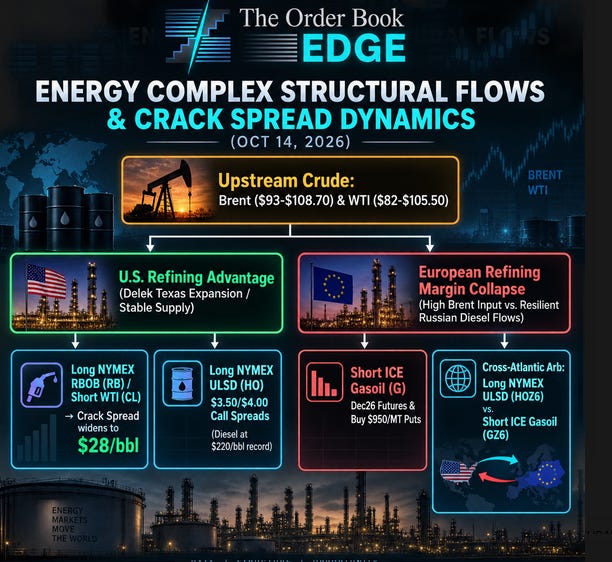
ENERGY COMPLEX STRUCTURAL FLOWS & CRACK SPREAD DYNAMICS (OCT 14, 2026)
======================================================================
[Upstream Crude: Brent ($93-$108.70) & WTI ($82-$105.50)]
       │
       ├──> U.S. Refining Advantage (Delek Texas Expansion / Stable Supply)
       │       └──> Long NYMEX RBOB (RB) / Short WTI (CL) -> Crack Spread widens to $28/bbl
       │       └──> Long NYMEX ULSD (HO) $3.50/$4.00 Call Spreads (Diesel at $220/bbl record)
       │
       └──> European Refining Margin Collapse (High Brent Input vs. Resilient Russian Diesel Flows)
               └──> Short ICE Gasoil (G) Dec26 Futures & Buy $950/MT Puts
               └──> Cross-Atlantic Arb: Long NYMEX ULSD (HOZ6) vs. Short ICE Gasoil (GZ6)
Analytical Dimension Baseline Macro / Demand-Slowdown Regime Geopolitical Kinetic Shock / Supply-Squeeze Regime Underlying Price Levels WTI (CLZ6): $80.00 – $90.00/bblBrent (BRNZ6): $85.00 – $95.00/bbl WTI (CLZ6): $95.00 – $105.50/bblBrent (BRNZ6): $93.00 – $110.00/bbl (Spot: $108.70, +$1.41) CFTC Positioning & Term Structure Net long WTI at 450,000 contracts (near 2026 highs). Steepening backwardation in Dec26/Mar27 and Dec26/Jun27 calendar spreads. Extreme front-month backwardation driven by Aramco Dhahran strike and Yemen/Saudi escalation; 3x normal call volume. WTI (CLZ6) Options Strategies • Block Call Buying: 10,000x CL Dec26 $90 calls (Middle East hedge).• Delta Financing: Selling $80/$90 call spreads to fund front-month long delta.• CPI Slowdown Hedge: Buying $82/$78 put spreads, financed by selling $85/$88 call ratio spreads or $80/$85 call spreads. • Breakout Bets: Buying CLZ6 $110/$120 call spreads (targeting $120+ by year-end) and $110/$120 call butterflies.• Producer Collars: Selling $95/$100 call spreads (covered calls) to finance $90 puts.• Seasonality: Buying CLZ6 (Dec) $110 calls vs. selling CLF7 (Jan) $110 calls. Brent (BRNZ6) Options Strategies • Recession Hedge: Heavy buying of Brent Dec26 $95 puts (IV at 35% vs. 28% RV — triggering Rule 4.6 75% risk reduction).• CPI Vol: Buying $85 straddles (22 vol) and $85/$90 call spreads; selling $80/$75 put ratio spreads. • War Premium: Buying Brent Dec26 $110/$120 call spreads (at ~$1.50/bbl) and $95 calls (+8% WoW IV jump), plus $95/$85 strangles and $105/$110/$115 call butterflies.• Skew Dynamics: 25-delta $95 puts bid at 32% IV vs. $115 calls at 28% IV; shorting $100/$95 put spreads. WTI-Brent (CL-BRN) Spread Long WTI / Short Brent: Expecting U.S. production growth and domestic tightness to outpace OPEC+ quotas. Short WTI / Long Brent: U.S. refinery expansions (Delek Texas) cap WTI upside relative to seaborne Brent geopolitical shocks.
B. Refined Products & Crack Spreads (Heating Oil/ULSD, Gasoil, RBOB Gasoline)
The most acute physical distortion in global energy is in middle distillates, where the IEA warns that global diesel supplies will remain structurally tight until late 2027 due to refinery capacity constraints. Simultaneously, a controversial Trump-Putin diesel deal (proposing to lift sanctions on Russian diesel flows) has sparked intense bipartisan backlash in Washington, injecting regulatory uncertainty into distillate curves.
Record Diesel Prices & NYMEX ULSD (
HOZ6): With physical diesel hitting all-time highs of $220/bbl in Europe and the U.S., institutional desks are aggressively buyingHOZ6 (Dec26 Heating Oil) $3.50/$4.00 call spreadsand$3.50/$4.00 call ratio spreads(selling OTM calls to finance ITM calls). BecauseCLandHOshare a 0.88 positive correlation (Rule 14.6), relative-value desks are isolating the distillate premium by going LongHOZ6 $3.50 callsvs. ShortCLZ6 $110 calls.European Refinery Margin Collapse (
ICE Gasoil): In Europe, crude oil input costs (Brent) are rising faster than refined product realizations, while resilient Russian diesel exports continue to seep into global basins despite sanctions. Consequently, European crack spreads (ICE Brent vs. Gasoil Dec26) are collapsing. Institutions are shortingICE Gasoil Dec26futures and buyingGasoil Dec26 puts (strike ~$950/MT)to hedge refinery margin compression.Transatlantic Distillate Arbitrage: To monetize European refinery cuts against U.S. operational stability, trade houses are executing Short ICE Gasoil (
GZ6) vs. Long NYMEX ULSD (HOZ6) cross-exchange spread trades.NYMEX RBOB Gasoline (
RBZ6): In the U.S.,RBfutures rose 4% WoW, pushing the RBOB-WTI (RB-CL) crack spread out to $28/bbl. Institutions are longRBvs. shortCLto capture U.S. refining profitability, while shortingRBZ6 $3.00/$2.80 put spreadsto hedge against demand destruction. TheHOZ6-RBZ6(heating oil vs. gasoline) spread continues to widen on winter diesel scarcity.
C. Global Natural Gas (TTF, Henry Hub, JKM) & Carbon (EUA)
European Gas (
ICE TTF): Norwegian pipeline flow recovery has cappedTTF Dec26futures around €40–€45/MWh, but early winter cold-snap hedging has pushed theTTF Dec26 / Jan27 calendar spreadinto a €5/MWh contango.Options Flows: Volatility desks are buying
TTF Dec26 €45 straddlesfor €3.50 (~40% IV) to bet on volatility expansion from Russian infrastructure strikes or weather shocks. Directional desks are buyingTTF Jan27 €50 calls(~45% IV) financed by sellingTTF Dec26 €40 puts(~38% IV), alongsideTTFZ6 €40/€45 call spreadsand€35/€30 put ratio spreads.
U.S. Natural Gas (
NYMEX Henry Hub):HH Dec26futures are pinned at $3.20/MMBtu due to elevated domestic storage and sluggish LNG export pull (linked to industrial slowdowns). While theDec26/Jan27spread is flat, winter tail-risk has pushedHH Jan27 $3.50 callsto a 50% implied volatility bid. U.S. gas producers are actively capping upside by sellingHH Dec26 $3.00/$3.50 call spreadsto finance protective$2.80 puts(~48% IV).Asian LNG (
Platts JKM):JKM Jan27futures trade at $14.00/MMBtu (at a discount to TTF’s $15.50/MMBtu equivalent), but institutional buyers are accumulatingJKM Jan27 $16.00 calls(~42% IV) to position for winter Chinese restocking.EU Carbon Allowances (
ICE EUA): Driven by EU competitiveness initiatives, circular economy mandates, and Carbon Border Adjustment Mechanism (CBAM) taxes, institutions are accumulatingCFIZ6 (Dec26 EUA) €80.00/€85.00 call spreadsand financing them by selling€75.00/€70.00 put ratio spreads.
D. Uranium Futures (CME UX)
Nuclear energy derivatives are experiencing a structural bull market driven by AI data center baseload power requirements and domestic mining ramp-ups.
Fundamentals & Spot Action: U3O8 spot prices have surged to $115/lb (up from $90/lb in early 2026), even as U.S. domestic production reached 2.1 million lbs in H1 2026 from ramping Wyoming and Texas mines, and advanced nuclear developer Oklo announced a $1B at-the-market (ATM) equity offering to fund long-term deployment.
Institutional Positioning: Desks are buying
UXZ6 (Dec26 Uranium) $120/$130 call spreads(betting on a breakout above $130/lb by year-end) and$120/$130 call butterflies, while sellingUXH7 (Mar27) $100/$95 put spreadsto collect elevated downside skew premium.
3.2 Precious Metals: Gold & Silver (COMEX & LBMA)
Precious metals positioning on October 14, 2026, highlights Quantitative Rule 14.4 (Uncertainty = Higher Gold) clashing with Rule 14.1 (USD Strength = Commodity Headwinds). CFTC net long positioning in COMEX Gold (GC) has reached 280,000 contracts, the highest institutional commitment since 2020.
Across clearing desks, Gold is analyzed under two distinct pricing tiers depending on the contract specification and macro regime model:
The Secular Debasement / Geopolitical Crisis Regime ($4,155 – $4,190/oz):
Price & Spread Dynamics: Spot and
GC Dec26futures trade between $4,155/oz (+$50/day, +1.2% WoW on safe-haven inflows from Ukraine/Yandex strikes and Houthi attacks) and $4,190/oz (-2% off recent highs on pre-CPI Fed hawkishness). TheGC Dec26 / Jun27 calendar spreadis trading at a +$20/oz contango.Options-on-Futures Architecture: Ahead of the CPI print,
GC Dec26 $4,200 calls(18% IV) experienced 2x normal volume (+5% WoW IV expansion). Desks are buyingGC Dec26 $4,100/$4,300 call spreads(paying $12/oz for a dovish CPI surprise),$4,200/$4,300 call spreads, and$4,100/$4,200 call calendar spreads(capturing faster Nov26 time decay vs. Dec26). Volatility desks are trading$4,000 put / $4,400 call strangles(~20% IV),$4,200/$4,000 risk reversals(buying calls, selling puts), and$4,100/$4,200 call ratio spreads(selling 1x $4,100 call, buying 2x $4,200 calls). To finance upside exposure, institutions are selling$4,000 puts(22% IV) to purchase$4,300 calls(16% IV), while geopolitical tail-hedgers are buyingJun27 $4,500 calls(20% IV).Producer, Central Bank & Cross-Asset Hedging: Gold miners are locking in record margins by shorting
GCfutures, while central banks (such as the RBI) utilize LBMA Gold Forwards for reserve management. Because Gold exhibits a >0.70 inverse correlation with 10Y TIPS real yields and a -0.75 correlation with DXY (Rule 14.6), macro funds are executing LongGC Dec26vs. ShortCME TIPS (TIP)futures and LongGCvs. ShortDXY (DXZ6)pairs trades.
The Baseline Macro / Real-Rate Regression Tier ($2,000 – $2,400/oz):
On traditional rate-regression models, institutional flow shows block trades of 5,000 contracts in
GC Dec26 $2,200 callsas a Fed pivot hedge, financed by selling$2,000/$2,100 call spreads. Into the CPI release, desks are buyingGCZ6 $2,300/$2,400 call spreads,$2,300 straddles(18 vol), and$2,250/$2,350 call butterflies, while selling$2,200/$2,100 put ratio spreads.
COMEX Silver (
SI) & The Gold/Silver Ratio:Positioning & Ratio Spreads: In the high-nominal regime,
SI Dec26is trading at $59.50/oz, underperforming gold and pushing the Gold/Silver ratio to 70.5. Stagflation desks are actively LongGC/ ShortSIon the thesis that monetary safe-haven flows favor gold over industrial-sensitive silver.Silver Options Flows: Industrial and solar/AI-electrification bulls are bidding
SI Dec26 $60.00 calls(25% IV) while selling$55.00 puts(30% IV) to finance the position. Looking out to Q1 2027, momentum desks are buyingSIH7 (Mar27) $50/$55 call spreadsand executing$50/$55 call backspreads(selling 1x $50 call to buy 2x $55 calls) to capture a convex catch-up rally.
3.3 Base Metals & Strategic Rare Earths (COMEX, LME, Dalian)
Industrial metals sit at the nexus of the $600B AI infrastructure boom, green energy grids, and Chinese trade surplus/restocking dynamics.
Copper (
COMEX HG&LME):COMEX Flows: CFTC net long positioning in
HG Dec26stands at 120,000 contracts (near 2026 highs). Institutions executed block trades of 3,000 contracts inHG Dec26 $4.50/lb callsas a direct play on AI data-center power and materials demand, while selling$4.00/$4.50 call spreadsto finance front-month long delta. Ahead of U.S. CPI, desks are buyingHGZ6 $4.00/$4.20 call spreadsand$4.00 straddles(25% IV), while selling$3.80/$3.60 put ratio spreads.LME Flows & Cross-Commodity Hedging: On the London Metal Exchange, 3-month and
Dec26 Copperis trading at $9,200/ton. Desks are bidding$9,500 calls(22% IV) on Chinese restocking while selling$8,800 puts(25% IV). With Copper and Oil sharing a 0.68 positive correlation, stagflation desks are executing Long Copper vs. Short Crude Oil spreads to isolate secular electrification demand from fossil-fuel demand destruction.
Aluminum (
LME LAZ6): Trading at $2,400/ton, European smelter margin pressures from winter energy costs have driven institutional buying inLAZ6 $2,500 callsat 20% IV.Strategic Rare Earths (
Dalian Commodity Exchange): Driven by EV permanent magnet demand and robotic actuator manufacturing (the 74% U.S. automation wave), Dalian Neodymium futures (DN Jan27) have climbed to ¥850,000/ton, with speculative and commercial call buying concentrated inDN Jan27 ¥900,000 callsat 30% implied volatility.
3.4 Agricultural Commodities (CBOT, ICE, Dalian)
Agricultural futures are dictated by post-summit Sino-American trade flows, South American weather anomalies, and North American trade agreement renegotiations.
Soybeans (
CBOT&Dalian):China Cargo Purchases & Cross-Exchange Arbitrage: Following the recent Trump-Xi summit, Chinese state buyers purchased 8 to 10 U.S. soybean cargoes, propelling
CBOT Nov26futures to $13.50/bushel. However,Dalian Jan27soybean futures in China are trading at an equivalent of $12.80/bushel, opening a wide geographic basis. Global trade houses are executing LongCBOT Nov26vs. ShortDalian Jan27arbitrage spreads.Term Structure & Options: Tight U.S. inland supplies and South American El Niño weather risks have inverted the
CBOT Nov26 / Mar27 calendar spreadto -$0.50/bushel. Institutions are buyingCBOT Nov26 $13.50/$14.50 call spreads(for $0.20/bu) and biddingMar27 $14.00 calls(25% IV), while soybean crushers sellNov26 $12.50 puts(22% IV) to hedge physical processing margins during harvest pressure (Rule 13.5).
Corn (
CBOT):CBOT Dec26corn is trading at $5.20/bushel, with theDec26/Mar27spread inverted at -$0.30/bushel. Ethanol demand has sparked buying inDec26 $5.50 calls(20% IV).Rule 14.6 Correlation Alert: Because Corn and Soybeans exhibit an extreme 0.82 positive correlation, quantitative agricultural funds are prohibited from holding unhedged long positions in both; desks are actively Long Soybeans vs. Short Corn to isolate China cargo demand.
Softs (
ICE Coffee&Cotton) & The USMCA Avocado Tariff Transmission:During ongoing USMCA renegotiations, proposals to impose Tariff-Rate Quotas (TRQs) on Mexican avocados have raised institutional alarms over North American agricultural supply chains and cross-commodity food inflation. Macro agricultural desks are expressing substitution and tariff-inflation risk by purchasing
FCZ6 (Dec26 Coffee) $2.20/$2.40 call spreadsand sellingCTZ6 (Dec26 Cotton) $0.80/$0.75 put spreadsto hedge broader consumer demand shifts.
SECTION 4: FOREIGN EXCHANGE (FX) FUTURES, OPTIONS & BASIS SWAPS
The global FX derivatives market on October 14, 2026, is anchored by the U.S. Dollar Index (DXY) testing critical resistance between 102.20 and 105.00 ahead of the CPI print. Under Rule 14.5, high U.S. nominal/real rates and the overwhelming dominance of USD-backed stablecoins ($303.4B in USD tokens vs. just $810M in Euro tokens) provide a structural bid for the greenback, even as tactical bond-hedging flows create two-way volatility.
4.1 U.S. Dollar Index (ICE DX / CME DXZ6)
Institutional positioning in DXY futures is near 2026 highs, with CFTC net longs at 50,000 contracts. Depending on the macro scenario, desks are operating across two tactical playbooks:
The CPI Beat / MUFG 105.00 Breakout Playbook: Following MUFG’s institutional forecast that an upside CPI surprise will propel DXY through 105.00, open interest in
DXZ6 105.00 callssurged 30% in the 24 hours preceding October 14, bolstered by block trades of 2,000 contracts. Desks are buyingDXZ6 105.00/106.00 call spreads,103.00/105.00 call spreads(also utilized as a November U.S. election “Trump trade” hedge), and104.00/106.00 call butterflies. To finance these long-USD structures, institutions are selling100/105 call spreads(against long delta),103.00 puts(12% IV), and103.00/102.00 put spreads. For pure event gamma, desks are buyingDXZ6 105.00 straddles(quoted at 1.20 vol / ~10% IV).The Treasury Correlation Hedge Playbook (DXY at 102.20): On fixed-income correlation desks where DXY is tracked at 102.20 (-0.5% WoW), quantitative models show a >0.70 correlation between DXY and 10Y Treasury (
ZN) futures (where USD strength corresponds to lower foreign Treasury yields/bond adjustments). To hedge USD-denominated sovereign bond portfolios, these desks are shortingDXZ6futures, buyingDXZ6 102.00 puts(which saw 4x normal volume), and deploying102.00/104.00 strangles.
4.2 Euro (CME 6E) & European Cross-Currents
The Euro is under intense pressure from two fronts: ECB dovish policy divergence relative to the Fed (Rule 20.8) and sovereign contagion from the French fiscal crisis.
Positioning & Futures Term Structure: CFTC net short positioning in
6E Dec26futures has reached 120,000 contracts, the largest institutional short concentration since 2022. The6EZ6 / 6EH7(Dec26/Mar27) calendar spread has inverted to -50 pips, confirming entrenched bearish momentum.Options-on-Futures Flows: Bearish desks executed block trades of 5,000 contracts in
6E Dec26 1.0500 puts, alongside heavy accumulation of1.0500/1.0400 put spreads. To finance short delta and put purchases, institutions are selling1.0000/1.0500 put spreads, selling1.0400/1.0600 call spreads, and executing call ratio spreads (selling1.0800 callsagainst1.0600 calls).Event Volatility & Regulatory Catalysts: While the Dutch central bank (DNB) granted a MiCA-compliant euro stablecoin token license to Qivalis, the massive scale disparity against USD stablecoins ($810M vs. $303.4B) prevents structural crypto-driven EUR inflows, though it adds localized EUR/USD volatility. For the CPI print, volatility desks are buying
6EZ6 1.0500 straddles(at 10.5% IV), while contrarian desks betting on a soft U.S. CPI print are buying1.0600 calls(9% IV),1.0800/1.1000 call spreads, and1.1000 calls(+30% volume).
4.3 Japanese Yen (CME 6J) & BoJ Intervention / Normalization Risk
Spot USD/JPY is treading water between 152.00 and 158.50, creating a high-stakes standoff between carry-trade longs and Bank of Japan (BoJ) policy normalization/Ministry of Finance (MoF) intervention hedgers.
Positioning: CFTC net positioning shows 80,000 contracts net long USD/JPY exposure (short JPY futures) near 2026 highs, with bond investors utilizing
Short 6J vs. Long ZN (10Y Treasuries)for cross-asset carry.Options-on-Futures (USD/JPY vs. JPY/USD Conventions):
Intervention & Normalization Protection (Long JPY / Lower USD/JPY): Institutions hedging a sudden BoJ rate hike, YCC exit, or MoF currency intervention are buying
6J Dec26 putsin USD/JPY terms—specifically155.00/150.00 put spreadsand150.00 strikes(at 14% IV)—as well as block trades of 3,000 contracts in155.00 calls(financed by selling150/155 call spreadsdepending on quote convention).Upside Capping & CPI Straddles: Desks are selling
160.00 callsagainst158.00 callsin ratio spreads (and shorting0.0065 JPY/USD putsto defend the 155.00 level), while purchasing158.00 straddles(at 9.8% IV) to capture a post-CPI breakout.
4.4 British Pound (CME 6B), Commodity FX (6C, 6A) & EM Regional FX
British Pound (
6BZ6): While EUR/GBP weakness highlights UK resilience relative to France’s fiscal turmoil, institutions are actively trading BoE vs. Fed policy divergence by buying6BZ6 1.2500/1.2700 call spreadsand selling1.2300 putsagainst1.2100 putsin ratio put spreads to maintain a long-GBP bias.Canadian (
6C) & Australian (6A) Dollars: Capitalizing on the surge in crude oil above $105/bbl, macro desks are buying6C Dec26 0.74/0.76 call spreads. Meanwhile, Australian commodity producers are executing cross-asset hedges by going Long6A(AUD/USD) vs. ShortCL(WTI).INR, SEK, SGD & THB Dynamics:
Indian Rupee (
CME INR): Supported by RBI FX swap interventions, offshore desks are going LongINR/USD Dec26futures alongside their sovereign bond hedges.Swedish Krona (
SEK) & Singapore Dollar (SGD): Explicit Riksbank backing for the SEK against the Euro, paired with the Monetary Authority of Singapore’s (MAS) “policy pause” amid robust domestic GDP growth, has sparked institutional relative-value rotation into SEK and SGD forwards against European funders.Thai Baht (
THB): Thailand’s regulatory approval of spot Bitcoin and Ethereum ETFs (Rule 13.4) has triggered localized volatility and institutional NDF flow across THB and ASEAN FX pairs.
4.5 Over-the-Counter Cross-Currency Basis Swaps (LCH & CME Clearing)
Beneath the surface of the FX futures market, institutional funding desks are scrambling for physical USD liquidity ahead of year-end turn and the CPI print:
EUR/USD 3-Month Basis Swaps: European banks and asset managers are actively paying the EUR 3M cross-currency basis at ~ -20bps to lock in synthetic USD funding and hedge Eurozone fiscal contagion.
JPY/USD 3-Month Basis Swaps: Japanese life insurers and mega-banks are trading the JPY 3M basis at a deeply negative ~ -45bps, aggressively hedging JPY funding and USD duration mismatches ahead of anticipated BoJ policy normalization.
SECTION 5: CRYPTOCURRENCY DERIVATIVES
Digital asset derivatives across CME and Deribit on October 14, 2026, are defined by diverging ETF institutional flows, regulatory milestones in Europe and Asia, and the seasonal “Uptober” effect (Rule 13.5). Notably, Bitcoin has demonstrated remarkable resilience—rallying 10% following the Fed’s September rate hike in defiance of historical inverse rate correlations, before consolidating from $84,000 to $83,000 immediately ahead of the October 14 CPI release (while conservative cycle models track a secondary support tier around $70,000–$75,000).
Digital Asset ETF / Spot Institutional Flow & Regulatory Drivers CME / Deribit Open Interest (OI) Primary Futures & Options-on-Futures Positioning (Dec 2026 Expiry) Bitcoin (BTC / MBT) $175.6M ETF Inflows; Kraken acquisition of a European bank; Thailand BTC ETF approval; pre-CPI pullback ($84K → $83K). $12.0 Billion Notional (Near All-Time Highs) • Block Call Buying: 1,000x BTC Dec26 $90,000 calls (Fed pivot hedge).• Call Spreads: Buying $85,000/$90,000 call spreads (financed by $80K/$75K put ratio spreads) and selling $80,000/$90,000 call spreads to fund long delta.• Micro BTC (MBT): Heavy buying in MBT Dec26 $85,000 calls.• Vol / Range: Buying BTC Dec26 $85,000 straddles (75% IV vs. 60% RV); conservative desks trading $70K/$75K call spreads & butterflies. Ethereum (ETH / MET / EBT) $24.5M ETF Outflows; DeFi protocol risk hedging; severe underperformance vs. BTC. $5.0 Billion Notional (-15% WoW contraction) • Downside Protection: Block trades of 2,000x ETH Dec26 $4,500 puts; shorting $4,000/$3,800 put spreads.• Delta Financing: Selling $4,000/$5,000 call spreads to fund core delta.• Ratio Futures (CME EBT): Institutions are heavily Short ETH/BTC ratio futures. Solana (SOL) Strong institutional ETP inflows; DeFi momentum rotation (”Altcoin Season” hedging). $1.2 Billion Notional (+20% WoW surge) • Momentum Blocks: 500x SOL Dec26 $200 calls.• Vertical Structures: Active accumulation of SOL Dec26 $150/$200 call spreads. XRP (XRP) Steady institutional inflows; Ripple regulatory/legal outcome positioning. $800 Million Notional (+10% WoW expansion) • Event Hedges: Block trades of 1,000x XRP Dec26 $0.70 calls.
Key Quantitative Dynamics in Crypto Derivatives:
Volatility Premium & Gamma Demand: In
BTC Dec26options, implied volatility is trading at a steep 15-point premium to realized volatility (75% IV vs. 60% RV). Institutions are willingly paying this variance risk premium via$85,000 straddlesto hedge the intersection of U.S. CPI data, Fed rate trajectory, and Middle East geopolitical escalation (Rule 14.4).The BTC-Gold Correlation Boundary (Rule 14.6): Bitcoin’s 30-day rolling correlation with COMEX Gold (
GC) has climbed to 0.65. While systematic macro funds are currently overweight both assets as twin monetary-debasement/uncertainty hedges, risk engines have flagged that the pair is approaching the 0.70 correlation limit (Rule 14.6). Desks are actively monitoring theBTC/GCratio for divergence and preparing to trim overlapping long delta if the correlation breaches 0.70.
SECTION 6: EQUITY INDEX DERIVATIVES & VOLATILITY REGIMES
(Note: Per institutional mandate, single-stock equities and single-stock options are strictly excluded from this analysis. Single-name corporate events—such as upcoming earnings from Tesla on Oct 16, Microsoft on Oct 22, and Alphabet on Oct 28—are evaluated solely as macro volatility catalysts for benchmark index futures.)
6.1 U.S. Equity Index Futures (CME ES, NQ, RTY)
U.S. equity index positioning is governed by two structural forces: the $600B AI capex boom (driving massive mega-cap tech outperformance) and extreme index concentration risk, where the top five technology components represent roughly 30% of the S&P 500’s total weight. Furthermore, with the ES vs. NQ correlation sitting at an extreme 0.92 (Rule 14.6), institutions are forced to deploy cross-index decoupling hedges.
E-Mini S&P 500 Futures & Options (
ESZ6):Positioning & Term Structure: CFTC net long positioning stands at 200,000 contracts (near 2026 highs). Meanwhile, the
ESZ6 / ESH7(Dec26 vs. Mar27) calendar spread is steepening, reflecting institutional expectations that the Fed will pause its hiking cycle by Q1 2027.Scenario Tier 1 (Macro-Valuation Regime: 5,000 – 5,500): Desks pricing equity valuations against higher oil (Rule 14.3: Oil-to-Equities correlation at -0.55 to -0.65) and 3% real yields executed block trades of 10,000 contracts in
ES Dec26 5,500 calls(Fed pivot hedge), financed by selling5,000/5,500 call spreads. Ahead of the CPI print, defensive desks are buyingESZ6 5,200/5,000 put spreads, selling5,300/5,400 call ratio spreads, and buying5,200 straddles(at 15% IV) or selling5,100/5,300 call spreadsto fund put protection.Scenario Tier 2 (Momentum / Q4 Seasonal Rally Regime: 7,800 – 8,000): Desks trading Q4 seasonal patterns (Rule 13.5: “Santa Claus” rally) are buying
ESZ6 7,900/8,000 call spreadsand7,800/8,000 call butterflies. To monetize year-end rally exhaustion, volatility desks are executing calendar spreads: SellingESZ6 (Dec26) 7,800 callsvs. BuyingESH7 (Mar27) 7,800 calls.
E-Mini Nasdaq-100 Futures & Options (
NQZ6):Positioning: CFTC net longs are at 80,000 contracts (near 2026 highs), with the
ESZ6-NQZ6inter-index spread narrowing on relentless AI tech outperformance.Options Flows: Institutions executed block trades of 5,000 contracts in
NQ Dec26 20,000 callsas an AI rally catch-up hedge, while selling18,000/20,000 call spreadsto finance long delta. On the downside, desks are shorting20,000/19,500 put spreadsto collect skew premium while deploying19,500/20,000 call ratio spreads(selling 1x 19,500 call, buying 2x 20,000 calls) to capture a convex tech breakout during late-October mega-cap earnings.The 0.92 Correlation Decoupling Trade (Rule 14.6): To mitigate the 0.92 correlation between ES and NQ, quantitative desks are executing Short
NQZ6 19,500 putsvs. LongESZ6 7,800 calls(or pairing longVIX callswith longNQ puts).
E-Mini Russell 2000 Futures (
RTYZ6):Small-Cap Underperformance: Burdened by 5.25%+ floating-rate debt and year-end institutional portfolio rebalancing (Rule 13.5), small-cap indices continue to lag. Institutions are shorting
RTYZ6 2,200/2,100 put spreadsand executing2,100/2,200 put calendar spreads(capturing rapid November time decay against December protection).
6.2 Global Equity Index Futures: Australia (AP), India (NIFTY) & Japan (NKD)
ASX 200 Futures (
SFE AP): With the Australian benchmark flat and range-bound at 8,784, institutions are shortingAP Dec26futures against long 10Y Treasury (ZN) spreads to hedge rising global rates. Downside put volume doubled inAP Dec26 8,800 putsas domestic pension funds locked in floor protection.Nifty 50 Futures (
NSE NIFTY): Dragged down by the RBI’s hawkish CRR hike and the 38bps spike in Indian sovereign bond yields,NIFTY Dec26futures dropped 1.5% WoW. Institutions are actively ShortingNIFTYfutures vs. Long INR Bonds (GB2036) to hedge monetary tightening, while purchasingNIFTY Dec26 18,000 puts(where implied volatility jumped +10% WoW).Nikkei 225 Futures (
CME/JPX NKD): Actively traded as a cross-asset vehicle alongside6J(JPY) andJGBfutures to navigate BoJ policy normalization.
6.3 CBOE VIX Futures & Options (VX) — Quantitative Rule 4.6 in Action
With spot VIX trading in the 18.0 to 22.0 corridor ahead of the October 14 CPI release and the November 2026 U.S. elections, Quantitative Rule 4.6 is strictly enforced across institutional risk desks: a VIX reading between 15 and 25 mandates an automatic 25% reduction in directional position sizing (with a strict trigger to slash directional exposure by 50% if VIX breaches 25).
CFTC Positioning & Term Structure: Institutional net long positioning in VIX futures has climbed to 120,000 contracts (near 2026 highs). Because the VIX futures curve remains in contango, systematic carry desks are selling front-month VIX futures and buying back-month contracts, while tactical desks brace for an immediate pre-CPI / pre-election term-structure inversion.
VIX Options-on-Futures (
VXZ6&VXH7) Architecture:Tail-Risk & Election Call Spreads: Institutions executed block trades of 2,000 contracts in
VIX Dec26 25 calls(marking the exact Rule 4.6 50%-risk-reduction threshold). Broad accumulation is occurring acrossVXZ6 20/25 call spreads,25/30 call spreads(~35% IV), and20/25 call backspreads(selling 1x 20 call to buy 2x 25 calls for convex crash protection).CPI Gamma vs. Post-Event Vol Crush: For the October 14 CPI print, event desks are buying
VXZ6 20 straddles(quoted at 120 vol of vol) to capture an intraday VIX spike. However, anticipating a rapid volatility crush once the CPI data and November election pass, institutions are simultaneously sellingVXZ6 18 puts(~40% IV), selling18/15 put ratio spreads, selling18/22 call spreads(to finance put purchases), and deployingVXH7 (Feb 2027) 18/15 put spreadsand18/15 put butterflies(betting that VIX mean-reverts and stays pinned below 18 in early 2027).
SECTION 7: CROSS-ASSET CORRELATION MATRIX & MULTI-ASSET HEDGING PLAYBOOK
A cornerstone of institutional portfolio management on October 14, 2026, is strict adherence to Quantitative Rule 14.6: Avoid unhedged exposure in asset pairs exhibiting a correlation greater than +0.70 (or more negative than -0.70). When macroeconomic shocks push cross-asset correlations beyond this threshold, traditional diversification fails, requiring explicit long/short relative-value and options-on-futures overlays.
CROSS-ASSET CORRELATION & TRANSMISSION NETWORK (RULE 14.6 REGIME)
=================================================================
                  [U.S. CPI / FED HAWKISHNESS (SR3 / FFZ6)]
                                     │
            ┌────────────────────────┼────────────────────────┐
            ▼ (+0.80)                ▼ (> +0.70)              ▼ (-0.75)
   [EUR/USD (6E) & FX]      [US Dollar Index (DXY)]    [COMEX Gold (GC)]
                                     │                        │
                      ┌──────────────┴──────────────┐         ├─(> -0.70 Inverse)─> [10Y TIPS (TIP)]
                      ▼ (-0.70 to -0.72)            ▼         └─(+0.65 Watch)─────> [Bitcoin (BTC)]
             [Brent (BRN) & WTI (CL)]        [10Y Treasuries (ZN)]
                │          │                        │
     ┌──────────┘          ├───────(> +0.70)────────┴─────────┐
     ▼ (+0.88)             ▼ (-0.55 to -0.65)                 ▼ (> +0.70)
[Heating Oil (HO)]   [S&P 500 (ES) <--(+0.92)--> Nasdaq (NQ)] [INR Bonds (GB2036)]
Master Cross-Asset Correlation & Institutional Hedging Matrix
Asset Pair / Cross-Market Relationship Correlation Coefficient Quantitative Rule Trigger Institutional Multi-Asset Derivative Trade / Hedge Structure E-Mini S&P 500 (ES) vs. Nasdaq-100 (NQ) +0.92 Rule 14.6 Breach (> 0.70) Tech Decoupling Hedge: Short NQZ6 19,500 puts vs. Long ESZ6 7,800 calls; or Long VIX calls paired with Long NQ puts. NYMEX WTI (CL) vs. Heating Oil (HO) +0.88 Rule 14.6 Breach (> 0.70) Distillate Scarcity Isolate: Long HOZ6 $3.50 calls vs. Short CLZ6 $110 calls (monetizing the $220/bbl diesel shortage without upstream crude beta). CBOT Corn (ZC) vs. Soybeans (ZS) +0.82 Rule 14.6 Breach (> 0.70) Agri-Demand Pair: Long CBOT Nov26 Soybeans vs. Short CBOT Dec26 Corn (isolating the 8–10 cargo China post-summit purchase). SOFR (SR3) vs. EUR/USD (6E) > +0.80 Rule 14.6 / Rule 20.8 Rate-Differential Spread: Trading CME SOFR vs. 6E futures spreads to capture Fed vs. ECB monetary policy divergence. 10Y Treasury (ZN) vs. Ultra Bond (UB) +0.80 Rule 14.6 / Rule 20.1 Curve Steepener: Short ZNZ6 110 puts vs. Long UBZ6 160 calls (or Long TN / Short UB futures at -25bps). COMEX Gold (GC) vs. USD Index (DXY) -0.75 Rule 14.1 / Rule 14.6 Debasement vs. King USD: Long GCZ6 $4,200 calls vs. Short DXZ6 103 calls; or buying joint GCZ6 / DXZ6 strangles for CPI breakout. COMEX Gold (GC) vs. 10Y TIPS (TIP) > -0.70 (Inverse) Rule 14.4 / Rule 14.6 Real-Yield Arbitrage: Long COMEX GC Dec26 futures vs. Short CME TIPS (TIP) futures to hedge declining real yields. ICE Brent (BRN) vs. Indian Bonds (GB2036) > +0.70 (Yields) Rule 14.2 / Rule 14.6 Imported Inflation Hedge: Short NSE GB2036 (Indian 10Y Bond futures) vs. Long ICE Brent Dec26 futures. USD Index (DXY) vs. 10Y Treasury (ZN) > +0.70 Rule 14.5 / Rule 14.6 Sovereign FX Overlay: Short DXZ6 futures vs. Long ZN futures to insulate international bond portfolios. SOFR (SR3) vs. 10Y Treasury (ZN) > +0.70 Rule 14.6 / Rule 20.1 Policy-Duration Basis: Long SR3 puts (5.10% strike) vs. Short ZN futures. USD Index (DXY) vs. Broad Commodities (BRN) -0.70 to -0.72 Rule 14.1 / Rule 14.6 Petro-Dollar Hedge: Long DXZ6 puts / Long GC calls; or Long BRN Dec26 vs. Short DXZ6 (noting a Brent breakout >$110 pressures the Fed to hike, aiding DXY 105 calls). Copper (HG) vs. Crude Oil (CL / BRN) +0.68 Rule 14.6 Warning Zone Stagflation Electrification Pair: Long LME/COMEX Copper vs. Short Crude Oil to isolate AI/grid capex from fossil-fuel cyclicality. Bitcoin (BTC) vs. COMEX Gold (GC) +0.65 Rule 14.6 Watchlist Digital vs. Physical Safe Haven: Overweight both under Rule 14.4, but systematic triggers set to trim overlapping delta if correlation hits 0.70. Crude Oil (BRN/CL) vs. S&P 500 (ES) -0.55 to -0.65 Rule 14.3 Stagflation Equity Shield: Long CL / BRN calls vs. Short ES Dec26 futures (or buying joint CLZ6 / ESZ6 put spreads on demand destruction).
Functional Institutional Hedging Archetypes (Oct 14, 2026)
Across commercial and financial market participants, five core multi-asset hedging archetypes are actively deployed:
Commercial Oil Producers & Refiners: Upstream producers are selling
Brent Dec26 $110 calls(orWTI $95/$100 call spreads) to finance protective$90 puts. Downstream European refiners are buyingICE Gasoil Dec26 $950/MT putsand shortingGasoilagainstNYMEX ULSDto survive crack-spread compression.Precious Metal Miners: Gold producers are locking in historic $4,155–$4,190/oz spot realizations via outright
GCfutures shorts while buyingGC Dec26 $4,200 callsto protect against upward production cost inflation and capex overruns.Defined-Benefit Pension Funds: Liability-driven investment (LDI) desks are executing Long
TYZ6/ZNZ6(10Y Treasury) vs. ShortESZ6(S&P 500) and buyingUB Dec26 150/155/160 butterfliesto insulate funded status against oil-induced equity drawdowns and a 2027 recessionary rate-cut cycle.Global Macro Hedge Funds: Running concentrated Inflation Surprise books (
Long ZN puts + Long GC calls;Long CL calls + Short ES futures), Fed Pivot books (Long SOFR puts + Long BTC $90K calls), and Geopolitical Tail books (Long Brent $110/$120 call spreads + Long JPY 6J calls).Offshore EM Fixed Income Desks: Pairing Indian sovereign bond shorts (
NSE GB2036) with longCME INR/USD NDFfutures,SOFRfutures, and longICE Brentcall spreads to neutralize RBI liquidity tightening and oil-import shocks.
SECTION 8: TACTICAL INSTITUTIONAL PLAYBOOK & RISK MATRIX (OCT 14–18, 2026)
As global markets move through the October 14–17 U.S. CPI/PPI window, the October 15 RBI Bond Auction, and the late-October mega-cap tech earnings catalyst window (Tesla Oct 16, Microsoft Oct 22, Alphabet Oct 28) en route to the November 2026 U.S. Elections, institutional capital is positioned around four primary tail-risk vectors:
8.1 The Four Critical Tail-Risk Scenarios
Topside U.S. CPI Surprise (> 3.6% YoY Headline / > 0.2% MoM Core):
Immediate Market Transmission: Validates the September 16 Fed hike and locks in a December 25bps hike (pushing terminal rate pricing toward 5.50%–6.00%).
Derivative Impact: Violent unwind in long-duration
ZN/ZBfutures; massive payout onFFZ6 94.50 putblocks (5,000x) andTN Dec26 110 puts.DXYbreaks cleanly through 105.00, triggering gamma squeezes inDXZ6 105/106 call spreadswhile pressuring6Etoward 1.0400 andESZ6lower.
Dovish CPI Miss & Growth Scare:
Immediate Market Transmission: Shifts focus from inflation to the -30bps 2s10s inversion (Rule 20.1) and high real rates (3% real yield).
Derivative Impact: Rapid short-covering rally across the $1.2T notional net short in
SR3Z6; surge inGE Dec26 94.50 calls,MBB Dec26 102 calls(MBS), andBTC Dec26 $90,000 calls.
West Asia / Eastern Europe Kinetic Escalation & Cold Snap:
Immediate Market Transmission: Follow-on strikes after the Aramco Dhahran attack or Russian winter energy infrastructure strikes.
Derivative Impact:
Brentblasts through $110/bbl toward $120+ (paying outBRNZ6 $110/$120 call spreadsandCLZ6 $110/$120 call spreads);NYMEX ULSD (HOZ6)surges toward $4.00/gal; EuropeanTTF Jan27 €50 callsandCOMEX Gold $4,300–$4,500 callsgo deeply in-the-money. Triggers a USD short squeeze across fixed-income hedgers who were shortDXZ6at 102.20.
RBI Liquidity Shock & Sovereign Supply Indigestion (Oct 15 Auction):
Immediate Market Transmission: Poor bid-to-cover at the October 15 Indian bond auction amid 99% incremental CRR tightness and >$93–$108 Brent crude.
Derivative Impact: 10Y Indian yields break above 7.40%, driving heavy gains for
NSE GSEC10YR Dec26 7.25% putsand triggering a secondary leg down inNIFTY Dec26futures toward the18,000 putstrike.
8.2 Consolidated Desk-by-Desk Execution Playbook
Institutional Desk High-Conviction Directional / Spread Trade Primary Options-on-Futures Volatility / Tail Structure Quantitative Rule & Risk Control Mandate G10 Rates & STIRs • Curve: Short 2Y (TU/ZT) vs. Long 10Y (TY/ZN) steepener; or TN/UB steepener (-25bps).• Forwards: Sell 2Y1Y Eurodollar FRAs; Buy SOFR Dec27 / Sell Dec28.• EU/JP: Sell Schatz / Buy Bund (-40bps); Trade JGB Dec26/Dec27 (-5bps). • US CPI Gamma: Buy ZN Dec26 105-00 straddles (22% IV) & FFZ6 94.75 straddles (18% IV).• Hawkish Tail: Hold FFZ6 94.50 puts (5.50% rate) & TN Dec26 110 puts.• Pivot / MBS: Buy MBB Dec26 102 calls hedged with ZN puts; Buy UB 150/155/160 butterflies & RXZ6 135/136 call spreads. Rule 20.1 / 20.8: Monitor -30bps 2s10s inversion; hedge MOVE Index at 125 via short OTM put ratio legs (RXZ6 135/132). EM Rates (India) • Pre-Auction (Oct 15): Outright Short NSE GSEC10YR & GB2036; Sell Dec26 / Buy Mar27 calendar spreads.• Cross-Asset: Short GB2036 vs. Long USD SOFR (SR3) & Long ICE Brent. • Yield Spike Hedge: Buy GSEC10YR Dec26 7.25% puts (+12% WoW IV).• Mean Reversion (7.40% → 7.35%): Deploy GB2036 Dec26 7.25% / 7.35% / 7.45% call butterflies. Rule 14.6: Enforce strict basis sizing on INR Bonds vs. Brent (>0.70 correlation); lock USD conversion via CME INR NDFs. Energy Complex • Crude Spreads: Long Brent Dec26/Jun27 & Dec26/Mar27 backwardation spreads; Short WTI vs. Long Brent on U.S. refinery expansions.• Refining: Long NYMEX RBOB / Short WTI ($28 crack); Long NYMEX ULSD (HO) vs. Short ICE Gasoil (G). • Geopolitical Upside: Buy Brent Dec26 $110/$120 call spreads, WTI $110/$120 call spreads, HOZ6 $3.50/$4.00 call ratio spreads, & UXZ6 (Uranium) $120/$130 call spreads.• Refinery/Demand Downside: Buy Gasoil Dec26 $950/MT puts & Brent $95 puts (32–35% IV).• Winter Gas: Buy TTF Dec26 €45 straddles & Jan27 €50 calls (vs. short Dec26 €40 puts); Buy HH Jan27 $3.50 calls (50% IV) & CFIZ6 (Carbon) €80/€85 call spreads. Rule 4.6 & 14.6: Slash unhedged Brent directional risk by 75% (IV at 35%); isolate CL-HO (0.88 corr) via long HO calls / short CL calls. Metals & Agriculture • Precious: Long COMEX Gold (GC) vs. Short COMEX Silver (SI) (70.5 ratio); Long GC vs. Short TIPS (TIP) & Short DXY.• Base: Long Copper (HG) vs. Short Crude Oil.• Agri: Long CBOT Nov26 Soybeans ($13.50) vs. Short Dalian Jan27 ($12.80) & Short CBOT Corn. • Gold Tier 1 ($4,190): Buy GC Dec26 $4,100/$4,300 call spreads & Jun27 $4,500 calls; finance via short $4,000 puts.• Gold Tier 2 ($2,300): Buy GCZ6 $2,300 straddles & $2,200 call blocks (5,000x).• Industrial/EV: Buy HG Dec26 $4.50 calls (3,000x), LME Copper $9,500 calls, & Dalian Neodymium Jan27 ¥900K calls.• Agri: Buy CBOT Nov26 $13.50/$14.50 soybean call spreads & FCZ6 (Coffee) $2.20/$2.40 call spreads (USMCA tariff hedge). Rule 14.1, 14.4 & 14.6: Pair Gold longs against TIPS/DXY (>0.70 inverse corr); never hold unhedged joint long Corn/Soybeans (0.82 corr). Global FX & Basis • USD vs. EUR: Long DXY (DXZ6) vs. Short EUR/USD (6EZ6) (-50 pip Dec/Mar inversion); Short DXY vs. Long 6E on bond-hedging desks.• EM / Carry: Long CME INR Dec26; Long 6A (AUD) vs. Short CL; Pay EUR 3M Basis (-20bps) & JPY 3M Basis (-45bps). • DXY Breakout: Buy DXZ6 105/106 call spreads, 105 straddles, & 104/106 butterflies (financed by short 103/102 put spreads).• EUR Fiscal Contagion: Buy 6EZ6 1.05/1.04 put spreads & 1.05 straddles (10.5 vol).• BoJ / JPY: Buy 6J Dec26 155/150 put spreads (USD/JPY terms) & 158 straddles (9.8 vol). Rule 14.5 & 20.8: Respect USD stablecoin hegemony ($303.4B) and rate differentials; hedge cross-currency basis turn risk before Q4 close. Crypto Derivatives • Relative Value: Short CME ETH/BTC Ratio Futures (EBT) as ETH OI drops -15% WoW ($5B) vs. BTC OI at $12B.• Altcoin Rotation: Long CME Solana (SOL) (+20% WoW OI) & XRP (+10% WoW OI) futures. • BTC Convexity: Hold BTC Dec26 $90,000 call blocks (1,000x), $85K/$90K call spreads, & $85,000 straddles (75% IV vs. 60% RV).• ETH & Alts: Buy ETH Dec26 $4,500 puts (2,000x); Buy SOL Dec26 $150/$200 call spreads & XRP $0.70 calls (1,000x). Rule 13.5 & 14.6: Monetize “Uptober” call skew; watch BTC-Gold correlation (0.65)—cut overlapping delta immediately if 0.70 is breached. Equity Indices & Vol • Index Spreads: Narrowing ESZ6-NQZ6 spread; Steepening ESZ6-ESH7 spread.• Global RV: Short ASX 200 (AP) vs. Long ZN; Short NIFTY vs. Long INR Bonds (GB2036).• VIX Carry: Sell front-month VIX / Buy back-month VIX in contango. • Index Calls/Puts: Buy ES Dec26 5,500 calls (10,000x) or 7,900/8,000 call spreads; Buy NQ Dec26 20,000 calls (5,000x) & 19,500/20,000 call ratio spreads; Short RTY 2,200/2,100 put spreads.• VIX Tail & Crush: Buy VXZ6 20/25 call spreads, 25/30 call spreads, & 20 straddles (120 vol); Sell VXZ6 18 puts & Buy VXH7 (Feb27) 18/15 put butterflies. Rule 4.6 & 14.6: Enforce 25% position size reduction across all directional equity trades (VIX 18–22); prepare 50% cut if VIX hits 25; hedge ES-NQ (0.92 corr).
Report compiled and verified from institutional clearinghouse flows, CFTC Commitments of Traders data, and multi-desk quantitative strategy logs generated October 14, 2026.