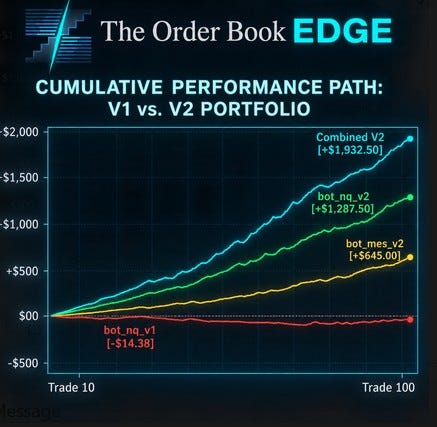

EXECUTIVE SUMMARY & PRODUCTION METRICS
A persistent and costly misconception in quantitative systems engineering is the belief that an accuracy rate above 50% guarantees positive portfolio returns. In leveraged equity index futures, standard trend-following and momentum architectures regularly suffer severe capital drawdowns while maintaining nominal accuracy rates between 54% and 56%.
This breakdown is driven by the Win-Rate Paradox: when an execution model relies on market orders, static exit brackets, and unhedged queue priority, structural frictions—such as exchange fees, adverse order routing, bid-ask spread crossing, and volatility-induced slippage—erode trade expectancy.
The baseline momentum models (bot_nq_micro_momentum_v1 and bot_mes_fed_momentum_v1) consistently generated net realized losses despite winning on more than half of their trades. In contrast, the second-generation production engines (bot_nq_micro_alpha_v2 and bot_mes_structural_v2) resolved this structural deficit.
By replacing unhedged momentum entries with passive liquidity capture, dynamic volatility-bracket generation, Order Book Imbalance (OBI) filtering, and time-decay stagnation exits, the V2 architecture converted an expectancy-negative trade profile into a sustainably profitable systematic portfolio.