
Executive Summary & Abstract
In quantitative finance, the transition from model design to live execution is guarded by an indispensable proving ground: paper trading within realistic market microstructure simulations. While backtesting often flatters algorithmic strategies through lookahead bias, frictionless fills, and idealized liquidity, overnight forward paper testing confronts models with the unyielding realities of temporal illiquidity, bid-ask widening, and regime transition.
This forensic analysis investigates the execution logs and performance metrics of a multi-asset algorithmic portfolio deployed across the overnight trading window of September 24–25, 2026 (18:00 UTC to 09:30 UTC).
================================================================================
SESSION TELEMETRY: 2026-09-24 18:00 UTC -> 2026-09-25 09:30 UTC
================================================================================
Total Paper Orders Generated:       55
Realized Closed Trades:             39
Portfolio Realized Net P&L:         -$470.81
Aggregate Win Rate:                 46.15% (18 Wins / 21 Losses)
Active Trading Strategies:          11 Unique Bot Deployments
Portfolio Expectancy (Per Trade):   -$12.07
Loss-to-Win Payoff Ratio:           1.58x ($49.10 Avg Loss vs. $31.11 Avg Win)
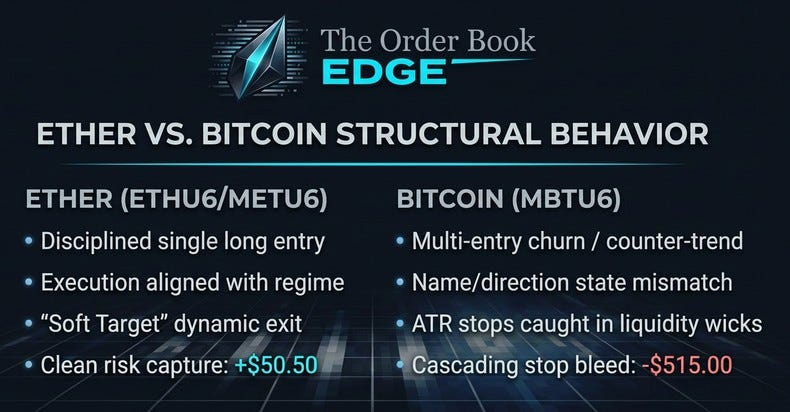
Asset Class Anchor:                 Micro Bitcoin (MBTU6) Drag: -$515.00
Net Non-Bitcoin P&L:                +$44.19 (Profitable Aggregate Baseline)
================================================================================
A surface-level review reveals an aggregate loss of -$470.81 and a sub-50% win rate. However, a deeper computational and statistical deconstruction uncovers critical structural insights:
Severe Concentration of Drawdown: Micro Bitcoin (
MBTU6) accounted for 109.4% of the portfolio’s net loss. Excluding Bitcoin, the remaining automated strategies produced a positive return of +$44.19.Toxic Payoff Asymmetry: The portfolio suffered from an inverted risk-reward structure where the average loss ($49.10) outsized the average gain ($31.11) by 57.8%, violating fundamental portfolio survivability axioms.
Telemetry & Tracking Desynchronization: Multiple high-conviction strategies exhibiting historical 100% win rates failed to log orders, while others suffered severe tracking drift between live baselines and paper execution.
Temporal Market Regime Sensitivity: Bot architectures configured for liquid continuous sessions failed to adapt to the distinct microstructure of the Globex overnight window, where widening spreads and low volume density amplified stop-loss hunting.
This post-mortem details the empirical performance of each deployed algorithm, diagnoses root causes across quantitative execution and risk engineering, and translates all underlying equations, risk filters, and mechanics into production pseudocode algorithms.